
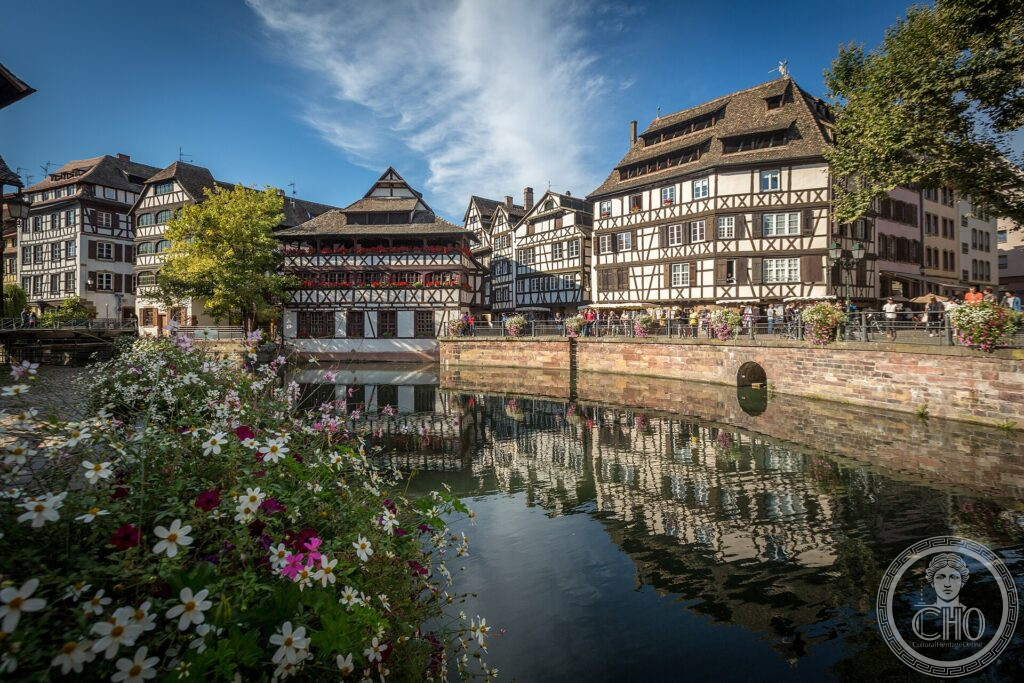
Stretta fra i due bracci dell’Ill, la città vecchia di Strasburgo unisce il gotico tedesco e l’eleganza francese. La cattedrale in arenaria rosa svetta sui tetti, mentre nel quartiere della Petite France le case a graticcio dei conciatori si specchiano nei canali. Una sintesi alsaziana unica, oggi capitale d’Europa.
At a glance
The Grande Île is the historic heart of Strasbourg, an island enclosed by the two arms of the river Ill. It preserves a dense medieval and Renaissance townscape that fuses Germanic and French traditions, the legacy of a city long disputed between the two. Above it rises the cathedral of Notre-Dame, a masterpiece of Gothic art in pink sandstone with a single soaring spire. The picturesque Petite France quarter recalls the world of tanners and millers. Inscribed by UNESCO in 1988, the listing was extended in 2017 to include the German-era Neustadt.
Key facts
- UNESCO: World Heritage since 1988; extended in 2017 to the Neustadt
- Cathedral: Notre-Dame, Gothic in pink Vosges sandstone, with a 142 m spire
- Astronomical clock: the cathedral’s Renaissance clock with its noon procession of figures
- Petite France: the former tanners’ and millers’ quarter of timber houses and canals
- Setting: the Grande Île is ringed by the two channels of the river Ill
- Capital of Europe: seat of the European Parliament and the Council of Europe
History
Roman Argentoratum grew into a free imperial city of the Holy Roman Empire and a centre of printing and humanism; Gutenberg worked here in the 15th century. The cathedral, built over several centuries and completed with its spire in 1439, was the tallest building in the world from 1647 to 1874. The Grande Île accumulated churches, merchant houses and the timber quarters of its craftsmen.
Annexed by France under Louis XIV in 1681, Strasbourg passed back and forth between France and Germany with the wars of 1871, 1918 and 1940, each leaving its architectural mark. Since the mid-20th century the city has become a symbol of European reconciliation and a seat of European institutions.
What you see
The cathedral dominates the island, its lace-like west front and single spire visible from afar; inside, the astronomical clock performs its procession at solar noon. Around it spread the medieval streets, the Place Kléber and the half-timbered houses of the old town.
In the Petite France, canals thread between flower-decked timber houses and old locks, crossed by the covered bridges and the Barrage Vauban — the most photographed corner of Alsace.
Practical information
- Cathedral: free to enter; the platform climb and clock show charge a small fee
- Time needed: a full day for the island, cathedral and Petite France
- Local table: Alsatian winstubs serve tarte flambée and regional wines
- Note: boat tours on the Ill circle the Grande Île
Getting there
Strasbourg is in Alsace, on the Rhine near the German border. High-speed TGV trains reach it from Paris in under two hours, and it is linked to German cities across the river. From the station the Grande Île is a short walk or tram ride. GPS: 48.5817° N, 7.7509° E.
Nearby
- Alsace Wine Route — villages and vineyards south of the city
- European Parliament — the modern institutional quarter north-east of the centre
- Colmar — a smaller Alsatian town of canals and timber houses, about 70 km south
Sources
- UNESCO World Heritage Centre — “Strasbourg, Grande-Île and Neustadt” (ref. 495)
- Ville et Eurométropole de Strasbourg — official city authority
- Encyclopaedia Britannica — Strasbourg
Find it on the map
See this place and what’s around it →📷 Become a Cultural Heritage Online photographer
Share your photos of places: they stay published under your name as the author. The more they're seen, the more you get noticed — and soon a contest will reward the most appreciated photos.
Log in or sign up free to add a photo