
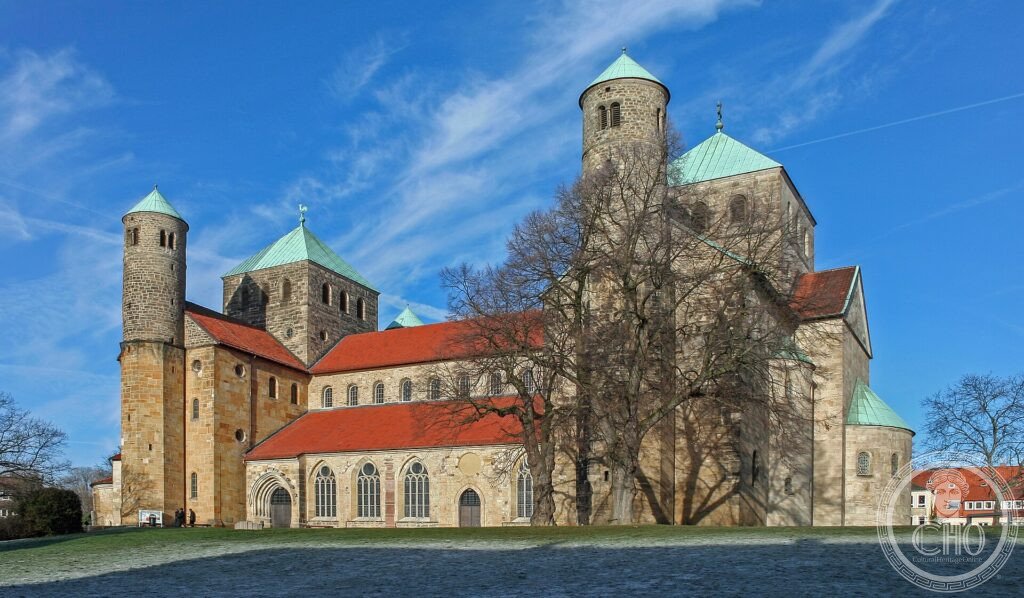
Under Bishop Bernward, around the year 1000, Hildesheim became a beacon of art: the church of St Michael with its painted ceiling, the bronze doors of the cathedral cast in a single pour, the Column of Christ. An Ottonian Romanesque treasure that survived the war and was rebuilt with care.
At a glance
St Mary’s Cathedral and St Michael’s Church in Hildesheim are twin masterpieces of Ottonian Romanesque art, inscribed together by UNESCO in 1985. St Michael’s, begun in 1010 under Bishop Bernward and completed in 1033, set a model of symmetrical, double-choired church design. The cathedral preserves an exceptional series of bronze and metal works commissioned by Bernward, including the great bronze doors and the Christ Column, and the legendary “Thousand-Year Rose”. Both churches were devastated in 1945 and faithfully rebuilt.
Key facts
- UNESCO: World Heritage since 1985
- St Michael’s: built 1010–1033, begun under Bishop Bernward and completed under Bishop Godehard, a model of Ottonian architecture
- Bernward Doors (1015): bronze cathedral doors each wing cast as a single piece, with biblical scenes
- Christ Column: a bronze column with reliefs spiralling like Trajan’s Column in Rome
- Thousand-Year Rose: a wild rosebush on the cathedral apse, by tradition centuries old
- War and rebuilding: both churches were destroyed in 1945 and reconstructed
History
Hildesheim became a diocese in 815 and reached its artistic height around the year 1000 under Bishop Bernward (993–1022), a scholar, statesman and patron with a personal interest in metalwork. He built the abbey church of St Michael as a balanced composition of towers and choirs, and commissioned for the cathedral a series of bronzes — the doors and the Christ Column — that revived large-scale bronze casting in the medieval West.
The treasures survived the centuries until an air raid in March 1945 reduced both churches to ruins. The bronzes had been removed for safety and were spared. Over the following decades St Michael’s and the cathedral were rebuilt, and the cathedral reopened after a major restoration in 2014.
What you see
St Michael’s rises in pale stone with two square towers and four round stair-turrets, its interior balanced between eastern and western choirs; the nave keeps its rare painted wooden ceiling showing the Tree of Jesse. In the cathedral, the Bernward Doors guard the entrance, their panels reading from Creation to Resurrection, and the Christ Column stands within.
On the outer wall of the apse climbs the Thousand-Year Rose, which famously bloomed again amid the rubble in 1945.
Practical information
- Entry: churches free to enter; the Cathedral Museum charges admission
- Time needed: 2–3 hours for both churches and the museum
- Note: the two monuments are about 15 minutes’ walk apart in the centre
- Services: visiting may be limited during worship
Getting there
Hildesheim is in Lower Saxony, about 30 minutes by train from Hanover. From the station it is a short walk or bus ride to the cathedral and St Michael’s in the old town. GPS: 52.1556° N, 9.9483° E.
Nearby
- Hanover — the regional capital with the Herrenhausen Gardens, 30 km north
- Goslar — a UNESCO mining town in the Harz, about 60 km south
- Marienburg Castle — a neo-Gothic royal castle south of Hanover
Sources
- UNESCO World Heritage Centre — “St Mary’s Cathedral and St Michael’s Church at Hildesheim” (ref. 187)
- Bistum Hildesheim — the diocese and Dommuseum
- Encyclopaedia Britannica — Hildesheim; Bernward of Hildesheim
Find it on the map
See this place and what’s around it →📷 Become a Cultural Heritage Online photographer
Share your photos of places: they stay published under your name as the author. The more they're seen, the more you get noticed — and soon a contest will reward the most appreciated photos.
Log in or sign up free to add a photoIs this page about you?
This page is read by travellers and heritage enthusiasts who find it on Google. Tell us how you are connected to this place and we will take it from there.