
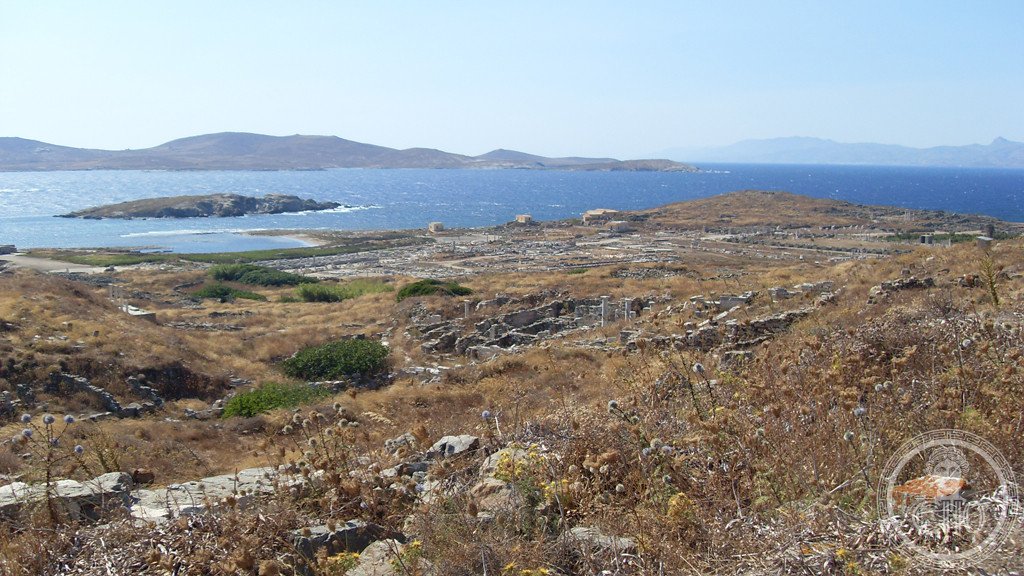
Delos was the most sacred island of the ancient Greek world, the mythical birthplace of Apollo and Artemis, and for centuries one of the Mediterranean’s great trading ports. Uninhabited since antiquity and forbidden to permanent settlement, the whole island survives today as a single, largely unbuilt-over archaeological site.
At a glance
According to Greek myth, Leto, pregnant by Zeus, was refused a birthplace by every land fearful of Hera’s anger, until the floating island of Delos took her in and she gave birth to the twins Apollo and Artemis. That divine birth made the whole island sacred: no death and no birth was permitted there, and the dying and the pregnant were ferried off to the neighbouring island of Rheneia. For a period of around eighty years, after Rome handed the island to Athens and declared it a free port, Delos became one of the busiest commercial centres in the Aegean, before being sacked in 88 BCE and never recovering.
Key facts
- Location: a small uninhabited island in the Cyclades, near Mykonos, Greece.
- Mythology: traditional birthplace of Apollo and Artemis, sons of Zeus and Leto.
- Status: permanent habitation has been forbidden since antiquity; today it is a single archaeological site.
- Heritage listing: inscribed as a UNESCO World Heritage Site in 1990.
- Coordinates: 37.3964° N, 25.2704° E.
History
Delos functioned as a Panhellenic sanctuary that Athens worked hard to control. In 654 BCE the Athenians carried out a first purification, exhuming and reburying on Rheneia every grave visible from the Temple of Apollo. A second purification followed in 426 BCE, during the Peloponnesian War, when the Athenian assembly formally banned all births and deaths from the island itself. From 478 BCE Delos served as headquarters of the Delian League, the alliance of Greek city-states whose treasury was kept in the Temple of Apollo, until Pericles moved it to Athens in 454 BCE, helping to fund the Parthenon.
Delos briefly became an independent city-state in 314 BCE, and by the mid-third century BCE its population included Greeks, Egyptians, Syrians, Phoenicians and Romans. The decisive turn came in 166 BCE, when Rome handed the island to Athens and made it a free port as a deliberate blow against Rhodes, which had backed Macedon. Delos rapidly replaced Rhodes as the region’s commercial hub, and for roughly eighty years it flourished as a major trading centre, including, according to ancient sources, a very large slave market run largely by Italian merchants known as the Italikoi.
That prosperity ended abruptly in 88 BCE, when Mithridates VI of Pontus sent his general Archelaus against the island; a further attack by pirates allied to Mithridates followed in 80 BCE. Delos never recovered and was eventually abandoned. The site lay largely undisturbed until 1873, when the French School at Athens began systematic excavation, a campaign that has continued for well over a century and has made Delos one of the most thoroughly excavated ancient sites anywhere.
What you see
The Sanctuary of Apollo forms the religious heart of the site, with the remains of three temples, including the Doric Temple of the Delians and the Hellenistic temple built under Attalos II, alongside the Propylaea gateway and the Ionic stoa of the Treasury of the Naxians. Nearby stands the base that once carried a colossal marble statue of Apollo, of which only fragments survive. The Terrace of the Lions, a row of marble lions carved on Naxos around 620 BCE to guard the now-dried Sacred Lake where Apollo was traditionally born, is the island’s best-known image; of the original animals, several remain in place, one is kept in the Delos Museum and another was long ago removed to Venice, where a copy now stands in its place.
Beyond the sanctuary lie the Agora of the Hermaists, once a guildhall for Italian merchants, and the theatre, with seating for several thousand spectators. The surrounding Theatre Quarter preserves an unusually complete residential district from the Roman period, including houses with fine mosaic floors. The House of the Masks takes its name from a mosaic depicting the exaggerated comic and tragic masks worn by ancient actors, set within an intricate geometric border and still in place on the original floor; it is regarded as one of the finest surviving Hellenistic mosaics anywhere. Other houses, including the House of Dionysus and the House of the Dolphins, contain further mosaic work. The Delos Museum, on the island itself, holds sculpture, bronzes and mosaics recovered from the excavations.
Practical information
- Overnight stay: there is no accommodation on Delos and staying overnight is not permitted.
- What to bring: water and sun protection, as the island offers little shade and only minimal facilities.
- Best time to visit: spring and autumn are more comfortable than the height of summer, when the island can be very hot.
- Tickets and timetables: current opening arrangements, ferry schedules and admission details are best checked directly with the site’s official channels before travelling.
Getting there
Delos is reached by boat from Mykonos, with departures from the Old Port serving the island as the main year-round route; day trips also run in season from Naxos and Paros, though less frequently. Because there is no overnight stay on the island, visitors need to plan their return crossing carefully and should confirm current sailing times with the ferry operator before setting out.
Nearby
- Mykonos — the nearest inhabited island, and the departure point for boats to Delos.
- Rheneia — the neighbouring island to which the Athenians removed graves and, later, banned births and deaths from Delos.
- Naxos — the island whose sculptors carved the Terrace of the Lions and from which seasonal boats also run to Delos.
- Paros — another Cycladic island offering seasonal day-trip crossings to Delos.
Sources
- École française d’Athènes
- UNESCO
Find it on the map
See this place and what’s around it →📷 Become a Cultural Heritage Online photographer
Share your photos of places: they stay published under your name as the author. The more they're seen, the more you get noticed — and soon a contest will reward the most appreciated photos.
Log in or sign up free to add a photo