
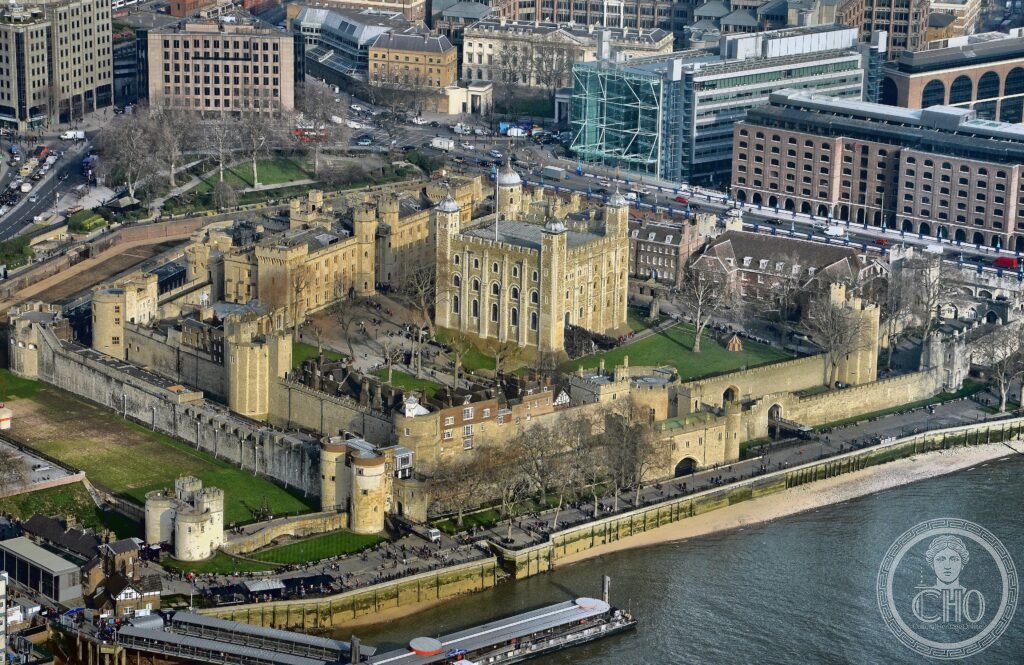
Founded by William the Conqueror in 1066 and expanded over nine centuries, the Tower of London has served as royal palace, fortress and prison. Today it holds the Crown Jewels of the United Kingdom and remains guarded by Yeoman Warders, making it one of the most historically layered sites in England.
At a glance
The Tower of London is a Norman fortress on the north bank of the Thames, inscribed as a UNESCO World Heritage Site in 1988 for its outstanding example of medieval military architecture. It combines the roles of royal palace, treasury, former prison and working garrison, and is home to the Yeoman Warders, known as Beefeaters, and to a small resident population of ravens tied to an old prophecy that the Tower and the Crown will fall if the birds ever leave.
Key facts
- Founded: 1066, by William the Conqueror after the Battle of Hastings
- White Tower: completed around 1100, the oldest surviving Norman military building in Greater London, measuring 36 by 32 metres and standing 27 metres tall
- Crown Jewels: housed here, including the St Edward’s Crown, the Imperial State Crown, the Koh-i-Noor diamond (105.6 carats) and the Cullinan I (530.2 carats)
- Yeoman Warders: around 36 in number, all retired non-commissioned officers with long military service, resident within the Tower complex
- Ravens: six kept at the Tower according to long-standing tradition
- Heritage status: UNESCO World Heritage Site, inscribed 1988
History
The Tower was founded by William the Conqueror in 1066, in the immediate aftermath of his victory at the Battle of Hastings, as a demonstration of Norman authority over London. Its central keep, the White Tower, was completed around 1100 and remains the oldest surviving Norman military building in Greater London.
The fortress grew substantially in the following centuries. Henry III added the inner curtain wall in the thirteenth century, and Edward I added the outer curtain wall and a moat fed from the Thames; the moat was later drained in 1843. For over five centuries, from 1279 to 1810, the Tower also housed the Royal Mint, and from 1210 to 1835 it kept a Royal Menagerie, with animals including elephants, lions, polar bears and a gorilla; one polar bear reportedly fished in the Thames.
What you see
Visitors enter through the main gate, where free tours led by Yeoman Warders set off at regular intervals. The Crown Jewels are displayed under tight security, with visitors filing past on a moving walkway to manage the flow of people. Inside the White Tower, the Chapel of St John the Evangelist on the second floor dates from around 1080 and is one of the oldest surviving parts of the complex. At low tide, the original waterway beneath the arch of Traitors’ Gate becomes visible, recalling the route by which prisoners once arrived by boat from the Thames.
The Bloody Tower, associated with the imprisonment of Sir Walter Raleigh and with the disappearance of the young princes Edward V and his brother Richard in 1483, and Tower Green, where seven high-ranking prisoners including Anne Boleyn and Catherine Howard were executed, are among the sites most closely tied to the Tower’s darker history.
Practical information
- Booking: tickets and tour information are available through the official Historic Royal Palaces website, hrp.org.uk
- Guided tours: free Yeoman Warder tours depart from the main gate at regular intervals throughout the day
- Access to the Crown Jewels: queues can build up, so visitors are advised to check current arrangements on the official site before travelling
Getting there
The Tower is served by Tower Hill station on the London Underground’s District and Circle lines, right by the entrance. It can also be reached from London Bridge station on the Jubilee and Northern lines, followed by a short walk, or by Thames Clipper river boat from Westminster Pier or Bankside Pier.
Nearby
- Tower Bridge — a short walk east; its bascule leaves still open for river traffic, and a high-level glass walkway looks straight down onto the Thames
- Westminster Abbey — about 3.5 km west, reachable by the District line to Westminster; itself a UNESCO World Heritage Site, it has hosted numerous royal coronations and contains Poets’ Corner
- Borough Market and Southwark Cathedral — about 1 km west via London Bridge; Borough Market has traded on this site since at least 1014, and the cathedral’s nave and choir date from between 1220 and 1420
Sources
- Wikipedia, Tower of London
- Wikipedia, Crown Jewels of the United Kingdom
- Wikipedia, Yeoman Warders
- UNESCO, Tower of London, World Heritage Site reference 488, inscribed 1988
- Derek Wilson, The Tower of London: A Thousand Years, Allison & Busby, 1998
Find it on the map
See this place and what’s around it →📷 Become a Cultural Heritage Online photographer
Share your photos of places: they stay published under your name as the author. The more they're seen, the more you get noticed — and soon a contest will reward the most appreciated photos.
Log in or sign up free to add a photoIs this page about you?
This page is read by travellers and heritage enthusiasts who find it on Google. Tell us how you are connected to this place and we will take it from there.