

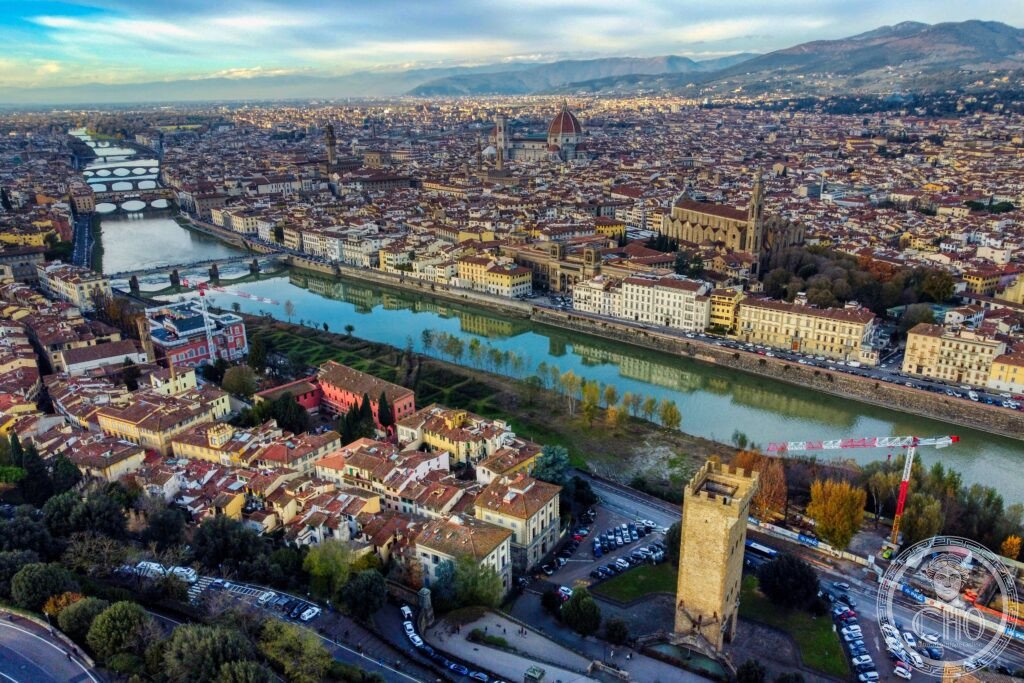
Florence’s historic centre concentrates an extraordinary run of Renaissance achievement into a small area: Brunelleschi’s dome over the cathedral, the Uffizi’s collection of Botticelli, Leonardo and Michelangelo, Michelangelo’s David, and the tombs of Dante, Galileo and Michelangelo himself in Santa Croce.
At a glance
The historic centre of Florence covers roughly 505 hectares and has been inscribed on the UNESCO World Heritage List since 1982. It is the capital of Tuscany and one of the region’s most visited cities. The centre is closely associated with the writers Dante Alighieri, Petrarch and Boccaccio, and with the quattrocento generation of artists, including Masaccio, Donatello, Ghiberti and Botticelli, whose work defined the early Renaissance.
Its landmarks include the cathedral of Santa Maria del Fiore with Brunelleschi’s dome, the Uffizi Gallery, the Galleria dell’Accademia with Michelangelo’s David, the basilica of Santa Croce, the Ponte Vecchio, and the Pitti Palace with the Boboli Gardens.
Key facts
- Cathedral: Santa Maria del Fiore, begun in 1296 under Arnolfo di Cambio; the dome, designed by Filippo Brunelleschi after he won the 1418 competition, was completed in 1436 and is the largest brick dome ever built, roughly 42 metres in internal diameter and 91 metres to the lantern.
- Uffizi Gallery: built from 1560 as the administrative offices of the Florentine state, designed by Giorgio Vasari for Cosimo I de’ Medici; it holds one of the world’s principal collections of Renaissance painting, including Botticelli’s Birth of Venus and Primavera, Leonardo’s Annunciation, Michelangelo’s Doni Tondo, and works by Raphael and Caravaggio.
- Michelangelo’s David: carved between 1501 and 1504 from a marble block abandoned decades earlier, now in the Galleria dell’Accademia; it stands 5.17 metres including its base and originally stood outside the Palazzo della Signoria until 1873.
- Santa Croce: the largest Franciscan church in the world, begun in 1294, and burial place of Michelangelo and Galileo Galilei, with a monument to Dante Alighieri.
- Ponte Vecchio: built in 1345, home to jewellers’ workshops since 1593, with the Vasari Corridor running above it.
History
Work on the cathedral began in 1296 under Arnolfo di Cambio, but its dome was not resolved until Filippo Brunelleschi won the design competition in 1418. He had tested his structural ideas on a smaller scale at the Sagrestia Vecchia in San Lorenzo between 1421 and 1428, developing a herringbone brick pattern that allowed the dome to rise without a wooden supporting frame. The dome was finished in 1436, using an estimated four million bricks, and the precise engineering of the technique is still debated by specialists.
The Uffizi building was commissioned in 1560 by Cosimo I de’ Medici from Giorgio Vasari, the painter and architect who also wrote the Lives of the Artists, published in 1550 and long regarded as the foundational text of art history. The marble block that became Michelangelo’s David had been quarried for the cathedral works committee in 1464 and left unused for twenty-five years before Michelangelo, then twenty-six, was given the commission in 1501; the finished statue stood outside the Palazzo della Signoria until it was moved indoors for conservation in 1873. At Santa Croce, begun in 1294, Michelangelo was buried in 1570 in a tomb designed by Vasari. Galileo Galilei, denied burial in the main church after his condemnation by the Inquisition in 1633, was reinterred there with full honours in 1737, when several relics, including fingers and a tooth, were removed from his remains and are now kept at the Galileo Museum in Florence.
What you see
The cathedral dome dominates the skyline and is best appreciated from the Piazzale Michelangelo, a hillside terrace south of the Arno that gives the most photographed view of the city. Inside the Uffizi, visitors move through rooms hung with Botticelli’s Birth of Venus and Primavera, Leonardo’s early Annunciation, Michelangelo’s only surviving painted panel, the Doni Tondo, and Caravaggio’s Medusa. At the Accademia, Michelangelo’s David stands under a purpose-built rotunda; close inspection shows the deliberately oversized head and hand, adjustments the sculptor made for a figure meant to be seen from below. Santa Croce’s interior is dense with funerary monuments, among them Michelangelo’s tomb with its three weeping allegorical figures and Galileo’s monument in the main nave. Outside, the Ponte Vecchio still carries jewellers’ shops along its length, with the Vasari Corridor passing above.
Practical information
- Tickets and hours: the Duomo, Uffizi, Accademia and Santa Croce each have separate admission arrangements and timetables, which change seasonally; check each institution’s official website before visiting.
- Getting around the sights: the cathedral, the Uffizi, the Accademia and Santa Croce all lie within the historic centre and can be visited on foot in sequence.
- Booking: given the volume of visitors to the Uffizi and the Accademia, advance booking through the official channels is advisable.
Getting there
The historic centre is compact, and its principal sights, the cathedral, the Uffizi, the Accademia and Santa Croce, all stand within easy walking distance of one another, making the district straightforward to explore on foot once in the city.
Nearby
- Ponte Vecchio — within the historic centre, a medieval bridge dating from 1345, lined with jewellers’ workshops and overlooked by the Vasari Corridor.
- Piazzale Michelangelo — on the hillside south of the Arno, the terrace offering the classic panoramic view of the city and its dome.
- Pitti Palace and Boboli Gardens — across the river from the centre, the former Medici residence and its adjoining formal gardens.
Sources
- UNESCO.
- Uffizi Gallery.
- Galleria dell’Accademia.
- Galileo Museum, Florence.
- Giorgio Vasari, Lives of the Artists (1550).
Find it on the map
See this place and what’s around it →Historical events at this place (28)
- 2017 Goya e Guido Reni. Tesori d’arte al Palp
- 2017 Per Castelli e Pievi del Chianti
- 2017 Il Liberty a Firenze
- 2018 Firenze in Foto
- 2018 Se io fossi immagine - Giorgio Galimberti
- 2018 Visita guidata allo Stabilimento Storico Alinari
- 2018 Opening straordinaria Studio dell'artista Lapo Gargani
- 2019 Stampa 3D al Museo
- 2019 500 anni di Cosimo I e Caterina de’ Medici: gli appuntamenti
- 2019 IL COLORE DEI MIEI GIORNI - I dipinti di Danièle Lorenzi Scotto
- 2019 Premio il GHIBELLINO, Città di Empoli
- 2019 Prospettive femminili a Casa Siviero
- 2019 Donne al tempo di Dante
- 2019 Inside Magritte
- 2020 16° Firenze e Cioccolato
- Esploratore Amerigo Vespucci è nato oggi
- 2020 Icone CONTEMPORARY Firenze
- 2020 BANDO per il sostegno al restauro di beni mobili
- 2020 Carapelli For Art
- 2020 Firenze al tempo del Coronavirus
- 2020 OmoGirando Firenze a luci rosse in età medievale e rinascimentale
- 2021 OmoGirando Firenze: dai matrimoni gay al primo Pride in età rinascimentale
- 2021 OmoGirando Firenze curiosa
- 2021 Mostra Frida Kahlo. Una vita per immagini - Sansepolcro
- 2021 Demo de Ritratto Acquarello - Roberto Andreoli
- Birth Anniversary: Galileo Chini — December 2, 1873
- Birth Anniversary: Gino Coppedè — September 26, 1866
- 2026 BIAF – 34ª Biennale Internazionale dell'Antiquariato di Firenze
📷 Become a Cultural Heritage Online photographer
Share your photos of places: they stay published under your name as the author. The more they're seen, the more you get noticed — and soon a contest will reward the most appreciated photos.
Log in or sign up free to add a photo