

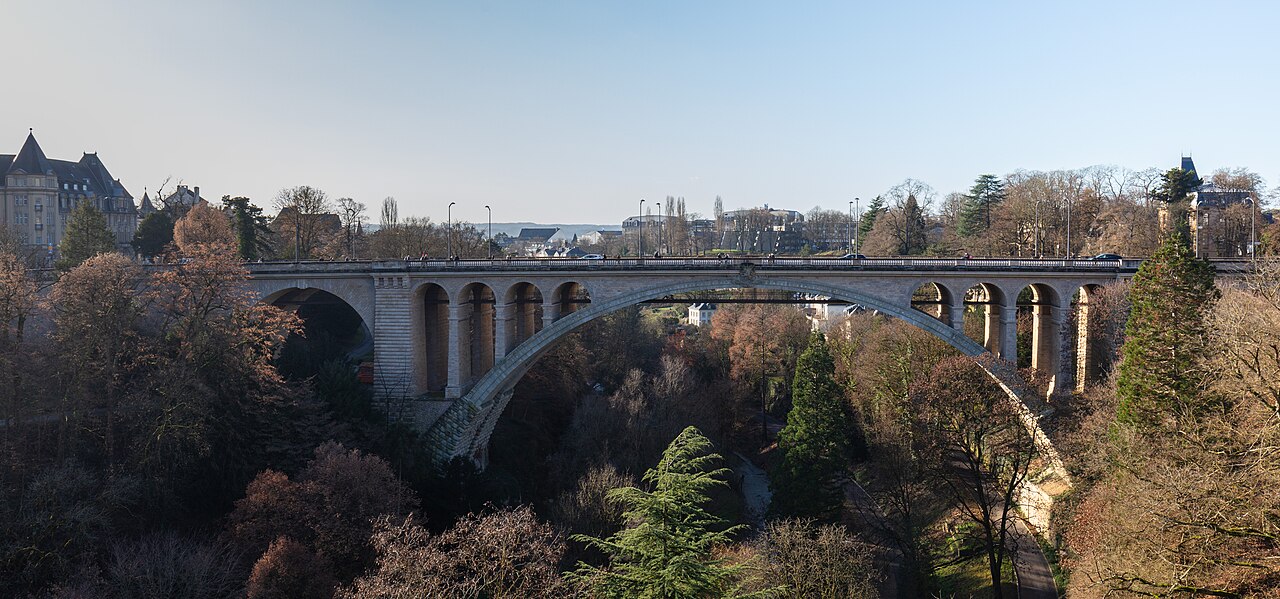
The largest stone arch in the world when built – the national bridge of Luxembourg, leaping the Petrusse valley in a single 84-metre span.
At a glance
- Type
- Road bridge
- Period
- 1900-1903
- Style
- Monumental stone engineering
- Location
- Luxembourg City, Luxembourg
- Coordinates
- 49.6075, 6.1273
- Engineers
- Paul Sejourne with Albert Rodange
Overview
The Adolphe Bridge carries the avenue from the old town to the station quarter across the deep green gorge of the Petrusse in one great double arch of 84.65 metres – on completion in 1903 the longest stone arch span on earth. Named for Grand Duke Adolphe, the first of the Nassau-Weilburg line to rule Luxembourg alone, it became at once the symbol of the independent Grand Duchy.
History
France’s great bridge engineer Paul Sejourne designed the structure with twin parallel arch ribs – an economy of stone that became textbook practice. The bridge carried the capital’s growth, two world wars’ occupations, and a century of traffic until a meticulous 2014-2017 restoration rebuilt the deck, added a suspended cycleway beneath, and returned the masonry to its golden tone.
Architecture and Design
The main span’s twin ribs rise 42 metres above the park; smaller flanking arches step the approaches. Sejourne’s classical detailing – voussoirs, cornice, balustrade – dignifies pure engineering, framing views of the casemates and the Gelle Fra memorial.
Cultural significance
The bridge appears on coins, stamps, and every panorama of the UNESCO-listed fortress city; for Luxembourgers it is the Nei Breck, the New Bridge, the engineering signature of national sovereignty between France and Germany.
Visiting today
Cross on foot for the gorge views, then descend to the Petrusse park to see the arch from below; the cycleway slung beneath the deck offers a unique passage. The Place de la Constitution at its head overlooks the casemates.
Getting there
The bridge links the city center to the station district; the free national transport network puts every tram and bus within reach.
Sources and resources
Find it on the map
See this place and what’s around it →Record researched and written by Luigi De Marchi for Cultural Heritage Online, 2026.
📷 Become a Cultural Heritage Online photographer
Share your photos of places: they stay published under your name as the author. The more they're seen, the more you get noticed — and soon a contest will reward the most appreciated photos.
Log in or sign up free to add a photo