
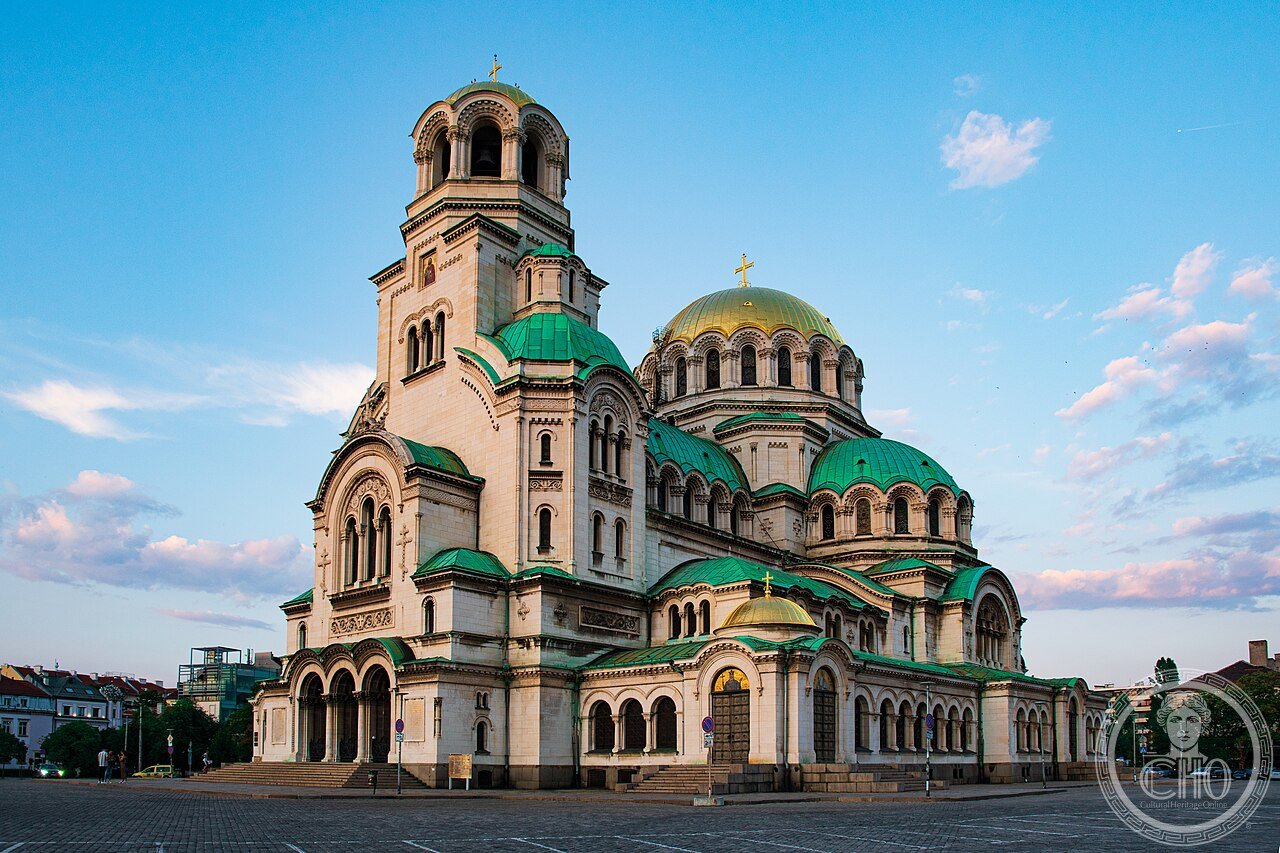
The largest Eastern Orthodox cathedral in the Balkans, built as a monument to the Russian soldiers who died liberating Bulgaria from Ottoman rule, its gold-leaf dome and richly ornamented interior making it the defining landmark of the Bulgarian capital.
At a glance
- Type
- Cathedral
- Period
- 1882-1912
- Style
- Neo-Byzantine
- Location
- Alexander Nevsky Square, Sofia, Bulgaria
- Coordinates
- 42.6961, 23.3319
- Architect
- Alexander Pomerantsev and collaborators
Overview
The Alexander Nevsky Cathedral in Sofia is the largest Eastern Orthodox cathedral in the Balkans and one of the most magnificent Neo-Byzantine churches in the world. Covering 3,170 square meters and capable of holding 5,000 worshippers, it dominates the historic center of the Bulgarian capital with its golden domes, Venetian-style bell tower, and sweeping colonnaded exterior. The cathedral is the seat of the Bulgarian Patriarch and one of the most visited sites in Bulgaria, drawing hundreds of thousands of pilgrims and tourists every year. Its crypt, entered from outside the main building, houses the National Art Gallery of Religious Iconography, one of the finest collections of medieval icons in Europe.
History
The cathedral was built to commemorate the approximately 200,000 Russian soldiers who lost their lives liberating Bulgaria from five centuries of Ottoman rule during the Russo-Turkish War of 1877-1878. Named for the medieval Russian warrior-prince Alexander Nevsky and for Tsar Alexander II of Russia, whose army fought the decisive campaigns, the building was conceived as Bulgaria’s supreme act of national gratitude. Construction began in 1882 under architect Alexander Pomerantsev but proceeded slowly through political upheavals; the cathedral was consecrated in 1912. The gold-leaf covering the central dome was regilt in 1998 through a gift from the Russian government. Over the following century, the cathedral survived two world wars, communist rule (during which religious practice was suppressed but the building preserved), and post-1989 transition. It remains the most important religious building in Bulgaria.
Architecture and Design
The cathedral is a masterwork of the Neo-Byzantine revival, a style that drew on the great domed churches of Constantinople and the medieval Orthodox tradition. The exterior presents a composition of gilded and lead-covered domes of varying sizes, the central dome rising 45 metres above the nave on a drum pierced by arched windows. The facade is clad in white and grey stone with carved decorative bands, blind arcading, and mosaic lunettes above the portals. The bell tower, modeled on Venetian campaniles, stands to one side. The interior is among the most lavishly decorated Orthodox spaces in Eastern Europe: 82 large murals and 273 icons were painted by a team of Russian, Czech, and Bulgarian artists; the floors are Italian marble; columns are faced with onyx from Algeria and alabaster from Greece. The bells, the largest set in the Balkans, include one weighing 12 tonnes.
Cultural significance
The Alexander Nevsky Cathedral is simultaneously Bulgaria’s most important religious monument, its foremost national memorial, and its principal work of 19th-century architecture. It encodes in stone the founding narrative of the modern Bulgarian state: the Russian liberation, Bulgarian independence, and Orthodox faith as the bedrock of national identity. The square outside – with the Synodal Palace, the former Royal Palace (now the National Art Gallery), and the National Assembly – forms the most historically charged public space in Bulgaria. For Bulgarians, the cathedral occupies a role analogous to Westminster Abbey in England or Notre-Dame in France: a building where religious, political, and cultural history converge. The crypt icon collection, spanning the 9th to 19th centuries, is a UNESCO-recognized heritage resource.
Visiting today
The cathedral is open daily for worship and visits; there is no entrance fee for the main church. The crypt (National Art Gallery of Religious Iconography) charges a small admission fee and keeps separate hours – check locally as schedules vary by season. Photography is permitted in the interior without flash during services. The cathedral square is a central meeting point in Sofia and the surrounding streets contain many of the city’s main museums and galleries. Best visited early morning to avoid tourist crowds; evening visits during vespers services offer a memorable acoustic experience with the choir.
Getting there
Alexander Nevsky Cathedral is in central Sofia, easily walkable from the city’s main hotels and attractions. The nearest metro station is Serdika (Lines 1 and 2), approximately 10 minutes on foot. Trams 1, 2, and 6 stop nearby at Eagle Bridge (Orlov Most). The cathedral is about 2 km from Sofia Central Railway Station and 10 km from Sofia Airport; taxis and Uber operate throughout the city. The surrounding Alexander Nevsky Square is pedestrianized and connects to the Vitosha Boulevard shopping area via the National Assembly plaza.
Sources and resources
Find it on the map
See this place and what’s around it →Record researched and written by Luigi De Marchi for Cultural Heritage Online, 2026.
📷 Become a Cultural Heritage Online photographer
Share your photos of places: they stay published under your name as the author. The more they're seen, the more you get noticed — and soon a contest will reward the most appreciated photos.
Log in or sign up free to add a photoIs this page about you?
This page is read by travellers and heritage enthusiasts who find it on Google. Tell us how you are connected to this place and we will take it from there.