
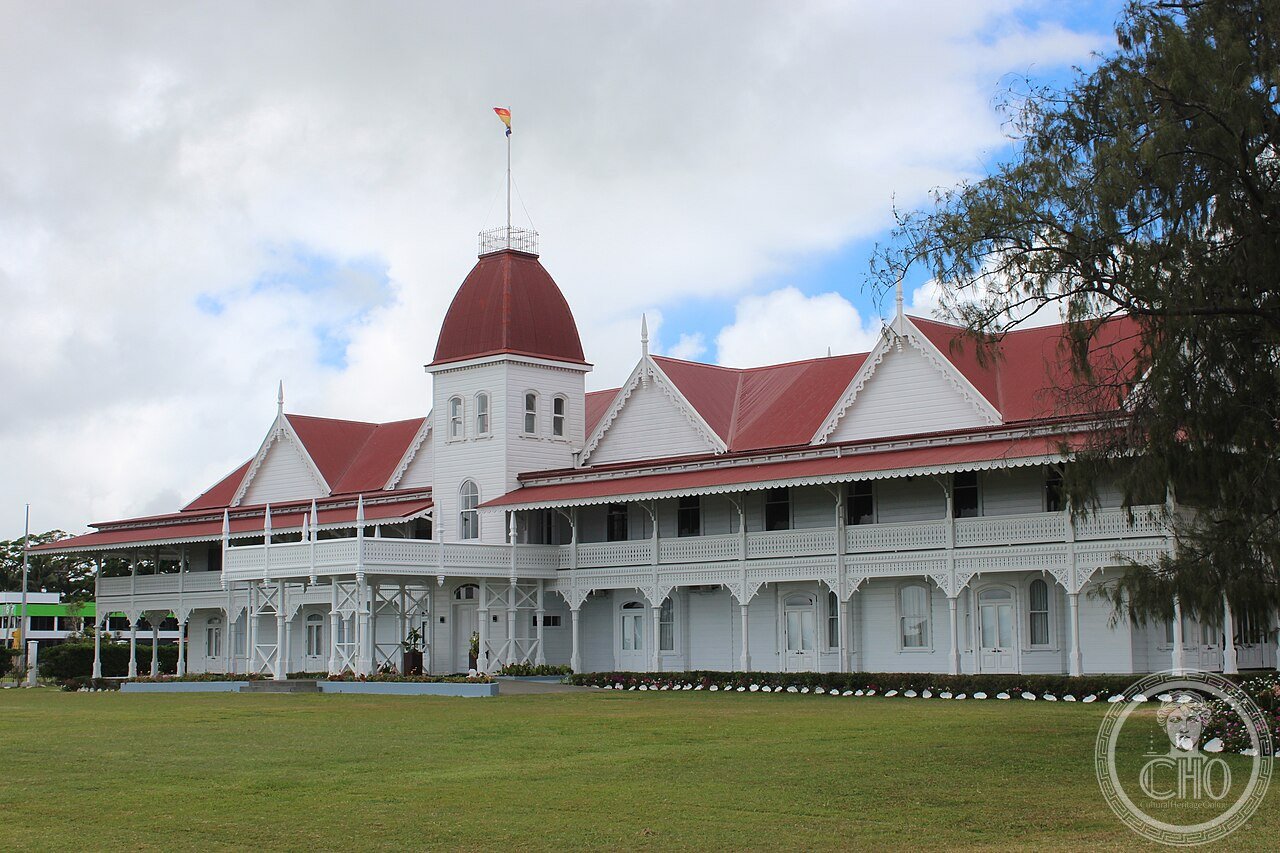
Royal Palace of Tonga
The oldest surviving building in Tonga and one of the most unusual royal residences on earth: a white prefabricated Victorian timber palace built in New Zealand and reassembled overlooking the Pacific Ocean, home to the Tongan royal family for over 150 years.
At a glance
- Type
- Royal Palace
- Period
- 1867
- Style
- Victorian Colonial Timber
- Location
- Royal Grounds, Vuna Road, Nuku’alofa, Tonga
- Coordinates
- -21.1333, -175.2000
- Architect
- New Zealand craftsmen (commissioned by King George Tupou I)
Overview
The Royal Palace of Tonga in Nuku’alofa is the oldest surviving building in Tonga and one of the most distinctive royal residences in the Pacific. A single-storey prefabricated wooden structure in Victorian colonial style, the palace features decorative timber fretwork, French doors opening onto wraparound verandahs on all four sides, a corrugated iron roof, and a formal garden with mature coconut palms. Though modest in scale compared to European royal palaces, it has housed the Tongan royal family continuously since 1867, from King George Tupou I through the current King Tupou VI.
History
King George Tupou I (r. 1845-1893), the founding father of the Kingdom of Tonga as a unified state, commissioned the palace from New Zealand craftsmen. The prefabricated structure was built in New Zealand, shipped across the Pacific, and assembled on the Royal Grounds in 1867. George Tupou I was a remarkable strategic ruler who navigated Tonga through the height of European imperialism: he codified Tongan law in 1862, abolished serfdom, and negotiated a Treaty of Friendship with Britain in 1900 that gave Tonga the status of a British protectorate rather than a colony, preserving Tongan sovereignty and making it the only Pacific monarchy to survive the colonial era intact. The palace has been the residence of every Tongan monarch since. Tonga regained full independence from British protection in 1970.
Architecture and Design
The Royal Palace exemplifies Victorian colonial prefabricated architecture, a construction method widely used in New Zealand and Australia in the 1860s. The building is a single storey raised on a low foundation, with a symmetrical plan and verandahs wrapping all four facades. The roof is clad in corrugated iron, the standard roofing material of the Victorian Pacific. Decorative timber fretwork adorns the verandah railings and bargeboards under the eaves, reflecting the Victorian taste for ornamental woodwork. French doors on each elevation provide cross-ventilation suited to the tropical climate. The formal garden is laid out along English lines, with mature coconut palms that have grown to full height over 150 years.
Cultural significance
The Royal Palace of Tonga represents the physical continuity of the only unbroken indigenous monarchy in the Pacific. While the palaces of Hawaii, Samoa, and other Pacific kingdoms were ended by annexation, the Tongan royal family has occupied this building without interruption for over 150 years, a living symbol of Tongan sovereignty and the remarkable diplomatic achievement of King George Tupou I. For Tongans the palace is the literal and symbolic center of national identity. The building is also a rare intact example of Victorian prefabricated colonial architecture in the Pacific.
Visiting today
The Royal Palace grounds are closed to the public as they remain an active royal residence. However, the palace exterior and formal gardens can be clearly viewed from the Royal Grounds waterfront promenade along Vuna Road, which runs between the palace grounds and the harbor. The best views are from the seafront, where the white facade is visible through the garden palms. Visitors should respect the perimeter fence and not attempt to enter the grounds. Nearby points of interest include the Royal Tombs (Malae Kula), the Free Wesleyan Church of Tonga, and the Talamahu Market.
Getting there
The Royal Palace is located on the northern waterfront of Nuku’alofa, the capital of Tonga, on the island of Tongatapu. Nuku’alofa is served by Fua’amotu International Airport, approximately 22 kilometres south of the city centre; taxis are the standard transport from the airport. The palace is within walking distance of the town centre and most hotels, approximately 10 to 15 minutes on foot from the central market area. Vuna Road runs along the waterfront directly past the palace grounds. There is no public bus service in Nuku’alofa; taxis and rental vehicles are the standard transport options.
Sources and resources
Find it on the map
See this place and what’s around it →📷 Diventa un fotografo di Cultural Heritage Online
Condividi le tue foto dei luoghi: restano pubblicate con la tua firma come autore. Più vengono viste, più ti fai conoscere — e presto un concorso premierà le foto più apprezzate.
Accedi o registrati gratis per aggiungere una fotoDo you manage this place?
This page is read by travellers and heritage enthusiasts who find it on Google. Keep it accurate — and make it work for you. Free for non-profit heritage institutions.