
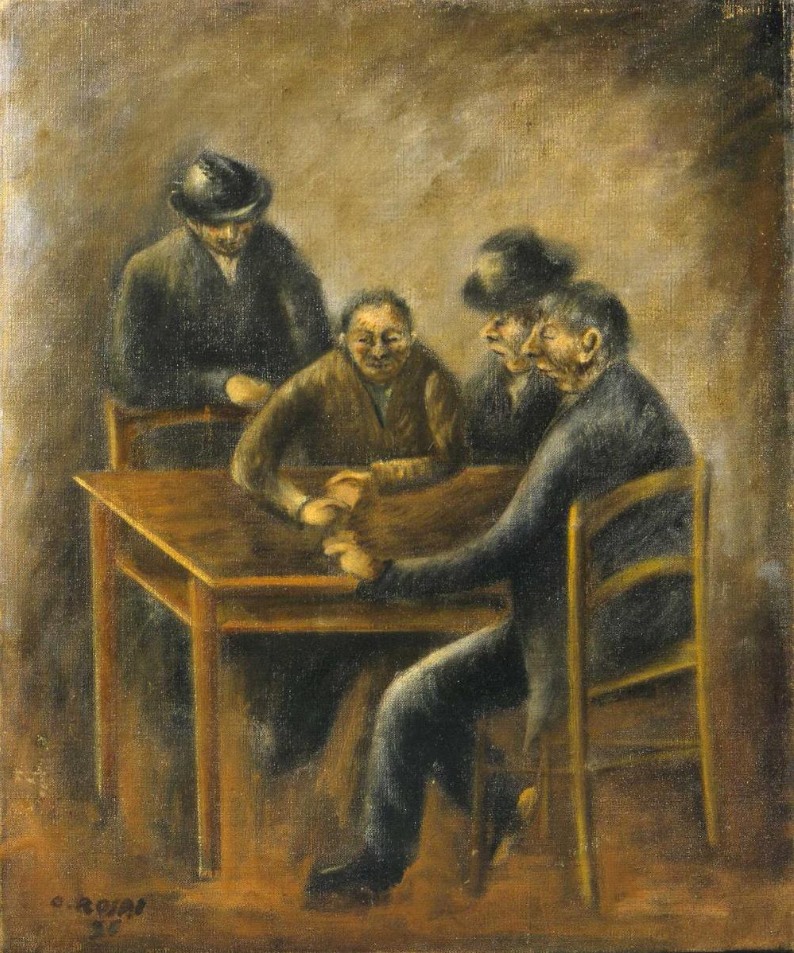
La partita di carte is a painting by Ottone Rosai created in 1936. The work depicts a card game, a domestic subject treated with the formal restraint characteristic of the Novecento Italiano movement to which Rosai contributed.
Rosai, born in Florence in 1895, came of age during the Futurist period and exhibited with the Lacerba group before the First World War. After 1918, he embraced the return to order that defined Italian modernism in the interwar decades, devoting himself to the study of early Italian painters and developing a distinctive figurative language. By the 1930s, his work was widely recognised through major exhibitions including the Seconda Mostra del Novecento Italiano in Milan (1929) and the Venice Biennale.
About Ottone Rosai
Rosai graduated from the Florence Academy of Fine Arts in 1912 and was closely associated with Ardengo Soffici and the Florentine Futurists. A decorated veteran of World War I, he shifted toward representational painting in the 1920s and became a significant figure in the Novecento Italiano. He contributed regularly to the magazine Il Selvaggio from 1926 onward and participated in major group exhibitions throughout the 1930s.
Details
- Artist: Ottone Rosai (1895–1957)
- Year: 1936
- Movement: Novecento Italiano
- Subject: Card game, domestic genre scene
Explore more: 118 heritage places in Firenze
Frequently asked questions
Who was Ottone Rosai?
Ottone Rosai was a Florentine painter born in 1895 who studied at the Florence Academy of Fine Arts. He began as a Futurist associated with the Lacerba group, served in World War I, and later became a major exponent of Novecento Italiano, the return-to-order movement that dominated Italian modernism in the interwar period.
What was Novecento Italiano?
Novecento Italiano was an artistic movement of the 1920s and 1930s that emphasised a return to order, figuration, and engagement with Italian Renaissance tradition after Futurism’s avant-garde radicalism. Rosai participated in the movement’s key exhibitions, including the Seconda Mostra del Novecento Italiano in Milan in 1929.
What subjects did Rosai typically paint?
Rosai worked across figurative genres including domestic scenes, portraiture, and studies informed by early Italian painting. La partita di carte exemplifies his treatment of everyday subjects through the formal restraint and compositional clarity characteristic of his mature style.


