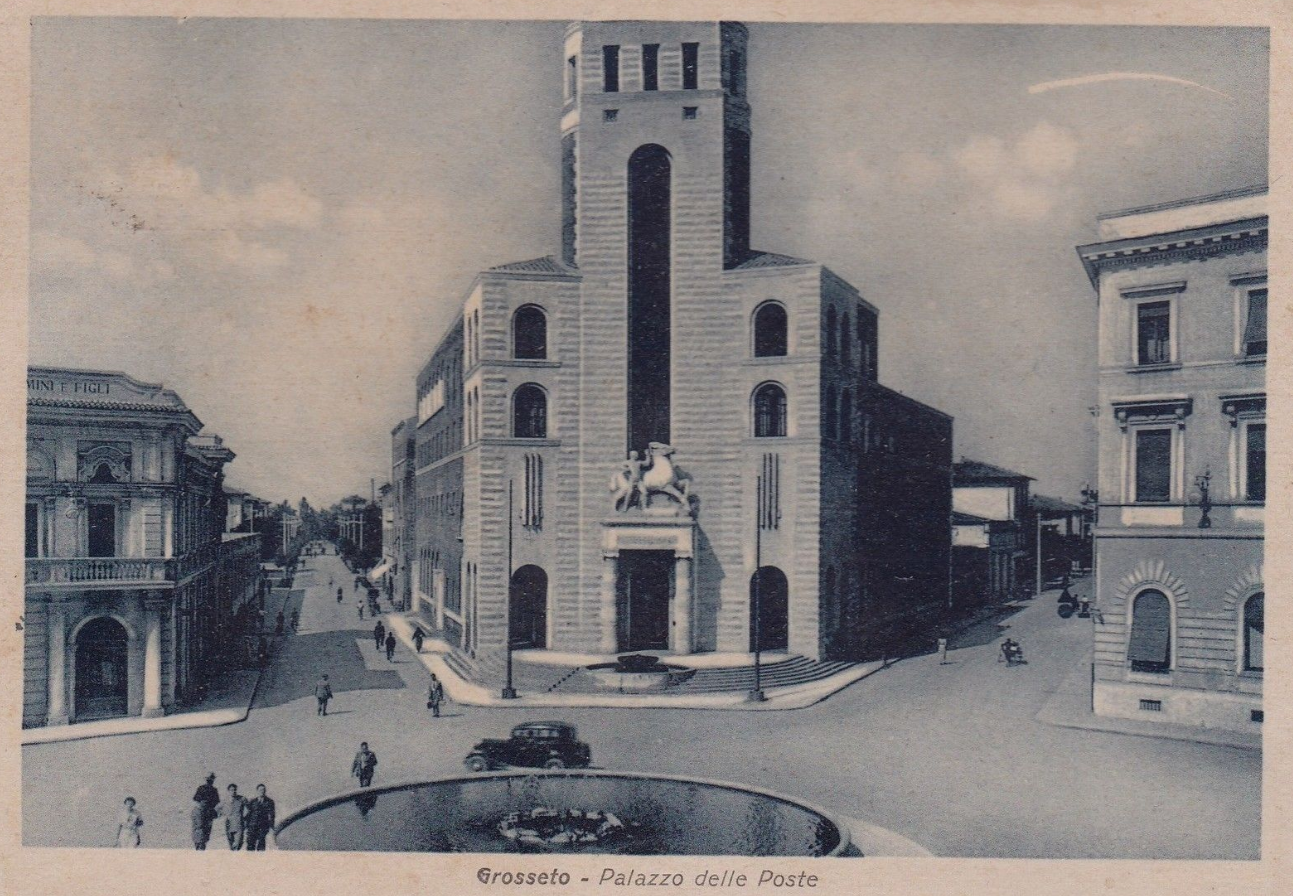
The Palazzo delle Poste in Grosseto, Tuscany, was designed by Italian architect Angiolo Mazzoni and completed in 1931–32. Built as part of the state’s comprehensive modernization programme, the structure exemplifies the architectural vocabulary applied to public buildings during Italy’s interwar period.
Mazzoni held the position of chief architect for the Ministry of Communications and the State Railways, roles that granted him authority over hundreds of public commissions across the peninsula. His post offices and railway stations became vehicles for a coordinated modernist aesthetic tied to institutional identity. The Grosseto post office reflects the functional and geometric clarity characteristic of this era’s institutional design.
About Angiolo Mazzoni
Born in Bologna in 1894, Mazzoni trained at the Academy of Fine Arts in his native city and briefly studied under Marcello Piacentini in 1920. He entered the Ministry of Communications in 1924 and rapidly ascended to independent commissions by 1926. Over his long career, Mazzoni designed hundreds of public buildings, post offices, and railway stations that shaped the built environment of interwar Italy.
Details
- Architect: Angiolo Mazzoni
- Location: Grosseto, Tuscany, Italy
- Year: 1931–32
- Building type: Post office
- Period: Italian interwar modernism
Explore more: 5 heritage places in Grosseto
Frequently asked questions
Who designed the Palazzo delle Poste in Grosseto?
Architect Angiolo Mazzoni designed the building in 1931–32. Mazzoni was chief architect for the Italian Ministry of Communications and State Railways, positions that made him one of the period’s most prolific designers of public institutions.
When was it built?
The Palazzo delle Poste was completed in 1931–32 as part of Italy’s broader programme of public infrastructure modernization during the interwar years.
What architectural movement does it represent?
The building exemplifies the rational and geometric aesthetic applied to institutional architecture in 1930s Italy, reflecting modernist principles in public design of the period.
Sources
- S1 — Ciucci, Giorgio. Gli architetti e il fascismo: architettura e città 1922-1944. Einaudi, 2002. ISBN 978-88-06-16310-5.
- S2 — Nicoloso, Paolo. Mussolini architetto: Propaganda e paesaggio urbano nell'Italia fascista. Einaudi, 2008. ISBN 978-88-06-19086-6.
Spotted an error? Write to editorial@culturalheritageonline.com and we correct it the same day.