
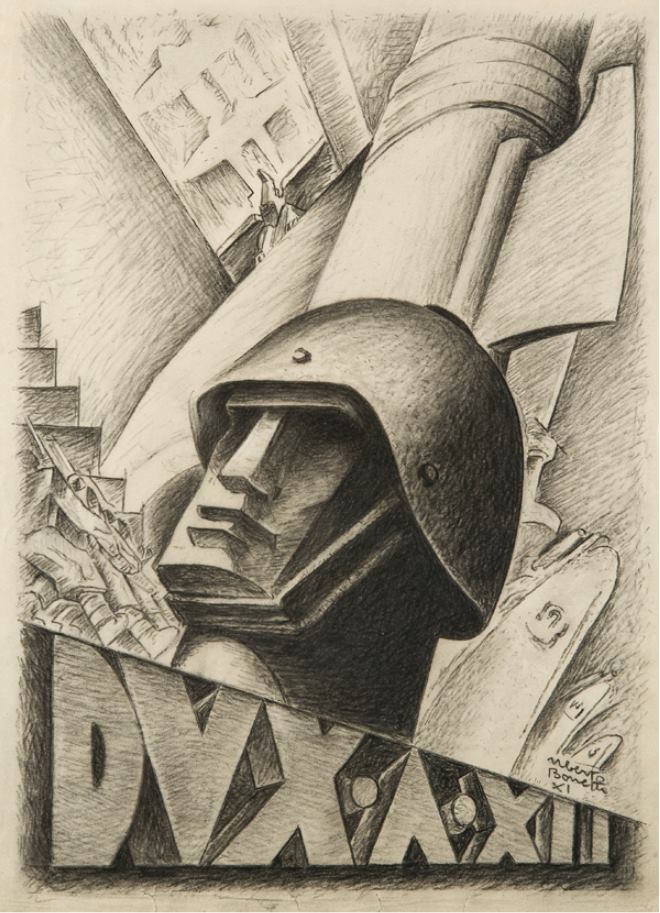
Dux is a painting created by Italian artist Uberto Bonetti in 1933, produced during his period of engagement with Futurist aeropittura—the Futurist movement centred on flight, speed, and dynamism as artistic subjects.
Bonetti, born in Viareggio in 1909, studied at the Academy of Fine Arts in Lucca under Lorenzo Viani. Around 1932, he adopted the principles of aeropittura as formulated by Marinetti, Balla, Depero, and other leading Futurists. This artistic turn coincided with his encounter with Filippo Tommaso Marinetti in Viareggio in 1930. Between 1932 and 1940, Bonetti produced his celebrated series Aeroviste italiane, aerial perspectives of Italian cities rendered in the dynamic vocabulary of Futurism.
About Uberto Bonetti
Uberto Bonetti (1909–1993) was an Italian painter and draughtsman from Viareggio. Alongside his painting practice, he worked as a fashion designer, creating garments encouraged by Depero and Thayaht. He also produced propagandistic drawings for the weekly L’artiglio between 1932 and 1935, and again in 1938, exploring themes of flight and motion.
Details
- Creator: Uberto Bonetti
- Year: 1933
- Movement: Futurism (aeropittura)
- Medium: Painting
Frequently asked questions
What is aeropittura?
Aeropittura was a Futurist artistic movement initiated in 1929 by Marinetti, Balla, Depero, and others that celebrated flight, speed, and aerial perspective as subjects and conceptual frameworks for painting.
Who was Uberto Bonetti?
Uberto Bonetti (1909–1993) was an Italian painter and draughtsman born in Viareggio who adopted Futurist aeropittura around 1932 and produced dynamic compositions exploring themes of flight and Italian cities throughout the 1930s.
What were the Aeroviste italiane?
The Aeroviste italiane were a series of aerial-perspective paintings executed by Bonetti between 1932 and 1940 depicting various Italian cities, including Pisa, Pistoia, Rome, Bolzano, and Sirmione, in the Futurist aeropittura idiom.


