
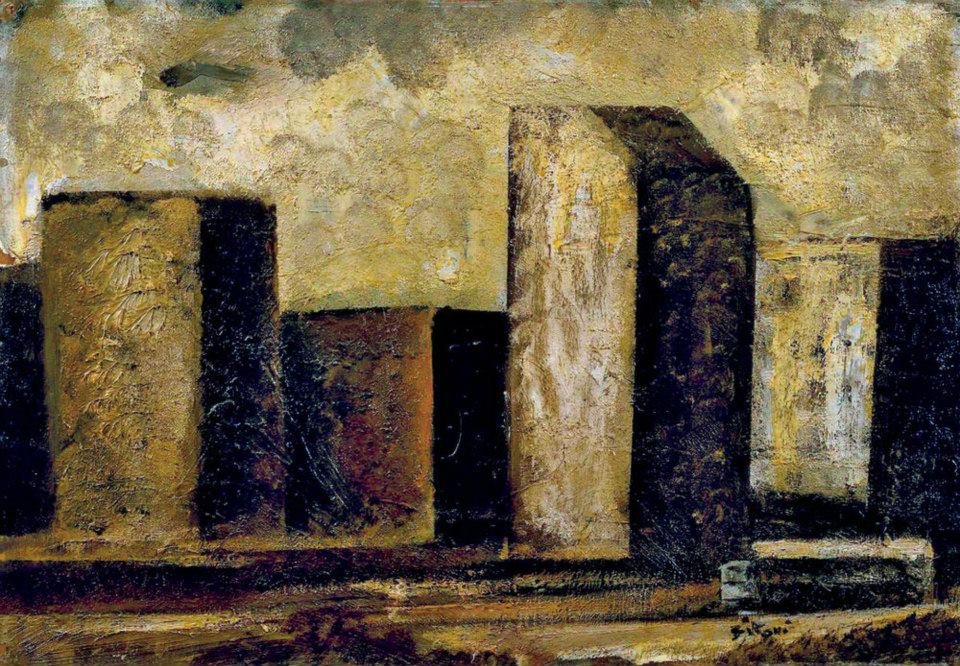
Paesaggio Urbano is a painting by Italian Modernist artist Mario Sironi, completed in 1928. The work demonstrates Sironi’s mature style, characterized by massive, immobile forms and a somber palette that defines his approach to figural and architectural subjects.
Sironi’s career spanned painting, sculpture, illustration, and design. He trained in Rome under Giacomo Balla, initially working in a Divisionist manner before developing the monumental aesthetic for which he became known. His urban landscapes represent a distinctly modern interpretation of the built environment, rendered through geometric volumes and restrained color.
About Mario Sironi
Sironi was born in Sassari, Sardinia, in 1885 and spent his formative years in Rome. After brief study in engineering, he turned to painting and attended the Scuola Libera del Nudo at the Accademia di Belle Arti di Roma. His early exposure to Divisionism came through contact with Balla and his circle; he later encountered Expressionist work during visits to Germany between 1908 and 1911. Throughout his career, Sironi worked across multiple disciplines, establishing himself as a central figure in Italian Modernism until his death in 1961.
Details
- Creator: Mario Sironi
- Date: 1928
- Medium: Painting
- Style: Italian Modernism
Frequently asked questions
Who was Mario Sironi?
Mario Sironi (1885–1961) was an Italian Modernist artist active as a painter, sculptor, illustrator, and designer. He studied under Giacomo Balla in Rome and became known for his characteristic style of massive, immobile forms rendered in somber tones.
What characterizes Sironi’s work?
Sironi’s paintings are typically characterized by monumental, static forms and restrained color. His urban landscapes and figural compositions reflect a distinctly modern sensibility shaped by his engagement with Divisionism and Expressionism.
When did Sironi create this painting?
Paesaggio Urbano was completed in 1928, during the mature phase of Sironi’s career when his monumental aesthetic was fully developed.
