
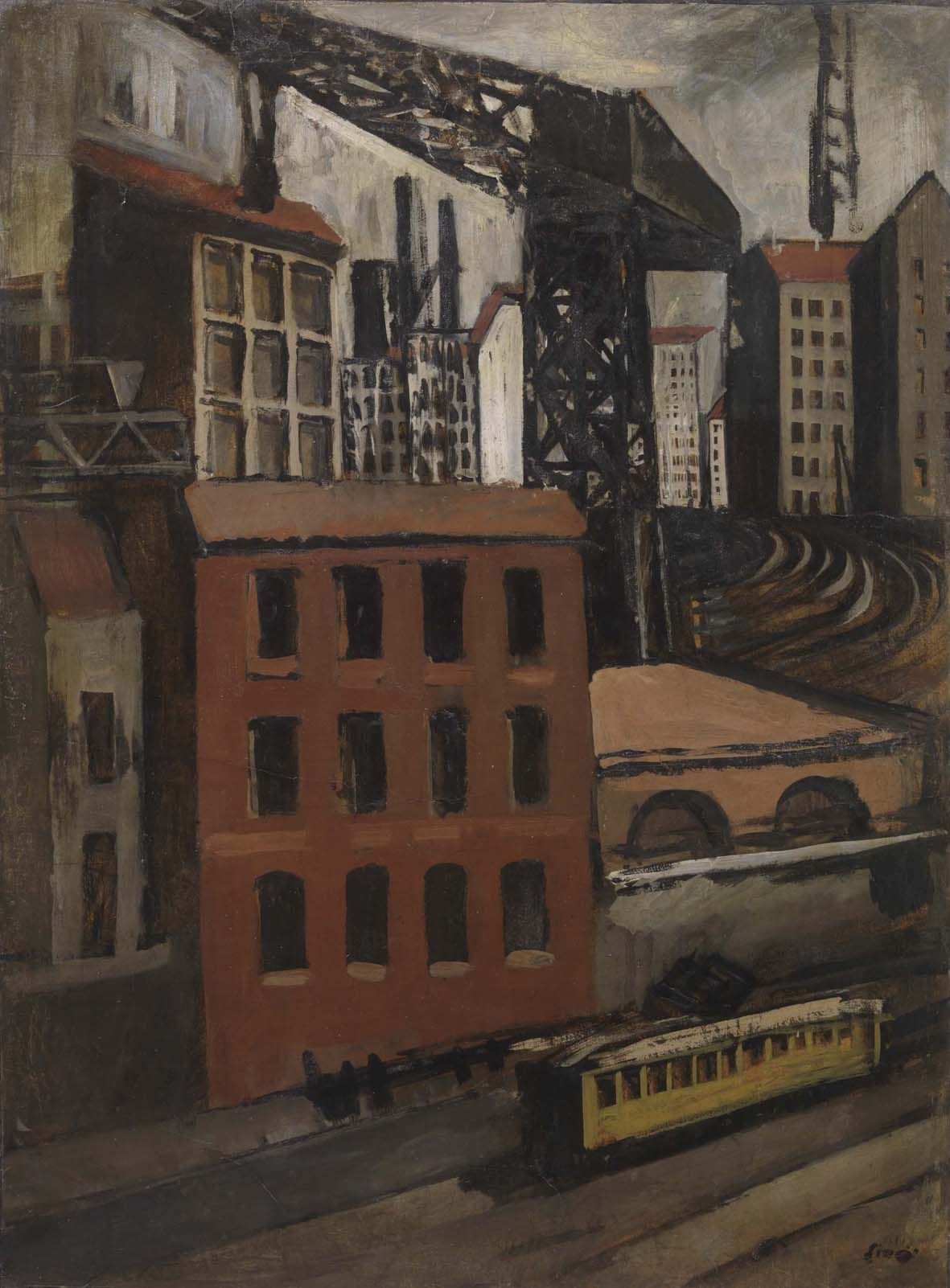
Periferia. Il tram e la gru is a 1921 painting by Mario Sironi, an Italian Modernist artist known for somber compositions built from massive, immobile forms. The work captures an urban periphery animated by industrial infrastructure—a tram and a crane—rendered in Sironi’s characteristic style of weighted, architectural monumentality.
Sironi’s approach to depicting the modern city emerged from his engagement with Divisionism in the early 1900s and his exposure to Expressionist work during travels in Germany. By the 1920s, his paintings had evolved into statements of formal severity, presenting industrial and urban subjects as grave, almost sculptural presences. The tram and crane in this composition are not anecdotal details but structural elements that define the composition’s emotional and visual weight.
About Mario Sironi
Born in Sassari, Sardinia, in 1885, Sironi abandoned engineering studies after a nervous breakdown to pursue painting in Rome. He studied under Giacomo Balla and later traveled to Paris and Germany, absorbing Divisionist and Expressionist influences. His practice extended across painting, sculpture, illustration, and design, establishing him as a central figure in Italian Modernism until his death in 1961.
Details
- Creator: Mario Sironi
- Year: 1921
- Movement: Italian Modernism
- Medium: Painting
- Subject: Urban periphery with tram and crane
On video
Frequently asked questions
Who was Mario Sironi?
Mario Sironi (1885–1961) was an Italian Modernist artist active as painter, sculptor, illustrator, and designer. He studied under Giacomo Balla in Rome and was influenced by Divisionism and German Expressionism.
What characterizes Sironi’s artistic approach?
Sironi’s paintings are marked by somber tones and massive, immobile forms. He treated industrial and urban subjects with formal severity, presenting them as grave, sculptural presences rather than descriptive scenes.
What does the title refer to?
The title translates as Periphery. The Tram and the Crane, identifying the industrial infrastructure depicted in the composition as central to the work’s subject and meaning.
Sources
- S1 — Pontiggia, Elena. Il Novecento Italiano. Abscondita, 2003. ISBN 978-88-8416-048-5.
- S2 — Ciucci, Giorgio. Gli architetti e il fascismo: architettura e città 1922-1944. Einaudi, 2002. ISBN 978-88-06-16310-5.
Spotted an error? Write to editorial@culturalheritageonline.com and we correct it the same day.


