
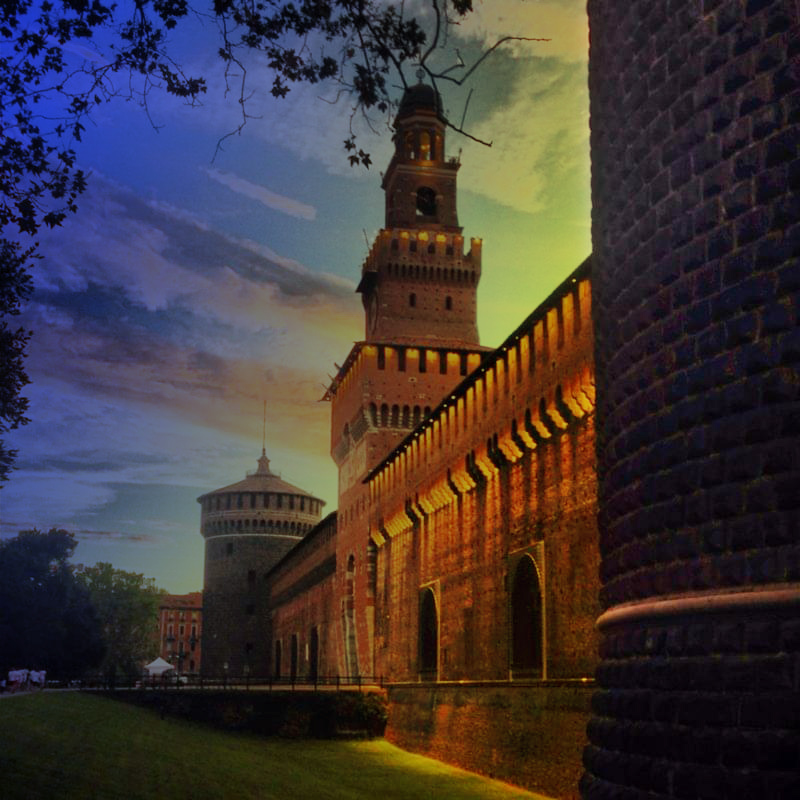
Sforza Castle, documented in March 2019, stands as one of the principal symbols of Milan and its history. Built in the fifteenth century by Francesco Sforza atop the remains of a previous fortification, the castle has undergone significant transformations across the centuries and ranks among Europe’s largest castles.
Fortifications and Structure
The outermost ring of fortifications, known as the “Ghirlanda,” represents the castle’s oldest section. Four towers occupy the corners, each oriented to one of the cardinal points. The South and East towers are cylindrical in shape, while the North and West towers are square. The entire perimeter remains encircled by the original moat, now dry.
Key Features and Entrances
The Torre del Filarete serves as the castle’s main entrance and is both the highest and most centrally positioned tower. The rear facade, the oldest section of the structure, contains the Ponticella of Ludovico il Moro, a bridge structure that once connected the ducal apartments to external walls no longer in existence. These rooms, where Ludovico il Moro withdrew following the death of his beloved wife Beatrice d’Este, became known as the “Salette Nere”—the black rooms—in reference to his mourning.
On video
Explore more: 193 heritage places in Milano
Frequently asked questions
Who built Sforza Castle and when?
Francesco Sforza constructed the castle in the fifteenth century on the remains of an earlier fortification.
What are the cardinal towers’ shapes?
The South and East towers are cylindrical, while the North and West towers are square.
What was the purpose of the Ponticella of Ludovico il Moro?
The bridge structure connected the ducal apartments to external walls that have since disappeared.


