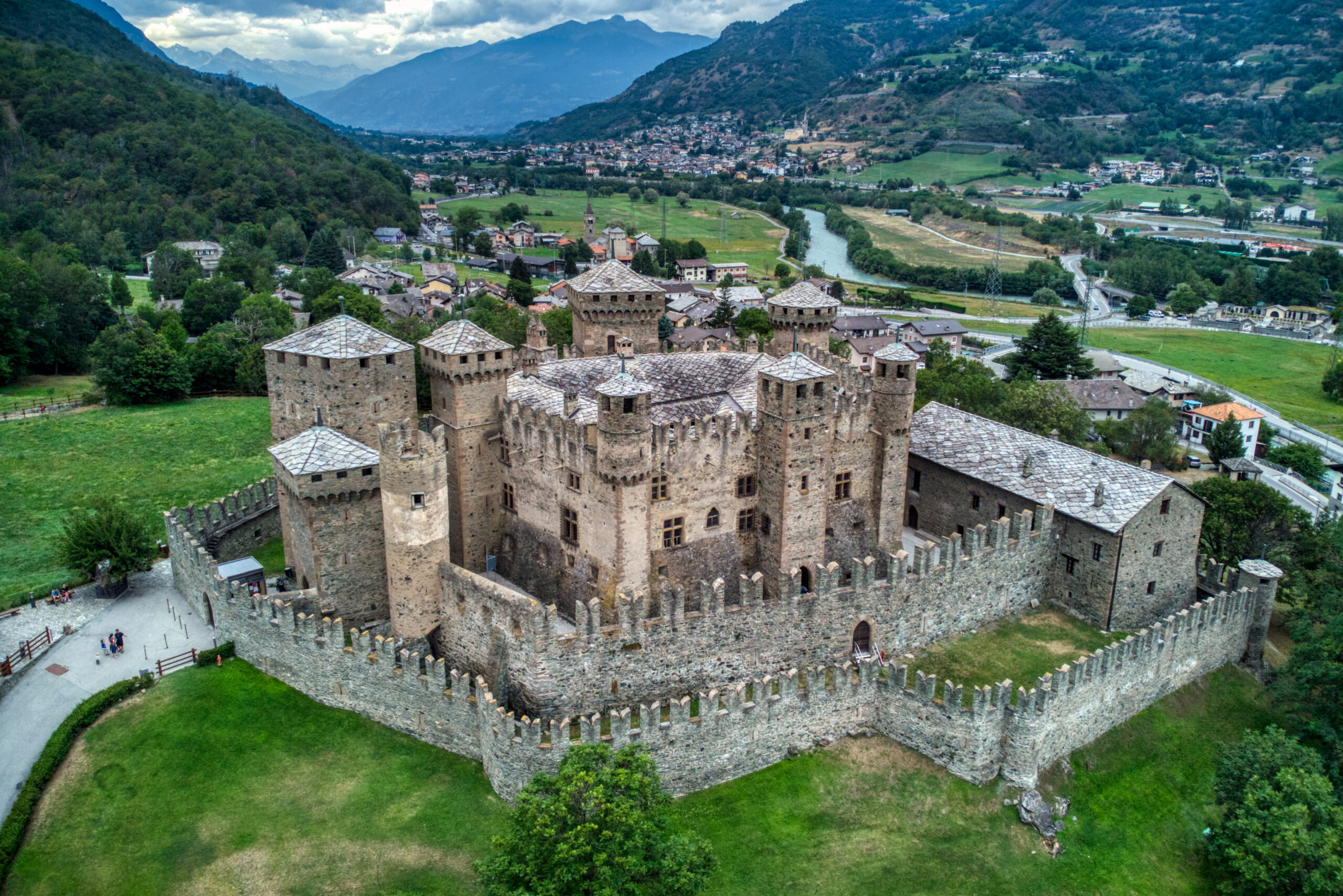
Fénis Castle in Val d’Aosta, presented in March 2019, stands as one of Italy’s best-preserved medieval fortifications, distinguished by its position on a gentle hill and elegant crenellated walls that suggest a function of representation rather than military defence.
Symbolic and Decorative Elements
The castle’s interior and walls contain multiple layers of symbolic meaning. Apotropaic masks—believed useful in driving away evil influences—appear throughout the structure. A fresco depicts Saint George slaying the dragon, a common medieval motif. The courtyard features a series of painted figures, each different from the others, holding parchments inscribed with proverbs and moral maxims in Old French, creating an atmosphere that evokes legendary tales of a distant past.
Architectural and Theatrical Design
The castle’s scenographic qualities distinguish it from purely defensive medieval structures. Its design emphasises representation and narrative over fortress function, with the surrounding landscape contributing to an overall sense of legendary storytelling rather than military pragmatism.
Film and Television Presence
The castle’s visual character has made it attractive to filmmakers. Various scenes of the film “Fracchia contro Dracula” and the television miniseries “La Freccia Nera” were shot within its walls, underscoring its distinctive architectural appeal.
On video
Frequently asked questions
What makes Fénis Castle architecturally significant?
Fénis Castle ranks among Italy’s best-preserved medieval castles and is distinguished by its elegant crenellated walls, position on a gentle hill, and emphasis on representational rather than purely defensive design.
What symbolic decorations appear in the castle?
The castle features apotropaic masks on its walls, a fresco of Saint George killing the dragon, and a courtyard with painted figures holding parchments inscribed with proverbs and moral maxims in Old French.
Sources
- S1 — Sereni, Emilio. Storia del paesaggio agrario italiano. Laterza, 1982. ISBN 978-88-420-2747-8.
- S2 — Barbera, Gioacchino. Dimore storiche ed eccellenze d'Italia. Sellerio, 2005. ISBN 978-88-389-1834-6.
Spotted an error? Write to editorial@culturalheritageonline.com and we correct it the same day.