
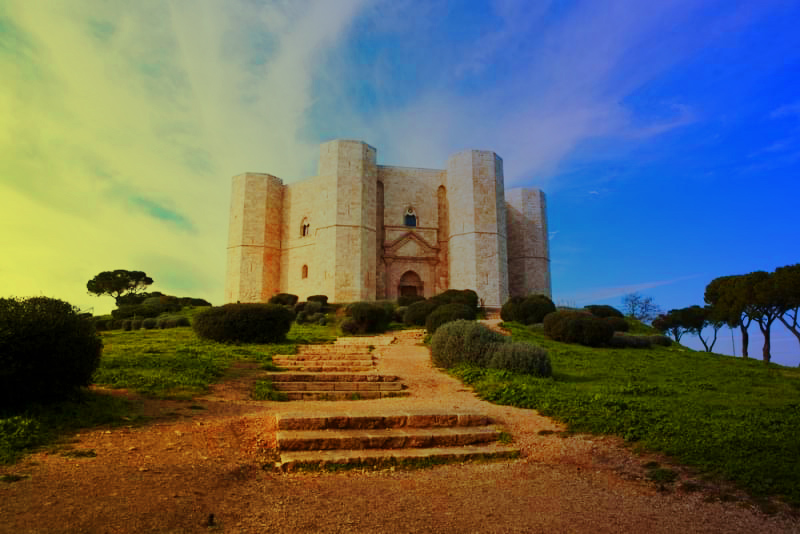
In March 2019, cultural heritage sources examined Castel del Monte, one of Italy’s most mysterious structures, located in the municipality of Andria in Puglia on a hill at 540 meters elevation. Built in the 13th century by Emperor Federico II, the fortress presents an octagonal plan with an octagonal turret at each corner.
An Unlikely Fortress
Despite its name, Castel del Monte exhibits none of the defensive characteristics typical of medieval castles. It has no moat or military architectural elements and does not occupy a strategically advantageous position. Its narrow spiral stairs would have been impractical for defense or escape, the loopholes are too narrow to shoot arrows from, and there are no stalls for horses or supplies. These absences have long puzzled historians about the structure’s true purpose.
Mathematical and Symbolic Design
The building appears to have been constructed according to precise mathematical and astronomical geometries while incorporating numerous symbolic elements. The unusual octagonal form itself seems to recall the shape of a crown, suggesting royal significance beyond simple military function.
A Royal Bathhouse Theory
Recent scholarship has proposed an alternative interpretation: that Castel del Monte functioned as a place for body care modeled on the Arabian hammam. This theory gains support from the structure’s multiple and ingenious water channeling and collection systems, extensive cisterns, and what are among the oldest bathing chambers in history. The building’s particular configuration and mandatory internal circulation path align more closely with this spa-like function than military defense.
Frequently asked questions
Who commissioned Castel del Monte?
Emperor Federico II commissioned the structure in the 13th century.
What are the building’s most distinctive features?
The octagonal plan with an octagonal turret at each corner, combined with sophisticated water systems, cisterns, and ancient bathing chambers, are its defining characteristics.
What is the current theory about its purpose?
Recent scholarship suggests it may have functioned as a royal bathhouse modeled on Arabian hammams rather than as a traditional military fortress.