
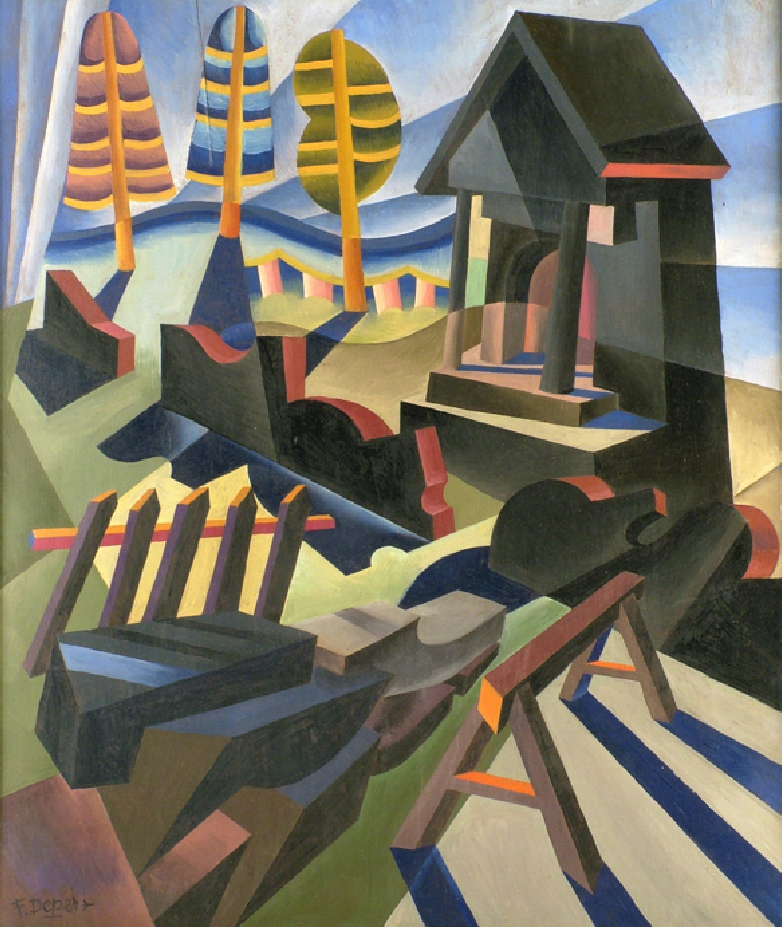
Pietre alpestri is a work by Italian futurist painter Fortunato Depero, created in 1934. The title translates as “Alpine Stones,” suggesting an engagement with landscape and natural form filtered through modernist abstraction.
Depero was a central figure in the futurist movement, having co-authored the manifesto Ricostruzione futurista dell’universo (Futurist Reconstruction of the Universe) with Giacomo Balla in 1915. That seminal text sought the abstract equivalent for all forms and elements of the universe, with the goal of making the world “more joyful” through integral recreation. By the 1930s, Depero’s practice encompassed painting, sculpture, graphic design, and stage design, reflecting the futurist ambition to dissolve boundaries between disciplines.
About Fortunato Depero
Depero was born in Trentino in 1892 and grew up in Rovereto, where he apprenticed to a marble worker before encountering futurism through an article by Filippo Tommaso Marinetti in 1913. He moved to Rome in 1914 and became one of the movement’s most prolific and versatile practitioners, working across visual and applied arts until his death in 1960.
Details
- Creator: Fortunato Depero
- Year: 1934
- Movement: Futurism
On video
Frequently asked questions
Who was Fortunato Depero?
Depero was an Italian futurist painter, sculptor, writer, and graphic designer born in Trentino in 1892. He co-authored a key futurist manifesto with Giacomo Balla in 1915 and worked across multiple artistic disciplines throughout his career.
What does the title mean?
Pietre alpestri translates from Italian as “Alpine Stones,” suggesting the work engages with natural landscape forms, interpreted through the abstract and dynamic language of futurism.
What was the futurist movement?
Futurism sought the abstract equivalent for all forms and elements of the universe, aiming to make the world “more joyful” through integral artistic recreation. Depero’s 1915 manifesto expanded upon ideas introduced by Filippo Tommaso Marinetti and other founding futurists.
Sources
- S1 — Pontiggia, Elena. Il Novecento Italiano. Abscondita, 2003. ISBN 978-88-8416-048-5.
- S2 — De Fusco, Renato. Storia del design. Laterza, 2002. ISBN 978-88-420-6623-1.
Spotted an error? Write to editorial@culturalheritageonline.com and we correct it the same day.


