
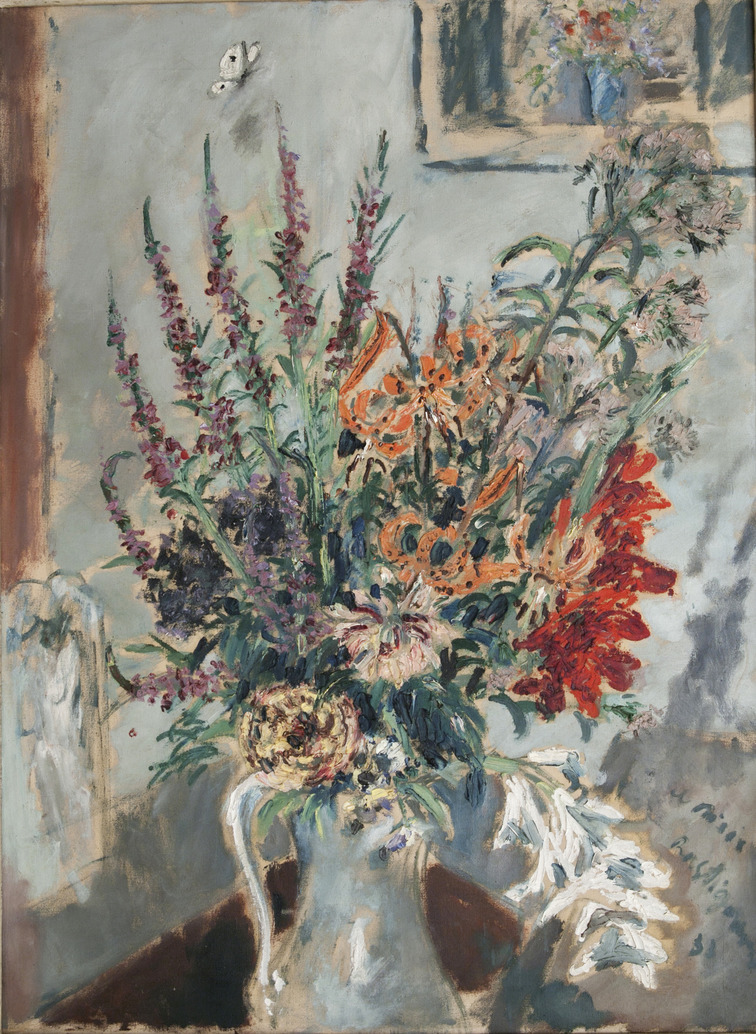
Vaso di fiori is a still life painting by Italian painter Filippo De Pisis, created in 1933. The work belongs to the category of floral studies for which De Pisis became best known throughout his artistic career.
De Pisis’s approach to still life, particularly his depictions of flowers, is marked by an airy immediacy and emotional intensity. His compositions often display unexpected juxtapositions of scale and space, creating a distinctive visual language that merges intimate domestic subjects with broader spatial ambiguity. The painting reflects De Pisis’s characteristic method of layering sensory observation with psychological depth, translating the sentimentality that defined his literary work into pictorial form.
About Filippo De Pisis
Filippo De Pisis (1896–1956) was an Italian painter and poet born in Ferrara. After studying literature and philosophy at the University of Bologna, he moved to Rome in 1919 and began his painting practice. Throughout his career, he developed a reputation for cityscapes, metaphysically-inspired maritime scenes, and still lifes. His work is characterized by an in-the-moment quality laden with what he himself described as a pathetic pleasure-pain—an emotional complexity that distinguished his output from his contemporaries.
Details
- Creator: Filippo De Pisis
- Year: 1933
- Subject: Still life with flowers
- Movement: Italian modern painting
On video
Frequently asked questions
What is Filippo De Pisis known for?
De Pisis is best known for his cityscapes, metaphysically-inspired maritime scenes, and still lifes, particularly those depicting flowers. His work is characterized by an airy, in-the-moment quality laden with emotional complexity.
Where did De Pisis spend his artistic life?
De Pisis spent his life between Rome, Paris, and Venice, developing his practice across these major European cultural centers.
What was De Pisis’s background before painting?
De Pisis studied literature and philosophy at the University of Bologna beginning in 1914 and published a collection of writings titled La città dalle 100 meraviglie in 1920 before establishing himself as a painter in Rome.
Sources
- S1 — Pontiggia, Elena. Il Novecento Italiano. Abscondita, 2003. ISBN 978-88-8416-048-5.
- S2 — Bossaglia, Rossana. Il Novecento italiano. Electa, 1995. ISBN 978-88-435-6178-0.
Spotted an error? Write to editorial@culturalheritageonline.com and we correct it the same day.


