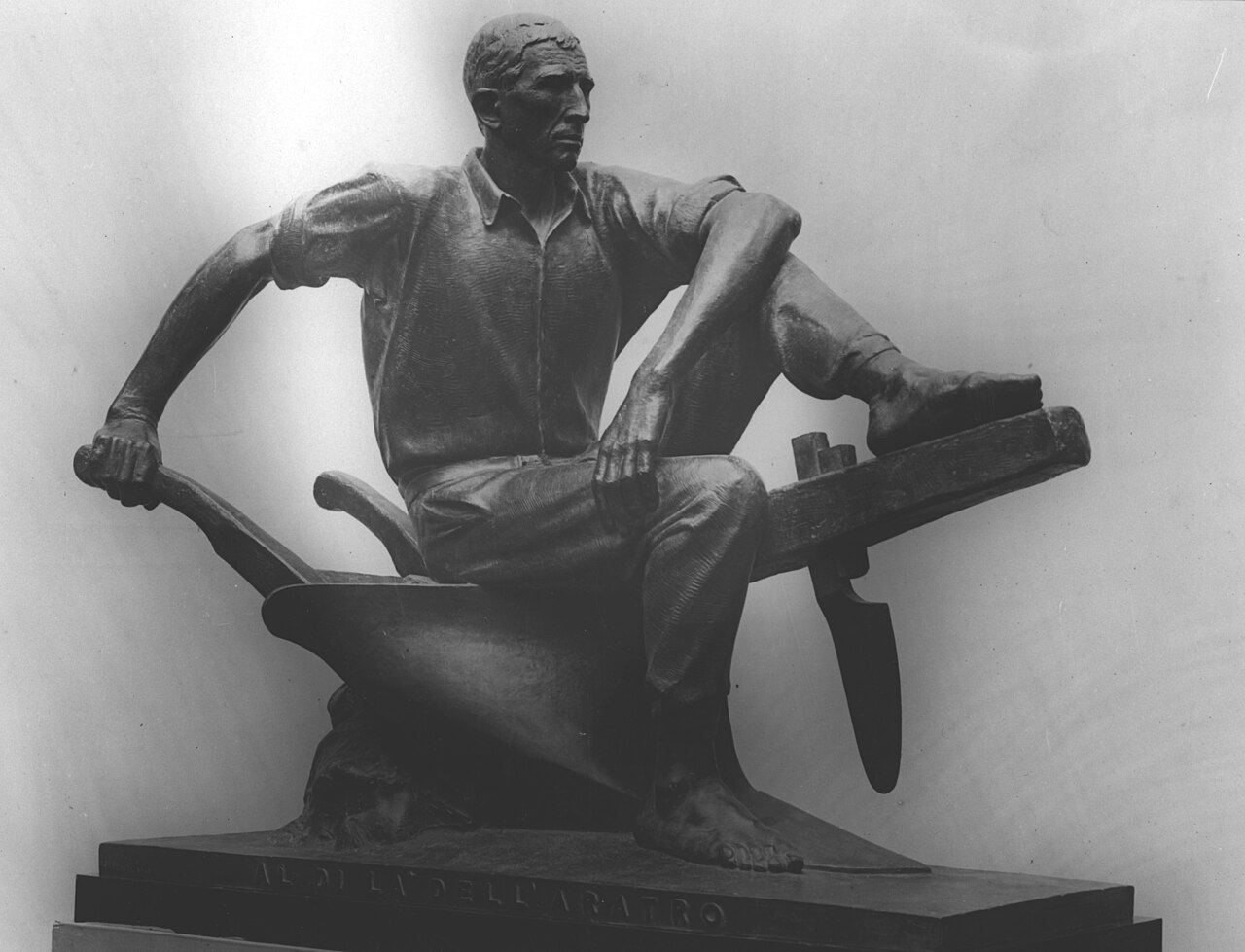
Al di là dell’aratro is a sculpture by Domenico Ponzi, created in 1937. The title—meaning “Beyond the Plough”—suggests a thematic engagement with labour and agrarian life, subjects central to Italian artistic discourse in the interwar period.
Ponzi was born in Ravenna in 1891 and trained at the Accademia Provinciale di Belle Arti di Ravenna from 1903. His early recognition came through his participation in Rome’s 1911 Universal Exposition, where he executed sculptural work for the Emilian-Romagnol Pavilion. Based in Rome during military service, he developed his practice within the contexts of early twentieth-century Italian modernism. He remained active as a sculptor until his death in Anticoli Corrado in 1973.
About Domenico Ponzi
Ponzi’s career spanned seven decades, from the Belle Époque through the post-war period. His training in provincial Ravenna and subsequent engagement with Rome’s artistic institutions positioned him within the broader currents of Italian sculpture, where questions of form, figuration and social subject matter occupied practitioners across multiple movements and decades.
Details
- Creator: Domenico Ponzi (1891–1973)
- Year: 1937
- Medium: Sculpture
- Region: Italy
Frequently asked questions
Who was Domenico Ponzi?
Domenico Ponzi was an Italian sculptor born in Ravenna in 1891. He trained at the Accademia Provinciale di Belle Arti di Ravenna from 1903 and gained early recognition through his work at the 1911 Universal Exposition in Rome, where he remained based and active until his death in 1973.
What is the subject of this sculpture?
The title Al di là dell’aratro translates as “Beyond the Plough,” suggesting a thematic engagement with labour and agrarian subjects, which were significant in Italian artistic practice during the 1930s.
When was this work created?
The sculpture dates to 1937, a period in which Ponzi was an established practitioner within Italian modernist sculptural traditions.
Sources
- S1 — Panzetta, Alfonso. Nuovo dizionario degli scultori italiani dell'Ottocento e del primo Novecento. AdArte, 2003. ISBN 978-88-422-1158-7.
- S2 — Pontiggia, Elena. Il Novecento Italiano. Abscondita, 2003. ISBN 978-88-8416-048-5.
Spotted an error? Write to editorial@culturalheritageonline.com and we correct it the same day.