
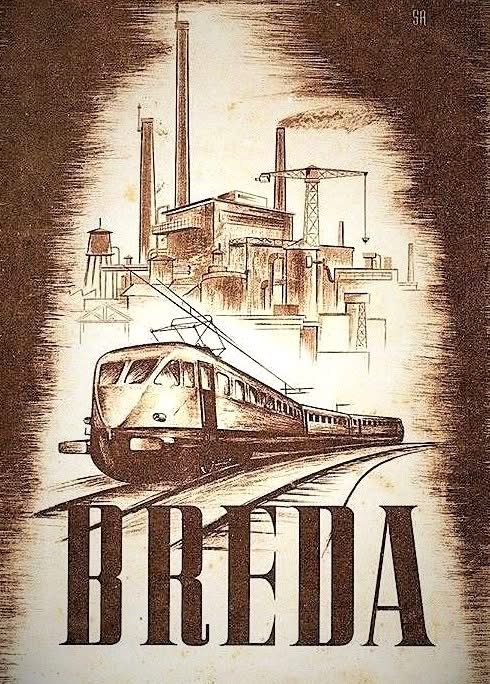
A factory skyline in silhouette, chimneys and cranes and a water tower, and beneath it, running out of the drawing toward the reader, a single streamlined train. Under both, in letters as tall as the locomotive itself: BREDA. The sheet makes its argument in one image — the works and the train are the same name — and the train is not a generic one. It is the shape that made Breda’s own reputation in the 1930s: the ETR.200, the fastest thing on Italian rails.
A company that made everything, and one thing it made best
The Società Italiana Ernesto Breda per Costruzioni Meccaniche was founded at Milan in 1886 by Ernesto Breda, an engineer from the province of Padua. By the 1930s it was one of the largest industrial groups in Italy, working across mechanical engineering — railway rolling stock, aircraft, lorries, machine tools, agricultural and construction machinery — and across steelmaking, metallurgy, shipbuilding and armaments. A firm that size advertised many things. This sheet is about the one that made the front pages: a train fast enough to be a matter of national pride.
The ETR.200
In 1936 Breda delivered the first six units of a new electric train, numbered ETR.201 to ETR.206 — the name stands for Elettro Treno Rapido. Each set was built as two identical driving cars with a third, intermediate car between them, mounted on four bogies with full aerodynamic fairing and streamlined covers over the joints between cars. The design’s sharply raked, rounded front end was as much a statement of intent as an aerodynamic feature: this train was built to be looked at as well as to go fast. It entered regular service on 21 April 1937, and it was widely judged, at the time, to be among the most handsome trains running anywhere in Europe — handsome enough that Benito Mussolini had one shipped to New York to be shown at the 1939 World’s Fair.
The reputation was not only for looks. On 20 July 1939, unit ETR.212, driven by Alessandro Cervellati, ran between Florence and Milan and reached 203 km/h on the stretch between Pontenure and Piacenza, at an average of 165 km/h for the whole run — a world speed record for the time, and the fact that has followed the ETR.200 into every account of it since.
The train today
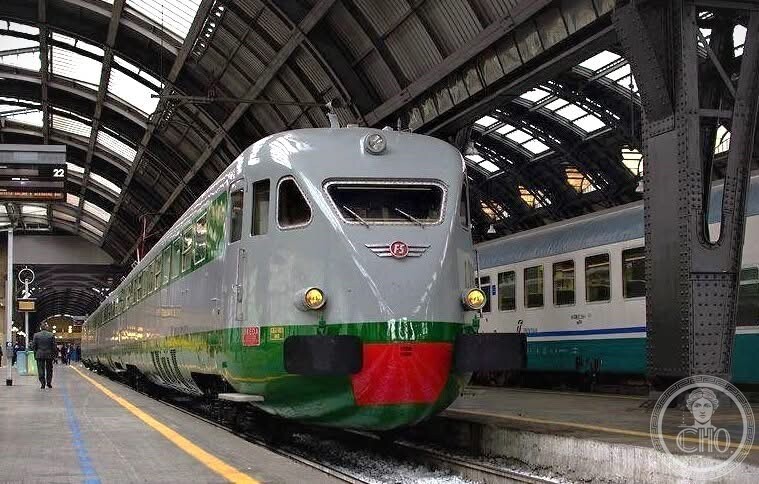
Streamlined trains of the 1930s do not, as a rule, survive as working machines; most were scrapped, rebuilt beyond recognition, or retired long before anyone thought to keep one intact. Examples of the type have been preserved and restored by Italy’s railway heritage operations and are occasionally seen again at major stations, still in a livery of grey, green and red that recalls the original scheme — a rare case of a 1930s Italian design that a passenger today can still stand beside on a real platform, rather than only in a photograph.
What is not settled
The advertising sheet itself carries no signature, no date and no printer’s line, in keeping with the practice across this whole run of Breda material: the company name and the drawing are all it offers, and we have not been able to attach a firm date to the printing beyond the general period the train itself belongs to. The specific identity of the preserved unit in the second photograph — its running number, and which body currently maintains it — has not been confirmed and is not asserted here.
About the advertising sheet. The work is still protected by copyright: under Italian law (L. 633/1941) rights run for 70 years from the death of the author. Since the author has not been identified, that term cannot be considered expired, and the image is treated as fully protected. It is reproduced here for documentation, study and critical purposes only, under Art. 70 of L. 633/1941 and the fair-use provision of 17 U.S.C. §107. It is not offered for sale, no reproduction rights are granted, and any request concerning the work should be addressed to the rights holders. Cultural Heritage Online publishes this material to document it, with no celebratory intent; see our terms and the DMCA contact published there.
Sources
- Società Italiana Ernesto Breda per Costruzioni Meccaniche — foundation at Milan in 1886 and the sectors the group worked in.
- Elettrotreno FS ETR.200 — delivery of the first units in 1936, entry into service on 21 April 1937, the New York World’s Fair exhibit, and the 203 km/h record run of 20 July 1939.
- The advertising sheet itself, for the wordmark and the subject.
- Luigi De Marchi, who photographed the preserved railcar.