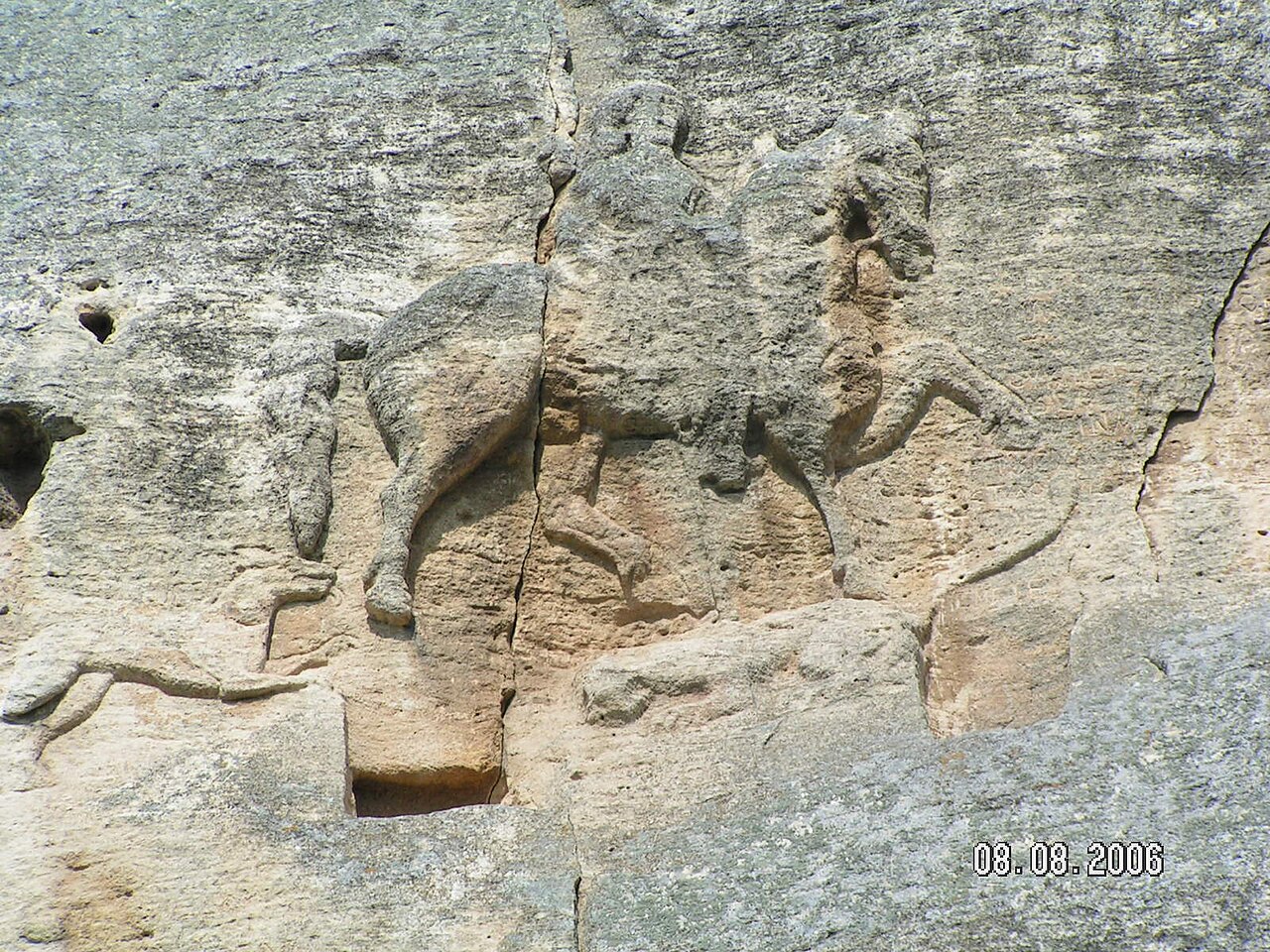
The Madara Rider is a 23-metre bas-relief carved into the face of a 100-metre limestone cliff near the village of Madara in Shumen Province, northeastern Bulgaria, created around 705–710 CE by Khan Tervel of the First Bulgarian Empire to commemorate his defeat of the Byzantine Emperor Justinian II. UNESCO inscribed it in 1979, making it one of the earliest sites on the World Heritage List and the only large-scale rock relief in Europe from the early medieval period. Three sets of Greek inscriptions flanking the figure — dated to 705, 731, and 822 CE — make it a unique documentary monument to the first century of Bulgarian statehood.
The Carving, the Inscriptions and the First Bulgarian Empire Northeastern Bulgaria · Shumen Province
The Madara Rider shows a mounted horseman at full gallop, his right arm raised and a lance or spear directed downward at a lion prostrate beneath the horse’s front hooves. A dog runs close behind the horse. The composition is carved in low relief into the smooth limestone face of a cliff on the western edge of the Madara Plateau, approximately 17 kilometres east of the town of Shumen. The carving sits roughly 23 metres above the plateau floor and can be reached by a path and stairway ascending the cliff; closer inspection reveals that the weathering of the soft limestone has significantly eroded the detail of the composition since it was created, though its main elements remain legible.
The attribution of the relief to Khan Tervel and the period 705–710 CE rests on the Greek inscription immediately adjacent to the horseman. The inscription, fragmentary but partially readable, refers to victories over enemies and the favour of God, and names the ruler who commissioned it. Tervel is historically significant as the Bulgarian khan who provided military assistance to the Byzantine Emperor Justinian II during his exile, allowing Justinian to recapture Constantinople in 705 CE; in exchange, Tervel received recognition of Bulgarian territorial control and the title of Caesar, the first such title granted to a non-Byzantine ruler. The carving may have been intended partly to commemorate this alliance and partly to assert Bulgarian prestige at a moment when the young Bulgarian state was establishing its identity in relation to the Byzantine Empire.
The second and third sets of inscriptions flank the relief at different heights. The second, dated to 731 CE, appears to record military victories by Khan Kormesiy and uses the relief as a surface on which to add a further layer of Bulgarian historical memory. The third, from 822 CE, is the most extensively preserved of the three and dates to the reign of Khan Omurtag, who was also responsible for constructing important architectural monuments and for a significant expansion of Bulgarian administrative infrastructure during his reign. The fact that three successive khans chose to use the Madara cliff as a commemorative surface over more than a century suggests that the site held a significance — perhaps pre-Bulgarian, perhaps connected to earlier Thracian or Byzantine use of the plateau — that made it a natural location for assertions of dynastic continuity and political legitimacy.
The Madara Plateau itself bears traces of occupation from the Neolithic period through the Thracian Iron Age, the Roman period, and early Byzantine settlement. A Thracian cave sanctuary near the base of the cliff appears to have been in use well before the Bulgarian carving was made, and Roman-period finds from the plateau — ceramics, architectural fragments, and the foundations of a small settlement — indicate that the site’s elevated position and its water supply made it attractive across different political eras. The Bulgarian state’s adoption of this pre-existing sacred and administrative landscape as the location for its founding monument was almost certainly deliberate.
The Madara Plateau, Shumen and the Medieval Bulgarian Landscape Shumen · 17 km from the Rider
The town of Shumen, 17 kilometres west of Madara, provides the practical base for visiting the Madara Rider and is itself home to two significant monuments that extend the medieval Bulgarian heritage context of the region. The Shumen Fortress occupies a prominent hill east of the town and preserves the remains of a fortified settlement with layers of occupation from the 4th century BCE through the 18th century CE. The fortress’s most substantial visible remains date to the early Bulgarian period and the later medieval Bulgarian kingdom, with sections of defensive wall, gate structures, and the foundations of residential and ecclesiastical buildings visible within the site.
The second Shumen monument is the Founders of the Bulgarian State Memorial, a concrete monument inaugurated in 1981 on the occasion of the 1,300th anniversary of the founding of the First Bulgarian Empire. The monument is a product of its time — a vast, abstractly sculpted complex rising on a hill above Shumen, combining figurative reliefs of Bulgarian khans and tsars with boldly geometric architectural forms in a style that reflects both Soviet-era monumental aesthetics and genuine ambition. It is striking, controversial, and now itself a document of the Bulgarian socialist period as well as of the medieval history it commemorates. The long concrete stairway ascending the hill is one of the defining experiences of a visit to Shumen.
The wider region around Madara and Shumen is part of the historical core of the First Bulgarian Empire. The medieval capital of Pliska, approximately 20 kilometres north of Shumen, was Bulgaria’s first capital following the establishment of the state in 681 CE and contains the foundations of an extensive palace complex, the Great Basilica (one of the largest churches in the medieval Balkans), and sections of the inner and outer fortification walls. The site museum at Pliska holds a significant collection of finds from the excavations. The second Bulgarian capital, Preslav (Veliki Preslav), approximately 20 kilometres south of Shumen, succeeded Pliska as the imperial capital in 893 CE and contains the remains of a palace complex, circular church, and workshops that produced the distinctive Preslav ceramic school — painted pottery tiles used in architectural decoration that represent a high point of early medieval Bulgarian craftsmanship.
Neither Pliska nor Preslav is currently a UNESCO World Heritage Site, despite repeated proposals and scholarly arguments for their inscription. They are, however, protected as national cultural monuments of exceptional significance and are actively excavated and presented to visitors. For anyone with an interest in early medieval Balkan history, the combination of the Madara Rider, Pliska, and Preslav within a compact geographic area makes the Shumen region the single most significant landscape of Bulgarian state formation in existence.
Further afield, the Thracian Tomb of Kazanlak, approximately 200 kilometres south in the Rose Valley, is the nearest UNESCO World Heritage Site to Madara. Inscribed in 1979 alongside the Madara Rider, it contains the finest surviving Hellenistic-period Thracian funerary paintings in Bulgaria, dated to the 3rd or 4th century BCE. The Boyana Church in Sofia (320 km southwest) and the Rila Monastery (430 km southwest) complete the Bulgarian UNESCO portfolio and represent later medieval and post-medieval periods of Bulgarian cultural history.
Practical information
The Madara Rider is reached from Shumen, which is served by regular train and bus connections to Sofia (approximately 5 hours by train), Varna on the Black Sea coast (approximately 1.5 hours), and other Bulgarian cities. From Shumen, bus services run to Madara village; the journey takes roughly 30 minutes. The site is a short walk from the village. A small museum and visitor centre at the site provides historical context; a stairway and viewing platform allow close approach to the cliff face. An entrance fee applies. From the plateau above the cliff, reached by a separate path, there are extensive views over the northeastern Bulgarian plain and the Shumen valley. The site is open year-round, though the path to the plateau may be slippery after rain. Spring (April–May) and early autumn (September–October) offer the most comfortable visiting conditions. Shumen has a reasonable range of accommodation. Varna, 90 kilometres east on the Black Sea, is a larger city with more extensive hotel options and an international airport with seasonal direct flights from European destinations.
Frequently Asked Questions
Who carved the Madara Rider and what does the composition mean?
The Madara Rider was carved on the orders of Khan Tervel of the First Bulgarian Empire, most likely between 705 and 710 CE, following his military and diplomatic victories over the Byzantine Empire. The attribution is supported by the Greek inscription immediately adjacent to the carving, which names the ruler and refers to events consistent with Tervel’s reign. The composition — a mounted horseman spearing a lion, with a dog at the horse’s heels — belongs to a tradition of royal iconography that was widespread across the ancient and medieval Near East and that the Bulgarians would have known through contact with Byzantine and earlier Thracian visual culture. The lion beneath the horse’s hooves conventionally represents an enemy defeated or a power overcome; the hunting imagery connects the ruler to themes of sovereignty, courage, and divine favour that cross multiple cultural traditions. The dog is a recurring element in such compositions, sometimes interpreted as a symbol of loyalty or of the successful hunt. The Madara carving is unusual in combining this conventional iconographic vocabulary with specific historical inscriptions, making it simultaneously a symbolic assertion of royal power and a documentary monument recording specific historical events. Two subsequent khans — Kormesiy in 731 CE and Omurtag in 822 CE — added their own inscriptions to the cliff, using the earlier carving as a legitimising backdrop for their own commemorative claims.
Why is the Madara Rider on the Bulgarian currency?
The Madara Rider appears on the reverse of the 1 stotinka, 2 stotinka, 5 stotinka, 10 stotinka, 20 stotinka, and 50 stotinka euro-candidate coins minted in Bulgaria for eventual Eurozone entry, as well as on the obverse of earlier Bulgarian lev coinage. It was chosen because it is the founding monument of the Bulgarian state — the oldest surviving large-scale artwork created by Bulgarians as Bulgarians, commissioned at the moment when the First Bulgarian Empire was establishing its identity and asserting its legitimacy relative to the Byzantine Empire. Its appearance on currency is part of a broader pattern in Bulgarian national culture that treats the Madara Rider as the visual emblem of Bulgarian historical continuity, alongside the Cyrillic alphabet (created in the same early medieval Bulgarian cultural sphere) and the Rila Monastery. The UNESCO inscription in 1979 reinforced this status by placing the monument within a framework of global as well as national heritage significance. The site was among the very first UNESCO inscriptions worldwide, predating the modern systematic nomination process, which gives it an additional historical significance within the World Heritage system itself.
What other Bulgarian UNESCO World Heritage Sites can be visited from Shumen?
Bulgaria has nine UNESCO World Heritage Sites, and the Shumen region sits in the northeastern part of the country, which is not the most densely inscribed area. The nearest inscribed site to Madara is the Thracian Tomb of Kazanlak, approximately 200 kilometres to the southwest in the Stara Zagora region, inscribed in 1979 alongside the Madara Rider in the same UNESCO session. The Kazanlak tomb is significant for its richly painted Hellenistic-period funerary chamber, dated to the 3rd or 4th century BCE, showing a Thracian feast scene with figures of outstanding quality. Further southwest, the Boyana Church on the outskirts of Sofia (approximately 320 km from Shumen) contains 13th-century frescoes considered among the finest medieval paintings in eastern Europe. The Rila Monastery, approximately 430 km southwest, is the most visited heritage site in Bulgaria and the largest and most significant Eastern Orthodox monastery in the country. The Ivanovo Rock Monasteries and the Sveshtari Thracian Tomb are both located in the northeastern Bulgarian region, roughly 100–150 km from Shumen, and while they are Bulgarian cultural monuments, their UNESCO status should be confirmed before planning a heritage circuit around them.