
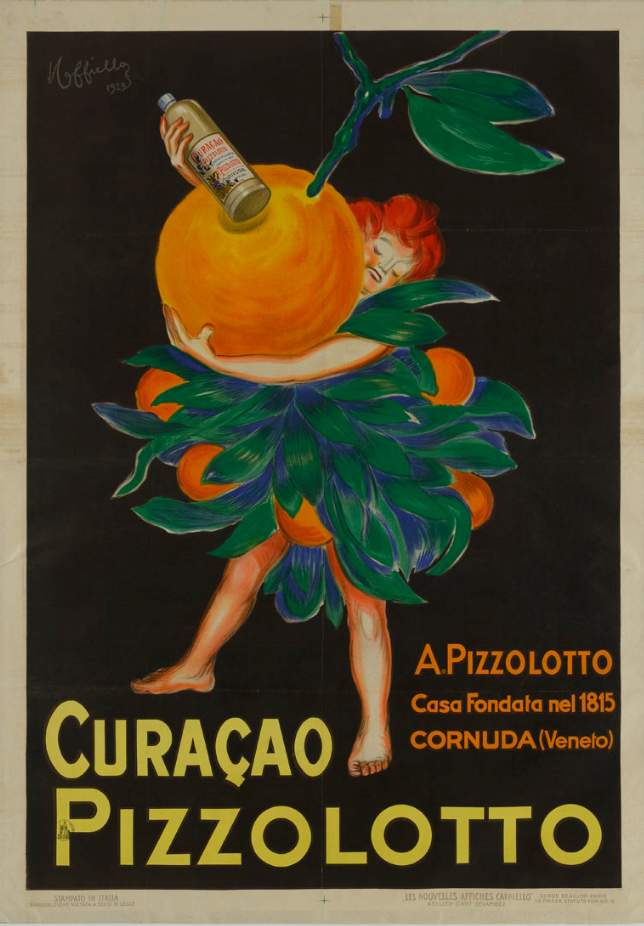
An advertising poster designed by Leonetto Cappiello in 1923. Cappiello was an Italian and French poster art designer whose innovations in advertising imagery earned him recognition as a founding figure in modern advertising design.
Cappiello’s approach marked a decisive break with the painterly tradition of nineteenth-century poster art. Where earlier designers such as Jules Chéret and Hugo D’Alesi worked within a decorative, illustrative mode, Cappiello developed a graphic language of bold, abstracted figures set against dark backgrounds. This stark contrast between form and ground created an arresting visual impact, making his work a template for twentieth-century commercial design. His method prioritized clarity and immediate visual impact—qualities essential to advertising’s commercial purpose.
About Leonetto Cappiello
Cappiello spent much of his career in Paris, where he developed and refined his distinctive poster aesthetic. His work as a painter and graphic designer established principles that would shape advertising art across Europe and beyond, earning him the epithet ‘father of modern advertising’.
Details
- Creator: Leonetto Cappiello
- Year: 1923
- Object type: Advertising poster
- Movement: Modern poster design
On video
Frequently asked questions
Who was Leonetto Cappiello?
Leonetto Cappiello was an Italian and French poster artist and painter who revolutionized advertising design through bold figural composition and high-contrast backgrounds, earning him recognition as a pioneer of modern advertising.
What made Cappiello’s poster design innovative?
Cappiello was the first major poster artist to use bold figures popping out of black backgrounds, creating a startling visual contrast that departed from the painterly tradition of earlier poster designers and became a template for modern advertising art.
Where did Cappiello work?
Cappiello mainly lived and worked in Paris, where he developed his distinctive approach to poster design over a long and influential career.
Sources
- S1 — Menegazzi, Luigi. Il manifesto italiano: 1882-1925. Electa, 1995. ISBN 978-88-435-5134-7.
- S2 — De Fusco, Renato. Storia del design. Laterza, 2002. ISBN 978-88-420-6623-1.
Spotted an error? Write to editorial@culturalheritageonline.com and we correct it the same day.


