
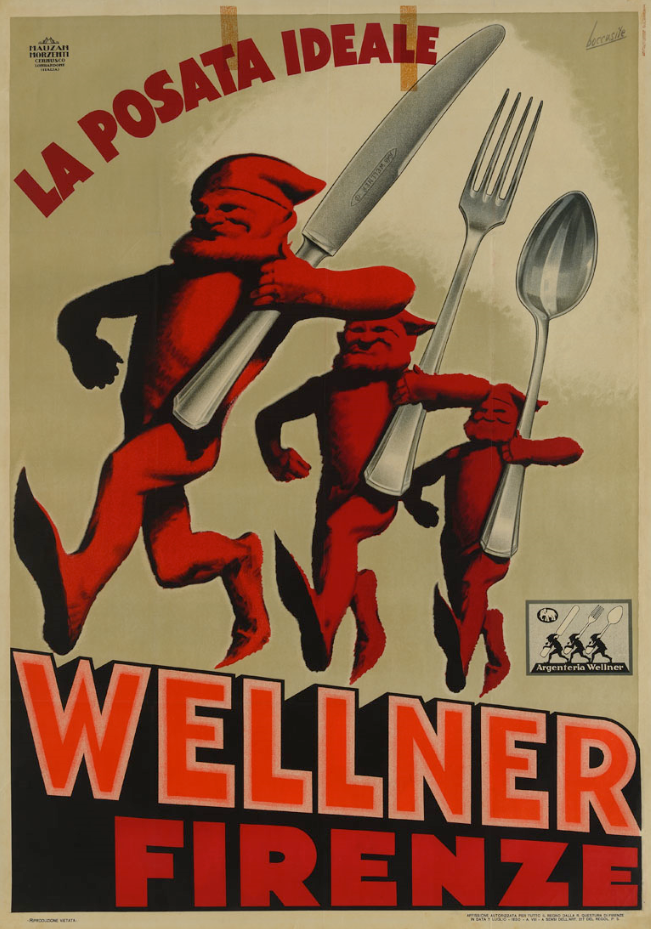
An advertising poster created by Gino Boccasile in 1930. Boccasile was one of the most important poster artists of the Fascist era, known for his distinctive graphic design and illustrations.
Born in Bari in 1901, Boccasile moved to Milan in 1925 following his father’s death and quickly established himself in the design field. Working with the Mauzan-Morzenti Agency, he produced posters and illustrated fashion magazines, earning recognition for his bold visual compositions and renderings of the female form. In 1932, he relocated to Paris, where his work was celebrated at the Salon des Indépendants. Upon his return to Milan, he founded the publicity agency ACTA in Galleria del Corso with Franco Aloi.
About Gino Boccasile
Boccasile (1901–1952) was a prolific Italian graphic designer whose career spanned the interwar period and beyond. Despite losing sight in his left eye early in life, he became one of Italy’s most sought-after poster artists, combining commercial acumen with refined visual sensibility. His work bridged advertising design, fashion illustration, and fine art.
Details
- Creator: Gino Boccasile
- Year: 1930
- Object type: Advertising poster
- Movement: Italian graphic design, Fascist era
On video
Frequently asked questions
Who was Gino Boccasile?
Gino Boccasile (1901–1952) was an Italian illustrator and graphic designer born in Bari. He became one of the most important poster artists of the Fascist era and was celebrated for his fashion illustrations and sensuous graphic style.
Where did Boccasile work during the 1930s?
After establishing himself in Milan at the Mauzan-Morzenti Agency, Boccasile moved to Paris in 1932, where his work was featured at the Salon des Indépendants. He returned to Milan and opened the publicity agency ACTA with Franco Aloi.
What characterized Boccasile’s poster design?
Boccasile was known for his bold graphic compositions and sensuous renderings, particularly of the female form. His work combined commercial advertising demands with refined illustrative technique, making him a leading figure in interwar Italian graphic design.
Sources
- S1 — Menegazzi, Luigi. Il manifesto italiano: 1882-1925. Electa, 1995. ISBN 978-88-435-5134-7.
- S2 — De Fusco, Renato. Storia del design. Laterza, 2002. ISBN 978-88-420-6623-1.
Spotted an error? Write to editorial@culturalheritageonline.com and we correct it the same day.


