
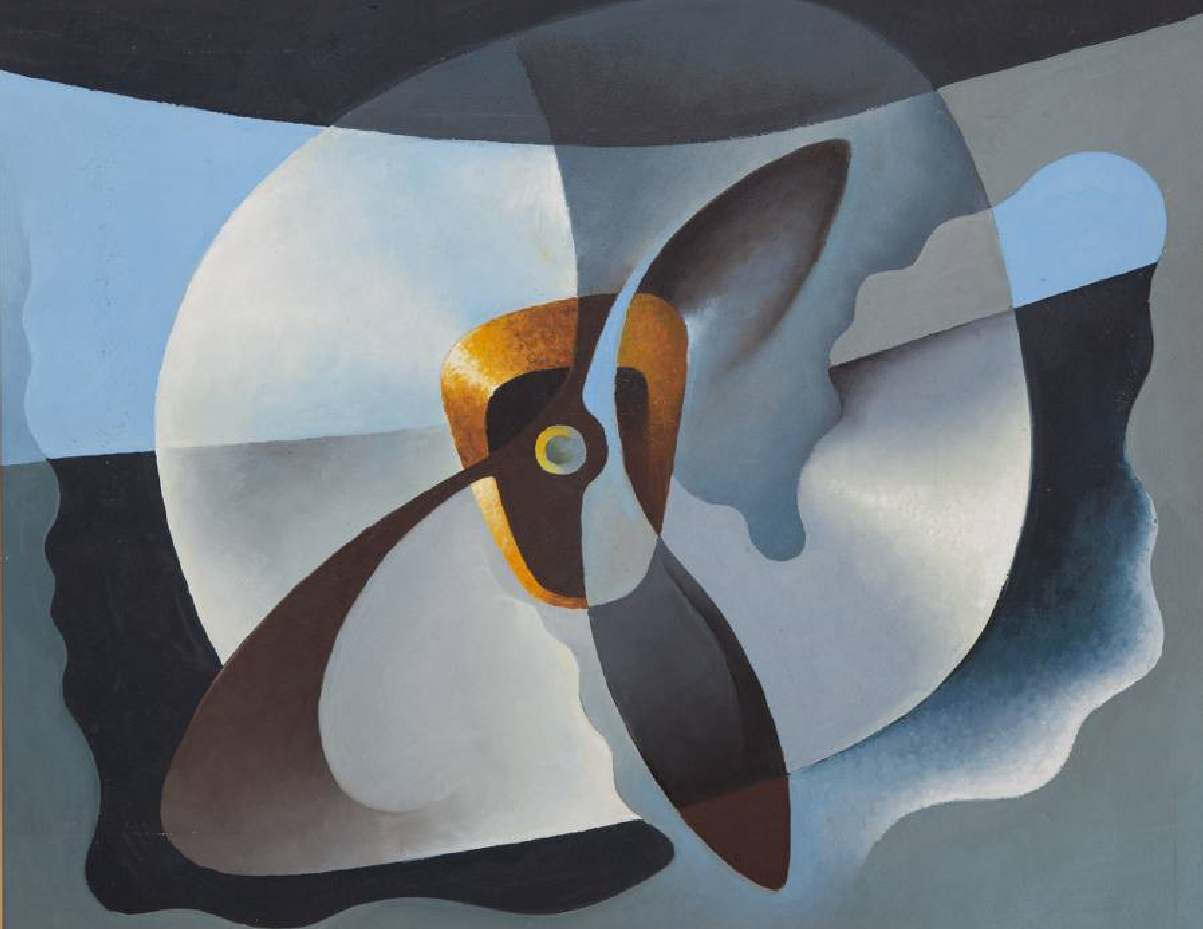
Motori in panne is a painting created by Tullio Crali in 1931. The work exemplifies the artist’s engagement with Futurism, a movement he joined in 1929 after establishing himself as a self-taught painter.
Crali’s practice centres on realistic depictions that synthesise speed, aerial mechanisation, and the mechanics of aerial warfare—subjects that define much of his contribution to the Futurist aesthetic. His work documents the fascination with modern flight and mechanical systems that animated avant-garde art of the interwar period. Though Crali remained committed to these themes throughout his early career, his artistic output ultimately encompassed a wider range of styles.
About Tullio Crali
Tullio Crali was a Dalmatian Italian artist whose involvement with Futurism began relatively late in the movement’s trajectory. Working without formal training, he developed a distinctive approach to depicting aviation and mechanical subjects with documentary precision, grounding the movement’s rhetoric of dynamism in recognisable imagery of modern technology and flight.
Details
- Title: Motori in panne
- Artist: Tullio Crali
- Year: 1931
- Movement: Futurism
- Medium and subject: Realistic painting exploring aviation and mechanical themes
On video
Frequently asked questions
Who was Tullio Crali?
Tullio Crali was a self-taught Dalmatian Italian artist and a late adherent to Futurism, joining the movement in 1929. He became known for realistic paintings combining speed, aerial mechanisation and the mechanics of aerial warfare.
What subjects did Crali typically paint?
Crali specialised in realistic depictions of aviation and mechanical systems, exploring themes of speed and aerial mechanisation. Though these subjects dominated his early work, he painted in various styles throughout his career.
When did Crali join the Futurist movement?
Crali joined Futurism in 1929, making him a relatively late adherent to the avant-garde movement that had emerged in the early twentieth century.
Sources
- S1 — Pontiggia, Elena. Il Novecento Italiano. Abscondita, 2003. ISBN 978-88-8416-048-5.
- S2 — Bossaglia, Rossana. Il Novecento italiano. Electa, 1995. ISBN 978-88-435-6178-0.
Spotted an error? Write to editorial@culturalheritageonline.com and we correct it the same day.


