
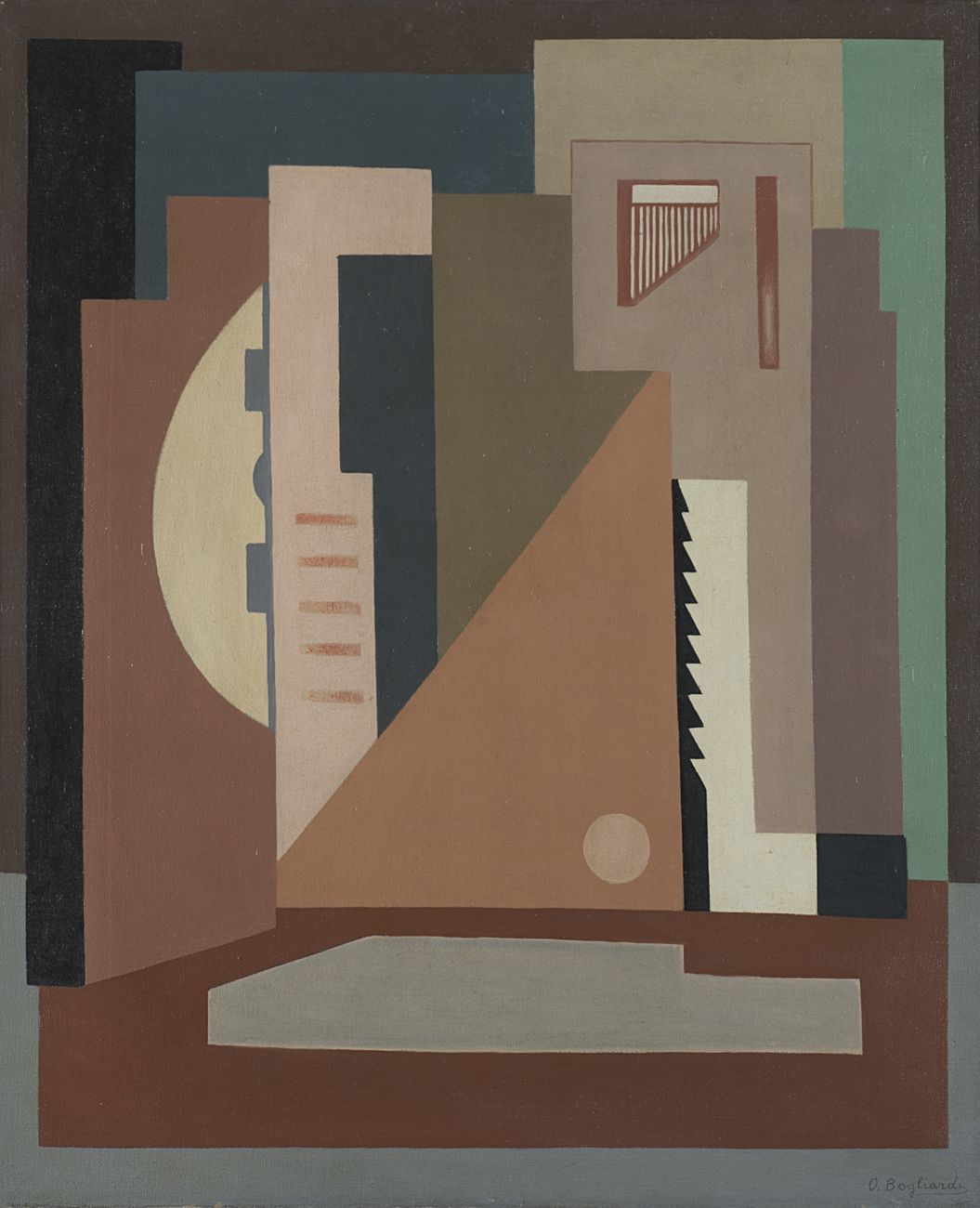
Composizione n.10 is an abstract painting by Oreste Bogliardi, created in 1934. The work dates from a watershed moment in Italian modernism, when Bogliardi and fellow artists Virginio Ghiringhelli and Mauro Reggiani co-signed the manifesto for Italy’s first collective exhibition of abstract painters that November.
Bogliardi had returned to Milan in 1926 following time in Paris, becoming an active participant in the struggle for modern Italian art through the circle that gathered around Galleria del Milione. By 1935, he and the small group of Italian abstractionists joined the international movement Abstraction-Création based in Paris, positioning Italian abstraction within broader European modernist currents. The painting exemplifies the geometric and non-representational vocabulary that defined this pioneering phase of Italian abstract art in the interwar period.
About Oreste Bogliardi
Oreste Bogliardi (1900–1968) was an Italian painter who studied at the Accademia di Brera, completing his training in 1924. He became instrumental in championing abstract art in Italy during the 1930s and exhibited widely throughout his career in Milan, Rome, Genoa and Rapallo. After the war, his work was recognized in major exhibitions including the 1966 Venice Biennale and the 1967 retrospective at Palazzo Strozzi in Florence, where he received the Fiorino d’Oro award.
Details
- Creator: Oreste Bogliardi
- Year: 1934
- Movement: Italian abstraction, Abstraction-Création (from 1935)
- Context: Co-signed manifesto for first Italian abstract painters’ collective, November 1934
Frequently asked questions
Who was Oreste Bogliardi?
An Italian painter (1900–1968) trained at the Accademia di Brera who became a key figure in promoting abstract art in Italy during the 1930s, working closely with Galleria del Milione in Milan.
What movement does this work represent?
The composition exemplifies early Italian abstraction, created in the year Bogliardi and others co-signed the manifesto launching Italy’s first collective exhibition of abstract painters. By 1935, he joined the international Abstraction-Création movement.
How was this work recognized later?
Bogliardi’s contributions to abstract art were acknowledged in major postwar exhibitions, including the 1966 Venice Biennale and the 1967 retrospective at Palazzo Strozzi in Florence, where he received the Fiorino d’Oro award.
Sources
- S1 — Pontiggia, Elena. Il Novecento Italiano. Abscondita, 2003. ISBN 978-88-8416-048-5.
- S2 — Bossaglia, Rossana. Il Novecento italiano. Electa, 1995. ISBN 978-88-435-6178-0.
Spotted an error? Write to editorial@culturalheritageonline.com and we correct it the same day.


