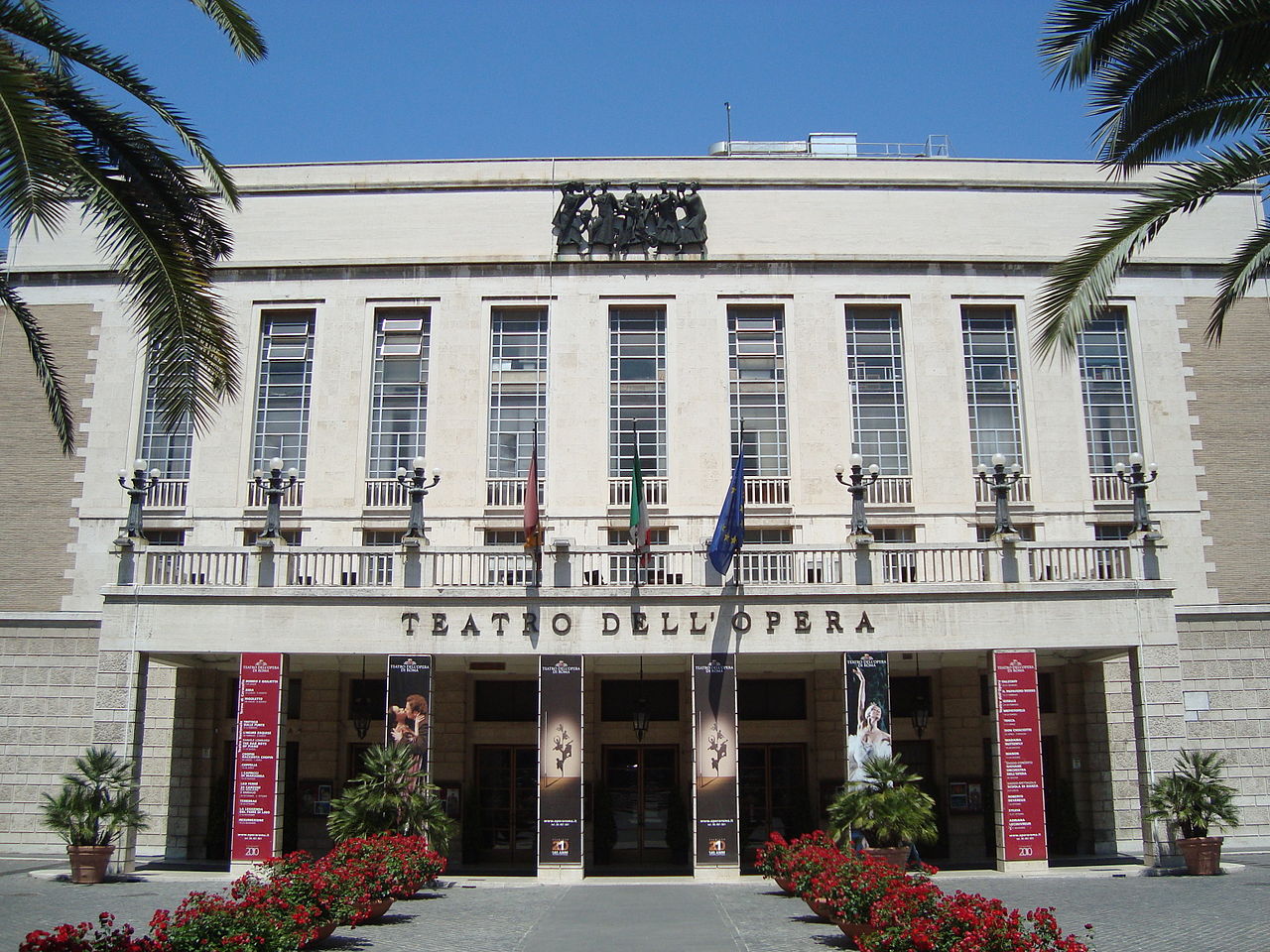
The Teatro dell’Opera di Roma, designed by Milanese architect Achille Sfondrini and financed by contractor Domenico Costanzi, opened in November 1880 as the Teatro Costanzi. Built in eighteen months on the site of the ancient house of Heliogabalus, the opera house was inaugurated on 27 November 1880 with a performance of Rossini’s Semiramide.
Sfondrini paid particular attention to acoustical design, conceiving the interior as a resonance chamber. The original structure featured a distinctive horseshoe shape, three tiers of boxes, an amphitheatre, and two galleries topped by a dome with frescoes by Annibale Brugnoli. The theatre originally seated 2,212 patrons.
About Achille Sfondrini
Sfondrini was a Milanese architect specialising in theatre design and renovation. His work on the Teatro Costanzi represents a significant achievement in late-nineteenth-century Italian theatrical architecture.
Details
- Architect: Achille Sfondrini (1836–1900)
- Financer and contractor: Domenico Costanzi (1819–1898)
- Opened: 27 November 1880
- Original name: Teatro Costanzi
- Original seating capacity: 2,212
- Current seating capacity: 1,560
- Dome frescoes: Annibale Brugnoli
- Location: Rome, Italy
Frequently asked questions
Who designed the Teatro Costanzi?
The opera house was designed by Achille Sfondrini, a Milanese architect specialising in theatre design and renovation. It was financed and built by contractor Domenico Costanzi, after whom the theatre was originally named.
When did the opera house open?
The Teatro Costanzi was inaugurated on 27 November 1880 with a performance of Gioachino Rossini’s Semiramide. The building was constructed in eighteen months.
Why has the theatre changed names?
Originally known as the Teatro Costanzi after its financier and builder, the opera house has undergone several changes of name as well as modifications and improvements throughout its history.
Sources
- S1 — Ciucci, Giorgio. Gli architetti e il fascismo: architettura e città 1922-1944. Einaudi, 2002. ISBN 978-88-06-16310-5.
- S2 — Nicoloso, Paolo. Architetture per un'identità italiana. Einaudi, 2012. ISBN 978-88-06-19086-6.
Spotted an error? Write to editorial@culturalheritageonline.com and we correct it the same day.