

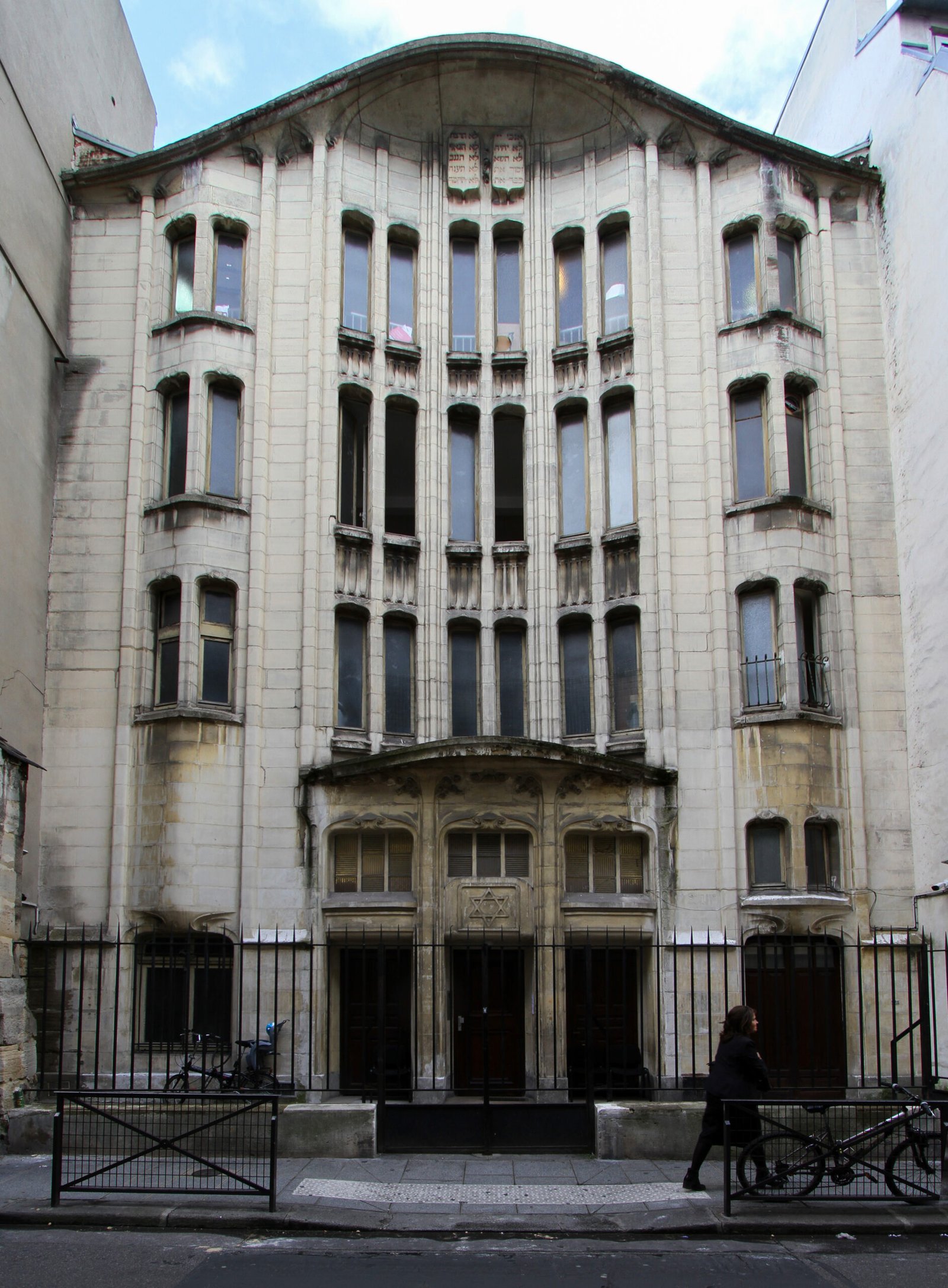
Hector Guimard’s only synagogue and one of his last great Art Nouveau works: a tall, narrow façade folded into a Marais street, its stone bending like a curtain pulled taut.
At a glance
At 10 rue Pavée, in the Marais, Guimard built the Agoudas Hakehilos synagogue for an Orthodox congregation, many of its members recent immigrants from Eastern Europe. Completed in 1913–1914, it is his only religious building and one of the last works of his Art Nouveau period. Guimard — married to the Jewish-American artist Adeline Oppenheim — took on a narrow, deep plot and turned the constraint into the design: the stone façade undulates in vertical waves, rising the full height of the building with almost no applied ornament. Inside, galleries on slender iron columns are packed into the slot of the site.
Key facts
- Completed: 1913–1914
- Architect: Hector Guimard (1867–1942)
- Style: Art Nouveau (late period)
- Address: 10 rue Pavée, 75004 Paris (Le Marais), France
- GPS: 48.855972, 2.360486 — Open in Google Maps
- Function: Active Orthodox synagogue, Ashkenazi rite
- Status: Listed monument historique (1989); Guimard’s only synagogue
History
The synagogue was commissioned by the Agoudas Hakehilos association — the “Union of the Communities” — an Orthodox body drawing mainly on Russian and Polish Jewish immigrants who had settled in the Pletzl, the Jewish quarter of the Marais. The plot on rue Pavée was narrow and hemmed in. Guimard drew the plans around 1913 and the building was completed by 1914, on the eve of the First World War.
On the night of 2–3 October 1941, during the German occupation, the synagogue was among several in Paris damaged by explosions set in a coordinated antisemitic attack. The building was repaired after the war and its congregation continued. In 1989 it was classified a monument historique, recognition both of Guimard’s authorship and of its place in the history of the quarter.
The synagogue remains in active use today, led by its rabbinic family and serving an Ashkenazi Orthodox community. It is one of the few Guimard buildings that has kept its original purpose unbroken for more than a century, and the only one he designed for worship.
What you see
The façade is a tall sheet of stone that bows outward in shallow vertical undulations, as if a curtain had been pulled taut and frozen. Guimard treated the masonry the way he treated iron elsewhere — as a material that flows — and kept carving to a minimum, so the movement is structural rather than applied. The narrow front rises straight from the pavement, taller than it is wide, shaped entirely by the constraints of the site.
Inside, when the building is open, the sanctuary is compact and vertical: women’s galleries are carried on slender cast-iron columns up the side walls, the Ark stands against the eastern wall, and the fittings — light brackets, balustrades, railings — show Guimard’s late, restrained line. Every element was designed to wring height and light from a plot that offered little of either.
Practical information
- Access: An active synagogue; interior visits depend on the community’s schedule and security arrangements
- Dress: Modest dress expected; men cover their heads inside
- Façade: Visible from rue Pavée at any time, free of charge
- Time needed: 15–20 minutes for the exterior
- Combine with: A walk through the Marais — the Jewish museum and Place des Vosges are close
Getting there
The synagogue is at 10 rue Pavée, in the 4th arrondissement, in the heart of the historic Marais. The nearest Métro is Saint-Paul (line 1), about four minutes’ walk to the east along rue de Rivoli and into rue Pavée. From the centre of Paris, line 1 runs directly to Saint-Paul. The surrounding streets — rue des Rosiers above all — form the old Jewish quarter of the city.
Nearby
- Musée d’art et d’histoire du Judaïsme, in the Marais
- Place des Vosges, the oldest planned square in Paris
- Rue des Rosiers and the historic Pletzl
- Paris — Belle Époque, Art Nouveau & Modernism (city guide)
Sources
- Plateforme Ouverte du Patrimoine (POP) / base Mérimée — monument historique record (listed 1989), Ministère de la Culture
- Musée d’art et d’histoire du Judaïsme — documentation on the Marais and its synagogues
- Musée d’Orsay — Hector Guimard collections and documentation
Gallery
Photographs by Luigi De Marchi.
Find it on the map
See this place and what’s around it →Record researched and written by Luigi De Marchi for Cultural Heritage Online, 2026.
📷 Become a Cultural Heritage Online photographer
Share your photos of places: they stay published under your name as the author. The more they're seen, the more you get noticed — and soon a contest will reward the most appreciated photos.
Log in or sign up free to add a photoIs this page about you?
This page is read by travellers and heritage enthusiasts who find it on Google. Tell us how you are connected to this place and we will take it from there.