
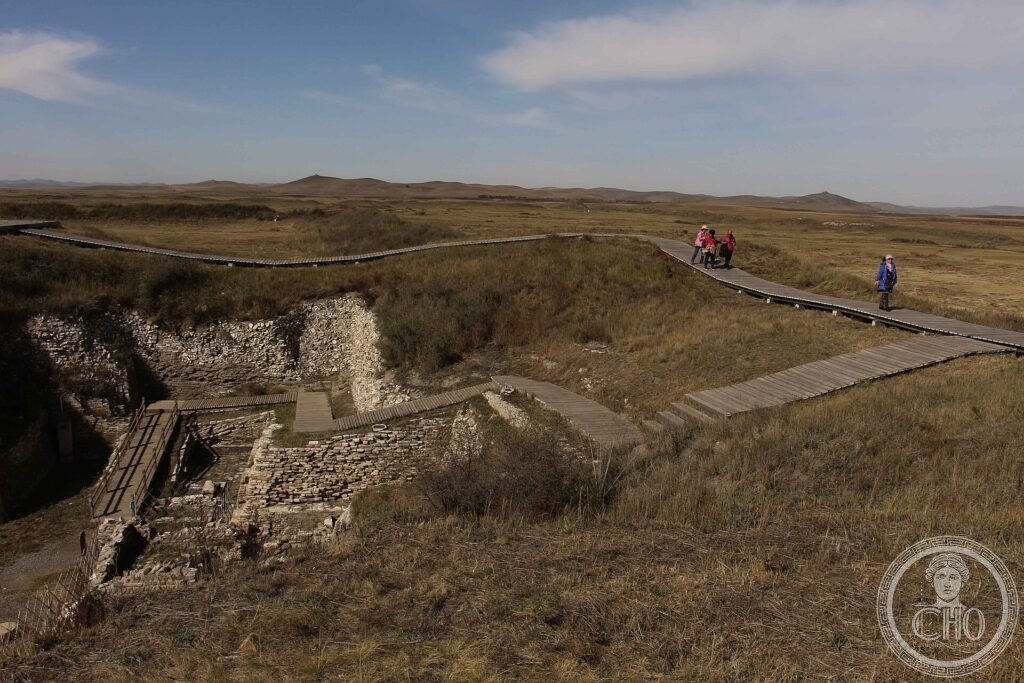
“In Xanadu did Kubla Khan / a stately pleasure-dome decree”: the name has evoked dream and luxury for centuries. Here, on the steppe of Inner Mongolia, Kublai Khan founded his summer capital, where the Chinese city met the nomadic camp. What remains are the walls and earthworks of an empire that joined two worlds.
At a glance
The Site of Xanadu (Shangdu), on the grasslands of Inner Mongolia, was the legendary summer capital of Kublai Khan, founder of the Mongol Yuan dynasty of China. Built in the 13th century, it was here that the nomadic culture of the Mongol steppe met the urban civilisation of China, in a planned city of palaces, temples and a walled enclosure beside the tents of the imperial camp. Immortalised in Coleridge’s poem, the archaeological site preserves the earthworks and foundations of this meeting of worlds. It was inscribed by UNESCO in 2012.
Key facts
- UNESCO: World Heritage since 2012 (Site of Xanadu)
- Kublai Khan: the summer capital of the Mongol Yuan emperor
- 13th century: built from 1256–1259
- Two cultures: where Mongol nomadic and Chinese urban worlds met
- Coleridge: immortalised in the poem “Kubla Khan”
- On the steppe: walls, foundations and earthworks survive on the grassland
History
Kublai Khan, grandson of Genghis, built Shangdu as his first capital in the 1250s before founding Dadu (Beijing) and conquering all of China as the Yuan dynasty. Shangdu then became the summer capital, where the court retreated each year, and where the emperor combined the planned palace-city of Chinese tradition with the tents, hunting grounds and rituals of his Mongol heritage.
Marco Polo described its splendour, and the name reached Europe; centuries later Coleridge made “Xanadu” a byword for visionary luxury. The Ming destroyed the city in the 14th century, leaving the walls and foundations on the steppe that archaeologists have since revealed.
What you see
The site spreads across the grassland as low walls, gates and the grassed-over foundations of palaces and temples within the rectangular enclosure, with the lines of the outer city and the imperial gardens beyond. Boardwalks lead visitors among the earthworks.
The vast steppe horizon, where the planned city once met the nomad camp, is the lasting impression of Xanadu.
Practical information
- Site: an archaeological park on the steppe, with a museum
- Time needed: half a day
- Note: remote; best reached by car, from Duolun or Zhenglan Banner
- Setting: in Inner Mongolia, north of Beijing
Getting there
The Site of Xanadu is in Zhenglan Banner, Inner Mongolia, China, about 350 km north of Beijing. It is reached by road. GPS: 42.359° N, 116.184° E.
Nearby
- Inner Mongolian grasslands — the steppe around the site
- Duolun — the nearest town
- Beijing — the later Yuan capital (Dadu), to the south
Sources
- UNESCO World Heritage Centre — “Site of Xanadu” (ref. 1389)
- State Administration of Cultural Heritage of China — official body
- Encyclopaedia Britannica — Shangdu; Kublai Khan
Find it on the map
See this place and what’s around it →📷 Become a Cultural Heritage Online photographer
Share your photos of places: they stay published under your name as the author. The more they're seen, the more you get noticed — and soon a contest will reward the most appreciated photos.
Log in or sign up free to add a photo