
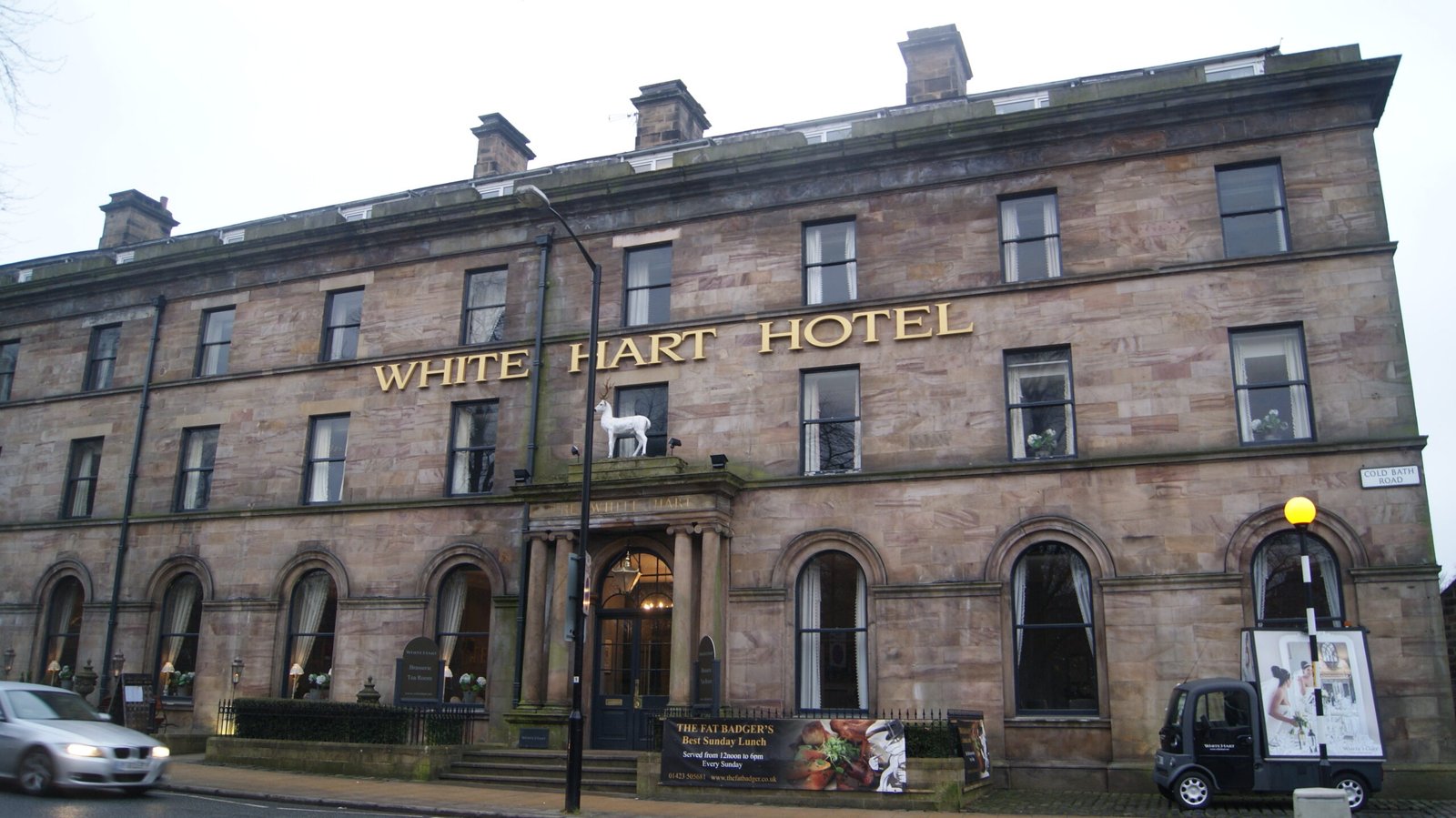
One of the great coaching inns of the Yorkshire spa, rebuilt as Harrogate’s mineral-water boom reached its height and praised by Pevsner as the best building in the town.
At a glance
The White Hart stands in the Montpellier Quarter of Harrogate, the North Yorkshire spa town that grew rich on its sulphur and iron springs. An inn has traded on the site since the eighteenth century, but the present building dates from 1846, when it was rebuilt to a design by the architect George Townsend Andrews (1804–1855) as the town filled with visitors taking the water cure. Nikolaus Pevsner judged it the best building in Harrogate, with “nothing gaudy or showy about it” — a restrained, confident frontage rather than a display piece. It is a Grade II* listed building, and after spells as a wartime ministry office and a post-war hospital annexe it trades again today as a hotel.
Key facts
- Location: Cold Bath Road, Montpellier Quarter, Harrogate, HG2 0NF
- Architect (present building): George Townsend Andrews (1804–1855)
- Rebuilt: 1846
- Earlier inn: recorded on the site by 1765, serving visitors to the sulphur wells
- Designation: Grade II* listed (Historic England ref 1315821)
- Critical verdict: Pevsner — “the best building in Harrogate”
- Today: a working hotel, restaurant and conference venue
History
Harrogate owed everything to its water. From the seventeenth century the town’s sulphur and chalybeate springs drew people who believed the foul-smelling wells could cure them, and by the eighteenth century inns were rising to lodge the visitors. A White Hart is recorded on this site by 1765, serving the spa trade and doubling, in the way of coaching inns, as a place for auctions and public business.
The Victorian decades turned the spa into a resort. The railway arrived, hydrotherapy became fashionable, and Harrogate rebuilt itself in stone. The White Hart was reconstructed in 1846 by George Townsend Andrews, an architect best known for his railway work in Yorkshire, giving the old inn the scale and dignity that the new age of the water cure demanded.
The twentieth century pressed the building into other uses. It was requisitioned during the Second World War for government departments, and after the war it served the National Health Service as a conference centre and hospital annexe. The University of York held it from 1988 before it returned to private hands, and it has since gone back to the trade it was built for.
What you see
The White Hart’s strength is its calm. Where later spa hotels reached for turrets and colour, Andrews gave the White Hart a long, even classical frontage that holds its corner of the Montpellier Quarter without shouting. That was the quality Pevsner singled out when he called it the best building in Harrogate and noted there was nothing gaudy or showy about it: the proportions do the work, not the ornament.
Its position is part of the point. The hotel sits among the stone terraces and gardens of the spa quarter, a short walk from the Royal Pump Room and the open green of the Stray, in a townscape built entirely for people who came to walk, drink the water and be seen. Read against that setting, the White Hart is the solid, sober anchor of a resort that otherwise loved to perform.
Practical information
- Operating hotel: the White Hart is a working hotel; its bar, restaurant and public rooms are open to non-residents.
- Exterior: the frontage can be seen for free from Cold Bath Road and the surrounding Montpellier streets.
- Time needed: 15–20 minutes to take in the building and the spa quarter around it; longer for a meal or a stay.
Getting there
Harrogate is about 15 miles (24 km) north of Leeds and has its own railway station on the line between Leeds and York, a few minutes’ walk from the hotel. By road the town is reached from the A1(M) via the A59 or A661. The Montpellier Quarter is at the western edge of the town centre, close to the Valley Gardens and the historic pump rooms.
Nearby
- Royal Pump Room Museum — the octagonal 1842 well-house over Harrogate’s strongest sulphur spring, now a museum.
- Valley Gardens — the spa town’s landscaped gardens, laid out over the mineral springs a short walk away.
- RHS Garden Harlow Carr — the Royal Horticultural Society’s northern garden, on the edge of the town.
Sources
- Historic England, listed building record 1315821 — https://historicengland.org.uk/listing/the-list/list-entry/1315821
- Wikipedia, “White Hart Hotel, Harrogate” — https://en.wikipedia.org/wiki/White_Hart_Hotel,_Harrogate
- Wikipedia, “George Townsend Andrews” — https://en.wikipedia.org/wiki/George_Townsend_Andrews
- Wikidata Q17536678 — https://www.wikidata.org/wiki/Q17536678
- N. Pevsner, The Buildings of England: Yorkshire, the West Riding — architectural assessment cited via the listing record
Find it on the map
See this place and what’s around it →📷 Become a Cultural Heritage Online photographer
Share your photos of places: they stay published under your name as the author. The more they're seen, the more you get noticed — and soon a contest will reward the most appreciated photos.
Log in or sign up free to add a photoIs this page about you?
This page is read by travellers and heritage enthusiasts who find it on Google. Tell us how you are connected to this place and we will take it from there.