

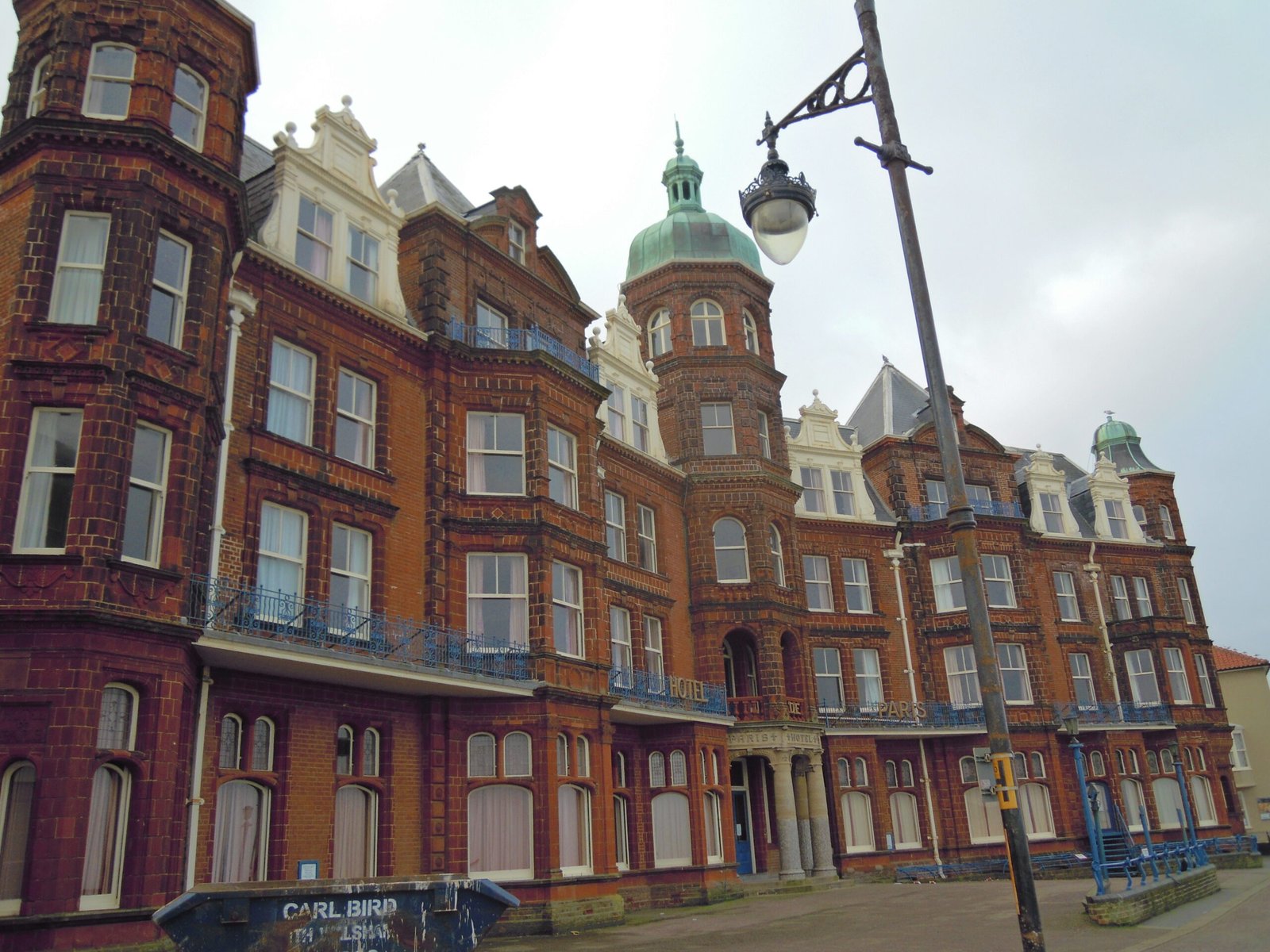
George Skipper gave the Norfolk coast a resort palace in red brick and terracotta, its octagonal tower standing over Cromer pier like a signature.
At a glance
The Hotel de Paris stands on the cliff-top above Cromer seafront, on the north coast of Norfolk, looking down over the pier and the beach. The present building was rebuilt in 1895–96 to a design by the Norwich architect George John Skipper (1856–1948), in red brick and terracotta under a steep slated roof. Three storeys and an attic rise to a five-storey octagonal tower that anchors the seaward corner and gives the hotel its silhouette. It is a Grade II listed building, and one of the exuberant seaside works that made Skipper’s reputation along this stretch of coast. More than a century on, it still trades as a resort hotel facing the North Sea.
Key facts
- Location: High Street, Cromer, Norfolk, NR27 9HG
- Architect (present building): George John Skipper (1856–1948)
- Rebuilt: 1895–96, commissioned by Alex Jarvis in 1891
- Original hotel: founded 1830 by Pierre le Françoise, a French émigré
- Materials: red brick and terracotta; steep slated roof
- Form: three storeys and attic, with a five-storey octagonal tower
- Designation: Grade II listed (Historic England ref 1171691, listed 21 January 1977)
History
The name reaches back to 1830, when a Frenchman, Pierre le Françoise, opened a hotel on the site to serve the growing number of visitors arriving at Cromer as the fishing town turned itself into a bathing resort. After his death in 1841 the business passed through several hands, and from the mid-century it was run by Henry Jarvis and his son.
By the 1890s Cromer was booming. The railway had brought the resort within easy reach of London and the Midlands, the crowd it drew was smart, and the old hotel was no longer enough. In 1891 Alex Jarvis decided to rebuild, and he turned to George Skipper, the Norwich architect who was then transforming his home city with the Royal Arcade and the Norwich Union offices. Skipper’s new Hotel de Paris, absorbing neighbouring properties, was completed in 1895–96.
The hotel remained in the Jarvis family until 1961, when it was sold to a Norwich owner, and it later passed to a hotel group. It is now operated within the Leisureplex group. The John Betjeman verdict on its architect — “he was to Norwich what Gaudí was to Barcelona” — is a reminder of the confidence with which buildings like this were designed.
What you see
Skipper worked in what contemporaries called the Modern Style — the British answer to Art Nouveau — and the Hotel de Paris is one of his boldest seaside statements. The walls are red brick dressed with terracotta, warm against the grey of the North Sea, and the composition builds toward the octagonal tower at the corner, five storeys high and topped with round-headed windows. The steep slated roofs and gables give the skyline a restless, almost continental profile, which is precisely the holiday note the name promises.
Position is half the effect. The hotel stands high on the cliff, so its main front looks straight out over the promenade, the pier and the sea beyond, while the entrance is reached from the town side on High Street. Seen from the beach or the end of the pier, the red mass and its tower read as the dominant building on the front — the piece of architecture that tells you, at a glance, that Cromer once dressed up for its visitors.
Practical information
- Operating hotel: the Hotel de Paris is a working seaside hotel; the public rooms, bar and restaurant are open to guests and diners.
- Exterior: the façade, tower and seaward setting can be enjoyed for free from the promenade, the pier and the clifftop gardens.
- Time needed: 15–20 minutes to walk the seafront and take in the building; longer for a meal or an overnight stay.
Getting there
Cromer sits on the north Norfolk coast, about 23 miles (37 km) north of Norwich. The town has its own railway station, Cromer, on the Bittern Line from Norwich, and the hotel is a short walk downhill toward the seafront. By road it is reached via the A140 and A149; parking in the town centre is limited, so the station or a public car park is often easier.
Nearby
- Cromer Pier — the Victorian pier below the hotel, home to the Pavilion Theatre and the town’s lifeboat station.
- Cromer Museum — a local-history museum in a row of restored fishermen’s cottages beside the parish church.
- Felbrigg Hall — a 17th-century National Trust country house and estate a few miles inland.
Sources
- Historic England, listed building record 1171691 — https://historicengland.org.uk/listing/the-list/list-entry/1171691
- Wikipedia, “Hotel de Paris, Cromer” — https://en.wikipedia.org/wiki/Hotel_de_Paris,_Cromer
- Wikipedia, “George Skipper” — https://en.wikipedia.org/wiki/George_Skipper
- Wikidata Q5912163 — https://www.wikidata.org/wiki/Q5912163
- Norfolk Heritage Explorer, record MNF52384 — https://www.heritage.norfolk.gov.uk/record-details?MNF52384
Find it on the map
See this place and what’s around it →📷 Become a Cultural Heritage Online photographer
Share your photos of places: they stay published under your name as the author. The more they're seen, the more you get noticed — and soon a contest will reward the most appreciated photos.
Log in or sign up free to add a photoIs this page about you?
This page is read by travellers and heritage enthusiasts who find it on Google. Tell us how you are connected to this place and we will take it from there.