
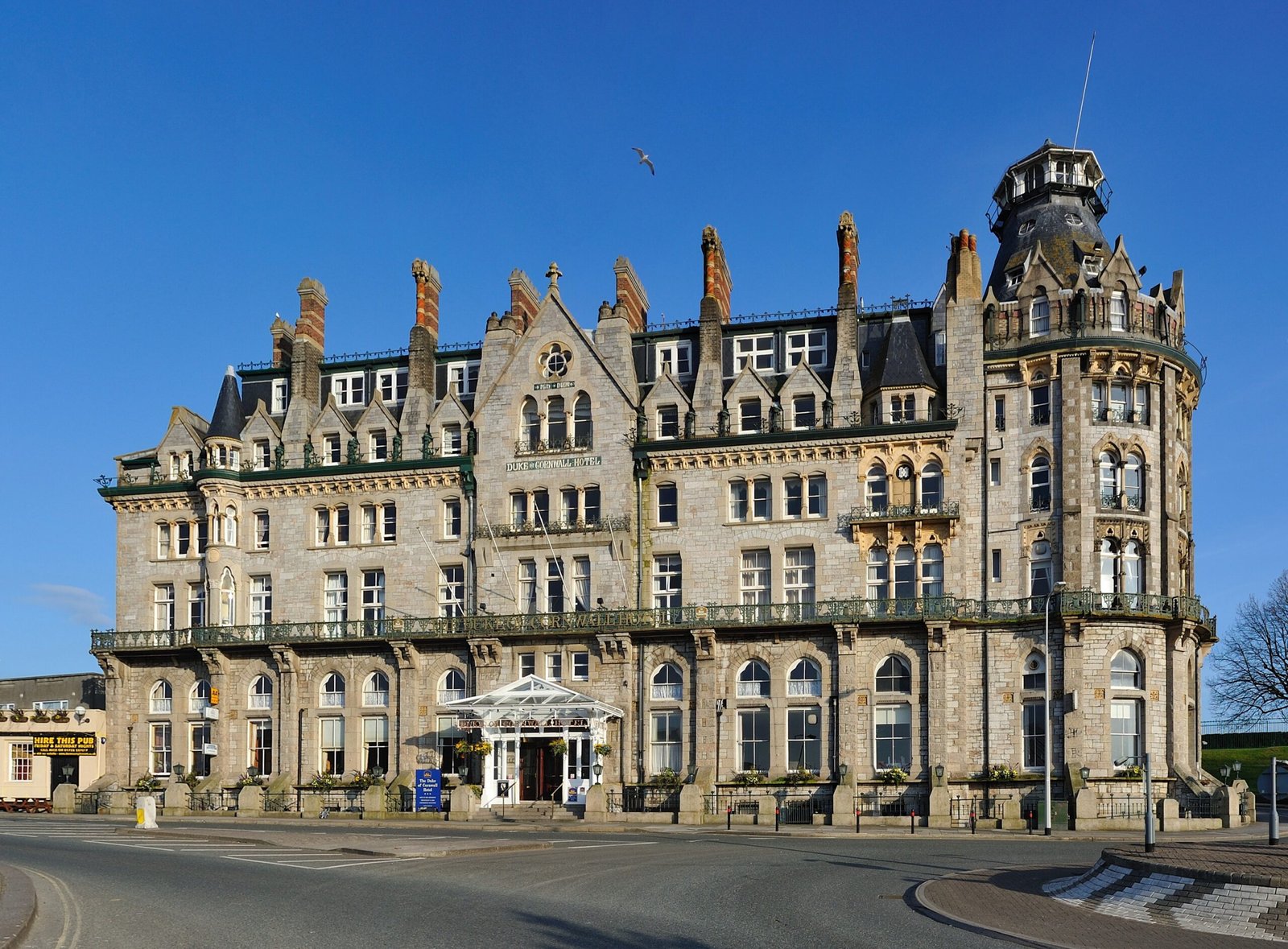
Built for the age of steam and steamship, Plymouth’s Gothic railway hotel so admired by John Betjeman that he ranked it among the finest examples of Victorian architecture in the country.
At a glance
The Duke of Cornwall stands on Millbay Road in Plymouth, a short walk from the harbour at Millbay where the ocean liners once called. It was built between 1863 and 1865 to a design by the architect C. Forster Hayward, in a full-blooded Victorian Gothic that used five different kinds of stone. The hotel went up to lodge the rail and sea travellers pouring into Plymouth after the railway reached the port, and it has kept its place at the centre of the city’s life ever since. It is a Grade II listed building, admired by John Betjeman, and survived the wartime bombing that flattened much of central Plymouth around it.
Key facts
- Location: Millbay Road, Plymouth, Devon, PL1 3LG
- Architect: C. Forster Hayward
- Built: 1863–1865 (opened 1865)
- Client: the Plymouth Hotel Company; cost about £40,000
- Style: Victorian Gothic, built from five different kinds of stone
- Designation: Grade II listed (Historic England ref 1386245, listed 1975)
- Today: a working hotel of some 72 bedrooms
History
Plymouth’s fortunes turned on movement — of ships, of trains, of people. The first steam train reached the port at Millbay in 1849, and within a decade the harbour was a gateway for ocean travel as well. The railway and dock interests saw that a city receiving the world needed a hotel to match, and the Plymouth Hotel Company built one: the Duke of Cornwall, raised between 1863 and 1865 at a cost of around £40,000.
For a century and a half the hotel has watched the great moments of the port pass through its doors. In 1912 it took in survivors of the Titanic brought ashore at Plymouth. During the Second World War, when the Luftwaffe reduced much of central Plymouth to rubble, the Duke of Cornwall came through with little damage — one of the few Victorian landmarks left standing in the rebuilt city.
Ownership has changed with the times, most recently passing to a hotel-management group in 2021, but the building’s role has not. John Betjeman, the great champion of Victorian architecture, ranked it among the finest examples of Victorian architecture in the country, and the city has kept it as a point of pride.
What you see
The Duke of Cornwall wears its Gothic openly. Pointed gables, steep roofs and a corner tower give it the vertical drama of a Victorian church or town hall rather than the flat classical calm of an earlier hotel, and the walls draw on five different stones for colour and texture. It was designed to be read from a distance, a landmark for travellers arriving by train or by sea, and it still reads that way from Millbay Road.
Inside, the set-piece is the staircase, a grand Gothic stair that climbs through the heart of the building and remains the feature guests remember. The scale throughout is generous, built for an age when a first-class hotel was expected to impress the moment you stepped out of the carriage. That confidence, more than any single detail, is what Betjeman responded to.
Practical information
- Operating hotel: the Duke of Cornwall is a working hotel with a restaurant and function rooms. At the time of writing it is undergoing a programme of restoration to its roof, windows and external stonework.
- Exterior: the Gothic front and tower can be seen for free from Millbay Road and the surrounding streets.
- Time needed: 10–15 minutes for the exterior; longer for a meal or an overnight stay.
Getting there
Plymouth is on the south Devon coast and has a mainline railway station on the route between London Paddington and Penzance. The hotel is about a mile from the station and close to the Millbay docks, from which ferries sail to Roscoff and Santander. By road the city is reached via the A38 Devon Expressway; the hotel is near the western edge of the city centre.
Nearby
- Plymouth Hoe — the seafront promenade with Smeaton’s Tower and the view over Plymouth Sound, a few minutes’ walk away.
- The Barbican — the old harbour quarter of cobbled streets and the Mayflower Steps, where the Pilgrims sailed in 1620.
- Royal William Yard — a vast former naval victualling yard by Sir John Rennie, now restaurants and galleries.
Sources
- Historic England, listed building record 1386245 — https://historicengland.org.uk/listing/the-list/list-entry/1386245
- Wikipedia, “Duke of Cornwall Hotel” — https://en.wikipedia.org/wiki/Duke_of_Cornwall_Hotel
- Wikidata Q5312994 — https://www.wikidata.org/wiki/Q5312994
- The Duke of Cornwall Hotel, official site — https://thedukeofcornwall.co.uk/about-us/
Find it on the map
See this place and what’s around it →📷 Become a Cultural Heritage Online photographer
Share your photos of places: they stay published under your name as the author. The more they're seen, the more you get noticed — and soon a contest will reward the most appreciated photos.
Log in or sign up free to add a photoIs this page about you?
This page is read by travellers and heritage enthusiasts who find it on Google. Tell us how you are connected to this place and we will take it from there.