

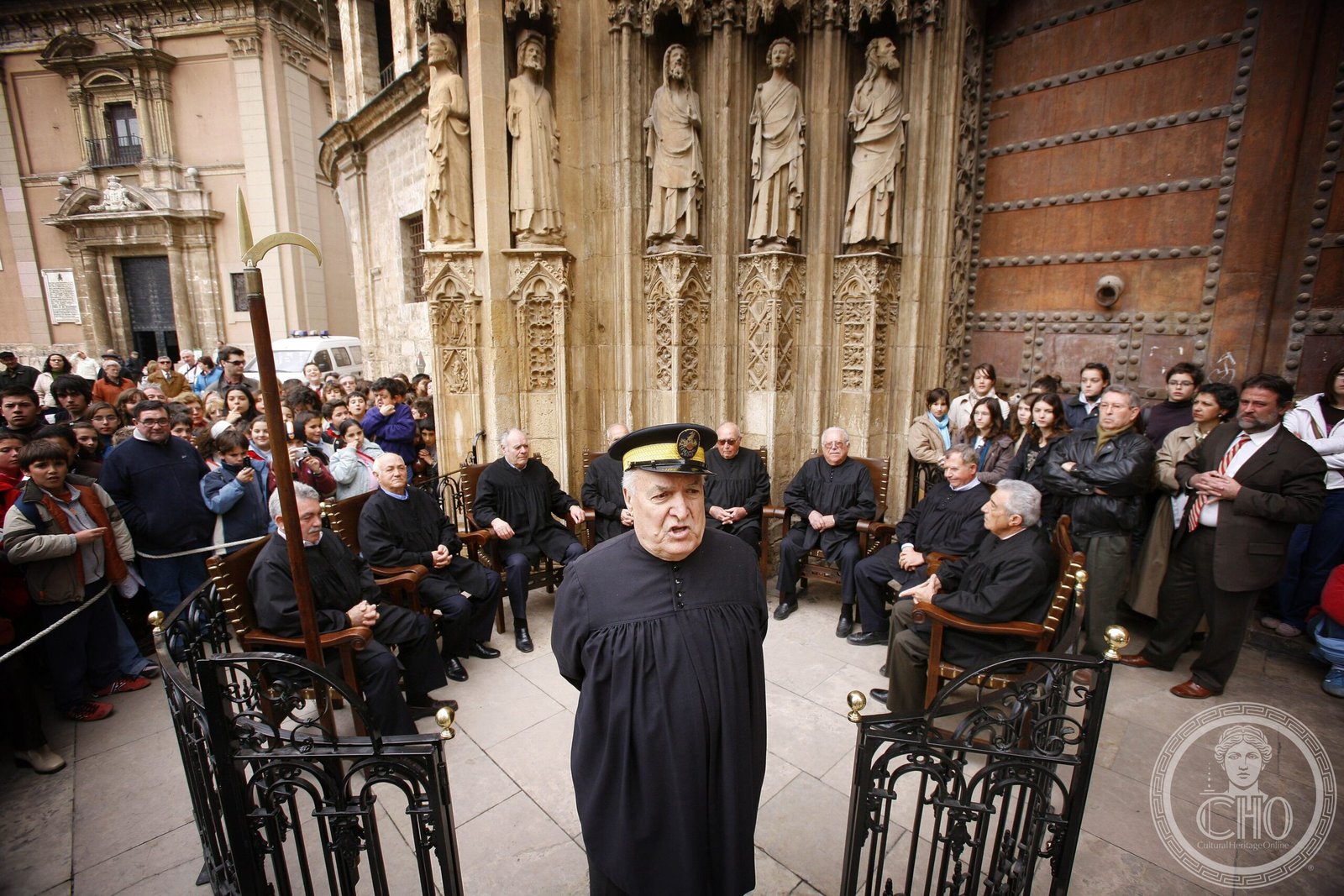
For over a thousand years, farmers have brought their water disputes to this extraordinary court, which still meets every Thursday to settle conflicts with oral testimony and centuries-old procedure.
At a glance
The Water Tribunal of the plain of Valencia (Tribunal de les Aigües) is an institution of justice dedicated to settling disputes over irrigation water among farmers in the Horta, the fertile agricultural plain surrounding the city. Operating continuously since medieval times, it adjudicates conflicts arising from the use of water distributed through nine major irrigation canals: Quart, Benàger i Faitanar, Tormos, Mislata, Mestalla, Favara, Rascanya, Rovella, and Xirivella. The tribunal represents the world’s oldest court still in active use and Europe’s oldest democratic institution.
Origins and history
The tribunal emerged from the irrigation systems established during the medieval period, when the plain of Valencia required sophisticated water management to sustain agriculture in a semi-arid landscape. Over centuries, the institution evolved to handle the complex legal and practical challenges of shared water rights among competing farming communities. Its longevity and continuous operation reflect the enduring importance of irrigation to the region’s economy and social fabric.
The tradition today
The tribunal convenes every Thursday in the Plaza de la Virgen, near the Cathedral of Valencia, to hear cases presented orally by farmers and representatives of the irrigation communities. Judges—known as síndicos and acequieros—listen to testimony and evidence without written pleadings, maintaining procedures that echo medieval practice. Decisions are delivered immediately and enforced through the irrigation communities themselves. The ritual and oral nature of proceedings remain unchanged, preserving democratic principles of transparency and direct participation.
Cultural significance
The tribunal embodies centuries of collective problem-solving in agriculture and water management. It represents a living link to medieval governance systems and demonstrates how communities can sustain equitable dispute resolution across generations. The tribunal’s recognition as intangible cultural heritage underscores its value as a model of participatory justice and environmental stewardship rooted in local knowledge and practice.
Key facts
- Country: Spain
- Anchor community: Valencia
- UNESCO Intangible Cultural Heritage: Irrigators’ tribunals of the Spanish Mediterranean coast (inscribed 2009)
- Meets: Every Thursday, year-round
- Adjudicates disputes across nine irrigation canals serving the Horta de València
- Recognized as the world’s oldest court in continuous operation
Where to experience it
You can attend sessions of the tribunal on Thursday mornings in the Plaza de la Virgen, adjacent to Valencia Cathedral in the city centre. Sessions are open to the public and conducted in Valencian, though the proceedings’ ritual and formal structure remain clear to observers. Check locally for current meeting times and any seasonal variations.
Sources & resources
Find it on the map
See this place and what’s around it →📷 Become a Cultural Heritage Online photographer
Share your photos of places: they stay published under your name as the author. The more they're seen, the more you get noticed — and soon a contest will reward the most appreciated photos.
Log in or sign up free to add a photo