
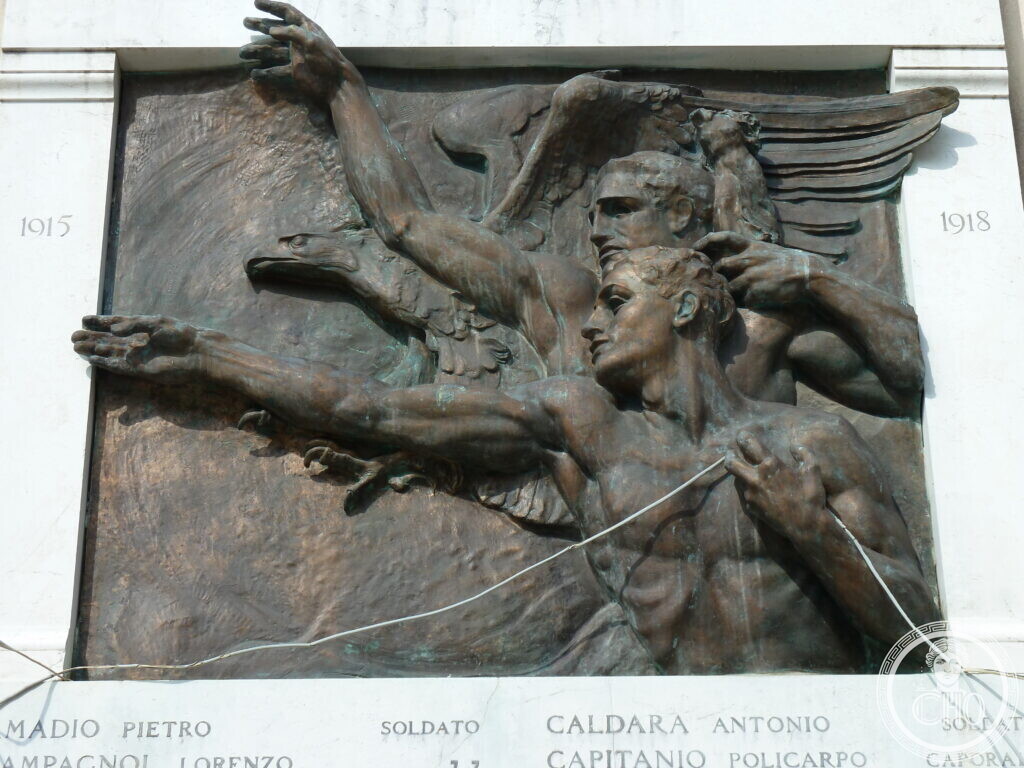
A winged Victory guiding a falling soldier, cast in bronze — carried across a purpose-built bridge over the canal for its unveiling, in front of the church it commemorates.
At a glance
Bronze relief on the facade of Palazzo Papadopoli at Fondamenta Condulmer, Santa Croce, facing the Chiesa dei Tolentini. A winged figure of Victory reaches forward beside a bare-chested soldier, an eagle at her side; the years 1915 and 1918 are cut into the stone at either edge. Below, two columns of names honour the fallen of the San Nicola da Tolentino parish. Sculpted by Eugenio Bellotto, unveiled 28 October 1922 — the date cut into the marble itself.
Key facts
- Sculptor: Eugenio Bellotto (1875–1947), Treviso-born, instructor at the Venice Academy of Fine Arts and president of the Tolentini parish’s own war-dead committee
- Unveiled: 28 October 1922, as inscribed on the monument
- Municipal contribution: 200 lire from the City of Venice toward its realisation
- Location: the facade of Palazzo Papadopoli, Fondamenta Condulmer, Santa Croce, facing the Chiesa dei Tolentini
- Later addition: three names missing from the original roll were added afterwards, one on the left column and two on the right
- GPS: 45.43772, 12.32106 · Open in Google Maps
History
Eugenio Bellotto was not a disinterested sculptor called in for a commission: he chaired the Tolentini parish’s own committee for its First World War dead, and it was his design that the committee brought to the city for approval. The chosen site sat directly across the canal from the church, on the facade of Palazzo Papadopoli at Fondamenta Condulmer — close enough that, on the day of the unveiling, a temporary wooden bridge had to be built across the water so the finished bronze could be carried over to it in a solemn procession, facing the church it was made to honour. The City of Venice contributed 200 lire toward the cost.
The relief itself avoids the era’s more common allegory of mourning: a winged Victory strides forward, an eagle beside her, one arm drawing a falling soldier up rather than laying him down. Cut into the stone at either edge, the years 1915 and 1918 frame the two columns of names below. The roll was not quite complete at the unveiling — three names came to light afterwards and were added to the columns, one on the left and two on the right, a small correction visible today to anyone who looks closely at the marble.
Nearby
- Palazzo Foresti Papadopoli — the building this memorial is fixed to, whose garden front looks onto the Giardini Papadopoli
- San Nicola da Tolentino — the parish church across the canal, which the memorial faces
Sources
- Pietre della Memoria, Lapide ai Caduti nella Grande Guerra della parrocchia di San Nicola da Tolentino – Venezia — pietredellamemoria.it: the unveiling (dated there to 29 October 1922; the inscription on the monument reads 28 October, and we follow the stone), Eugenio Bellotto’s dual role as sculptor and committee chair, the municipal contribution, the temporary bridge, the Palazzo Papadopoli location, and the later addition of three names
- On-site relief, verified from the contributed photographs: the Victory-and-soldier composition and the 1915/1918 dates
- Coordinates cross-checked against OpenStreetMap Nominatim for Fondamenta Condulmer, Santa Croce
Photo gallery

Photograph contributed by a Cultural Heritage Online member.
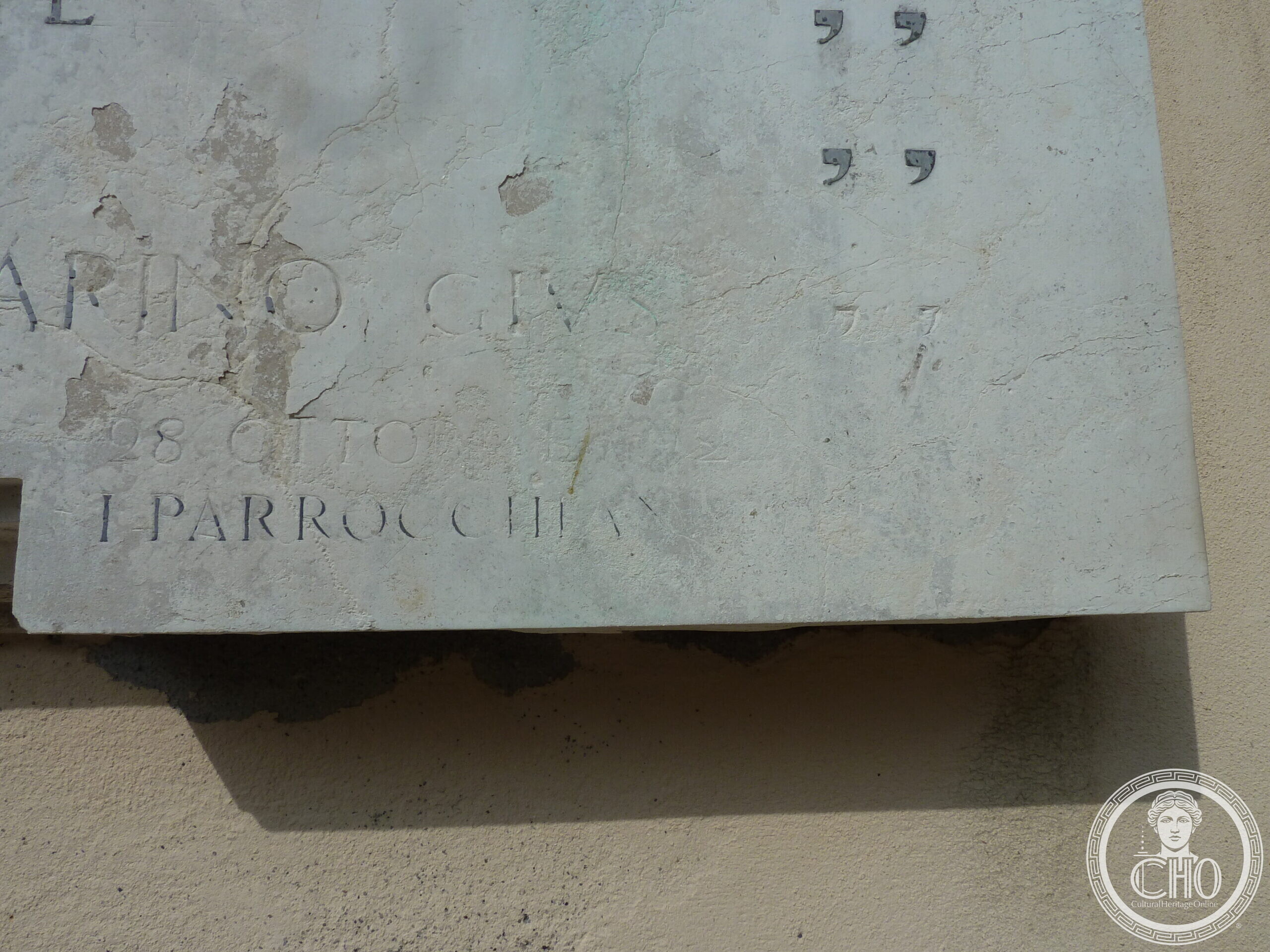
Correction, 21 September 2026. This page first gave the unveiling as 29 October 1922, the date recorded in the Pietre della Memoria census. The photographer Stefano Vigolo sent us a close photograph of the monument, on which the carved date reads 28 OTTOBRE. We have corrected the page to follow the inscription.
Find it on the map
See this place and what’s around it →Record researched and written by Carla Szathvary for Cultural Heritage Online, 2026.
📷 Become a Cultural Heritage Online photographer
Share your photos of places: they stay published under your name as the author. The more they're seen, the more you get noticed — and soon a contest will reward the most appreciated photos.
Log in or sign up free to add a photoIs this page about you?
This page is read by travellers and heritage enthusiasts who find it on Google. Tell us how you are connected to this place and we will take it from there.