
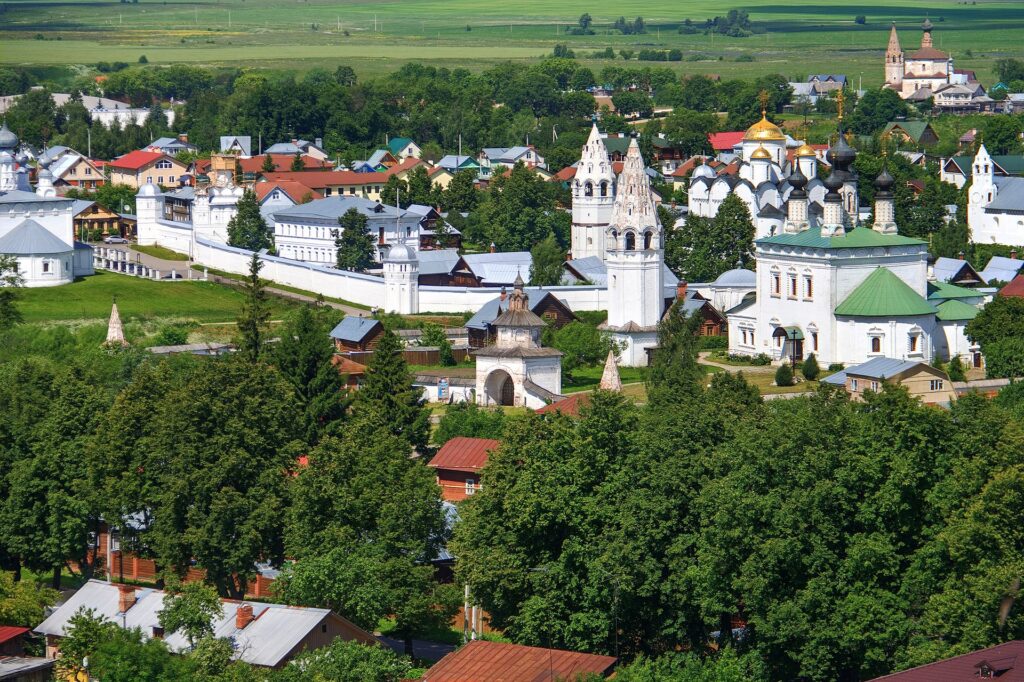
Before Moscow became the capital, the heart of Rus’ beat here, between Vladimir and Suzdal. In the twelfth century, cathedrals and churches rose here in pale white stone, carved with refined artistry: the “white monuments” that set the style of Russian architecture for centuries to come.
At a glance
In the 12th and 13th centuries the principality of Vladimir-Suzdal was the leading power of medieval Rus, and its rulers built a series of churches and cathedrals in gleaming white limestone, richly carved. These “White Monuments” — the Golden Gate and cathedrals of Vladimir, the cathedral of Suzdal, and the perfect little Church of the Intercession on the Nerl — set the pattern for later Russian architecture. The towns of Suzdal and Vladimir preserve them amid a wider landscape of monasteries. They were inscribed by UNESCO in 1992.
Key facts
- UNESCO: World Heritage since 1992 (White Monuments of Vladimir and Suzdal)
- White stone: 12th–13th-century churches in carved white limestone
- Vladimir: the Golden Gate, the Dormition and St Demetrius cathedrals
- Suzdal: the Nativity Cathedral and a townscape of monasteries
- Church on the Nerl (1165): a jewel of medieval Russian architecture
- Golden Ring: the towns are stars of Russia’s ring of historic cities
History
As Kievan Rus fragmented, the princes of Vladimir-Suzdal in the north-east rose to dominance in the 12th century under Andrei Bogolyubsky and Vsevolod the Big Nest. They proclaimed their power in stone, importing masons to build white-limestone cathedrals carved with intricate reliefs of saints, beasts and foliage, a style without exact parallel.
The Mongol invasion of 1238 shattered the principality, and leadership later passed to Moscow, but the white-stone churches survived. Suzdal, bypassed by industry, kept an extraordinary concentration of medieval and later religious architecture, becoming a living museum of old Russia.
What you see
Suzdal spreads its white monasteries, churches and bell-towers across green meadows along the Kamenka, crowned by golden and blue domes — one of the most complete old Russian townscapes. In Vladimir the Golden Gate and the great cathedrals stand on the hill above the Klyazma, their facades carved in stone.
Outside Vladimir, the Church of the Intercession on the Nerl rises alone above a flood-meadow, the most celebrated of all the white monuments.
Practical information
- Suzdal: a small town, walkable; many churches and a wooden-architecture museum
- Vladimir: about 35 km away, with the cathedrals and Golden Gate
- Time needed: one to two days for both towns
- Note: the Church on the Nerl is reached by a walk across the meadow
Getting there
Suzdal and Vladimir are about 200 km east of Moscow, on the Golden Ring. Vladimir has fast trains from Moscow (under 2 hours); Suzdal is reached by bus from Vladimir. GPS (Suzdal): 56.4194° N, 40.4533° E.
Nearby
- Vladimir — the Golden Gate and white-stone cathedrals, part of the site
- Bogolyubovo — the princely residence and the Church on the Nerl
- Moscow — the capital, about 200 km west
Sources
- UNESCO World Heritage Centre — “White Monuments of Vladimir and Suzdal” (ref. 633)
- Vladimir-Suzdal Museum-Reserve — official body
- Encyclopaedia Britannica — Suzdal; Vladimir
Find it on the map
See this place and what’s around it →📷 Become a Cultural Heritage Online photographer
Share your photos of places: they stay published under your name as the author. The more they're seen, the more you get noticed — and soon a contest will reward the most appreciated photos.
Log in or sign up free to add a photo