
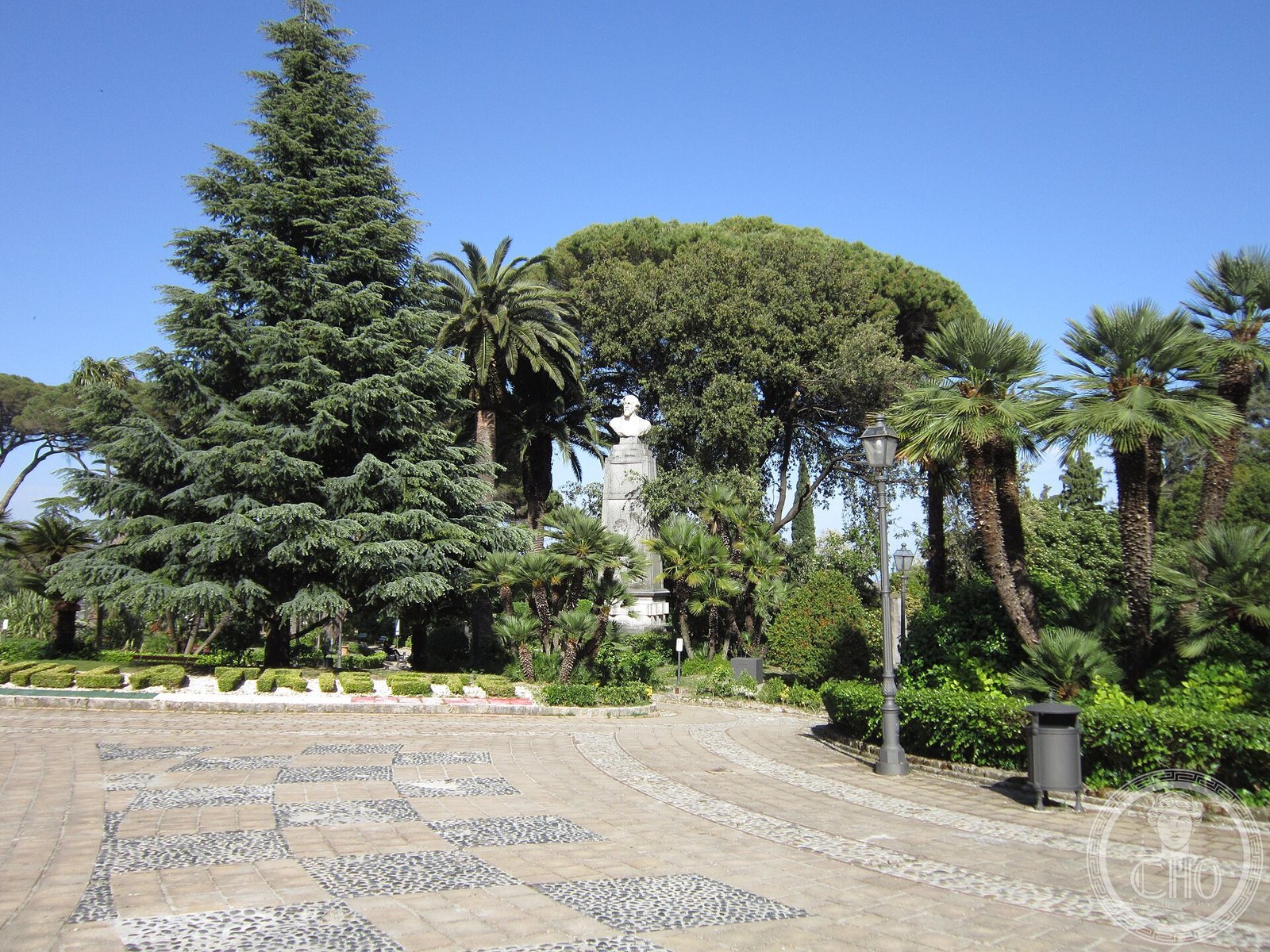
Villa Margherita is the principal public garden of Catanzaro, the regional capital of Calabria, laid out in the late nineteenth century on the city’s panoramic ridge and named in honour of Queen Margherita of Savoy. Overlooking both the Ionian and Tyrrhenian coasts on clear days, the garden combines formal tree-lined promenades, ornamental fountains, and historic statuary to form the civic green heart of a city whose hilltop position made it one of the most strategically situated capitals in southern Italy.
At a glance
- Type
- Historic public garden (villa comunale)
- Period
- Late 19th century; post-Unification municipal park
- Style
- Formal Italian garden with romantic landscape elements
- Location
- Catanzaro, Calabria, Italy
- Coordinates
- 38.9053° N, 16.5955° E
Overview
Villa Margherita occupies a commanding position on the Catanzaro plateau, at an elevation of approximately 320 metres above sea level, and is one of the city’s most beloved public spaces. The garden is laid out along a central axis with lateral allées of tall trees providing shade to promenading visitors, and its belvedere areas afford extraordinary views across the narrow Calabrian isthmus toward the sea on both sides. Statues of notable figures from Calabrian history and culture are distributed through the garden, reinforcing its role as a monument to local identity as much as a recreational space.
History
The garden was established in the years following Italian unification as part of a broader effort by the new municipal authorities of Catanzaro to modernise and beautify the regional capital. It was named after Queen Margherita of Savoy, wife of King Umberto I, in keeping with the widespread practice of dedicating civic improvements to members of the new royal family as gestures of patriotic loyalty. The design followed the conventions of the Italian villa comunale — formal paths, ornamental planting, and monumental features — adapted to the dramatic topography of the Catanzaro ridge, and the garden has been the focal point of the city’s public life ever since its inauguration.
What you see
The garden’s main entrance opens onto a broad central promenade flanked by mature Mediterranean trees — stone pines, palms, and magnolias — whose canopies create a continuous shade walk popular with residents at all hours. Ornamental flowerbeds and fountains punctuate the formal layout, while terraced belvedere points equipped with benches look out over the Catanzaro valley and, on clear days, toward the distant coasts. A bandstand and open-air performance areas have historically been used for civic concerts and festivals, sustaining the garden’s function as a centre of social and cultural life.
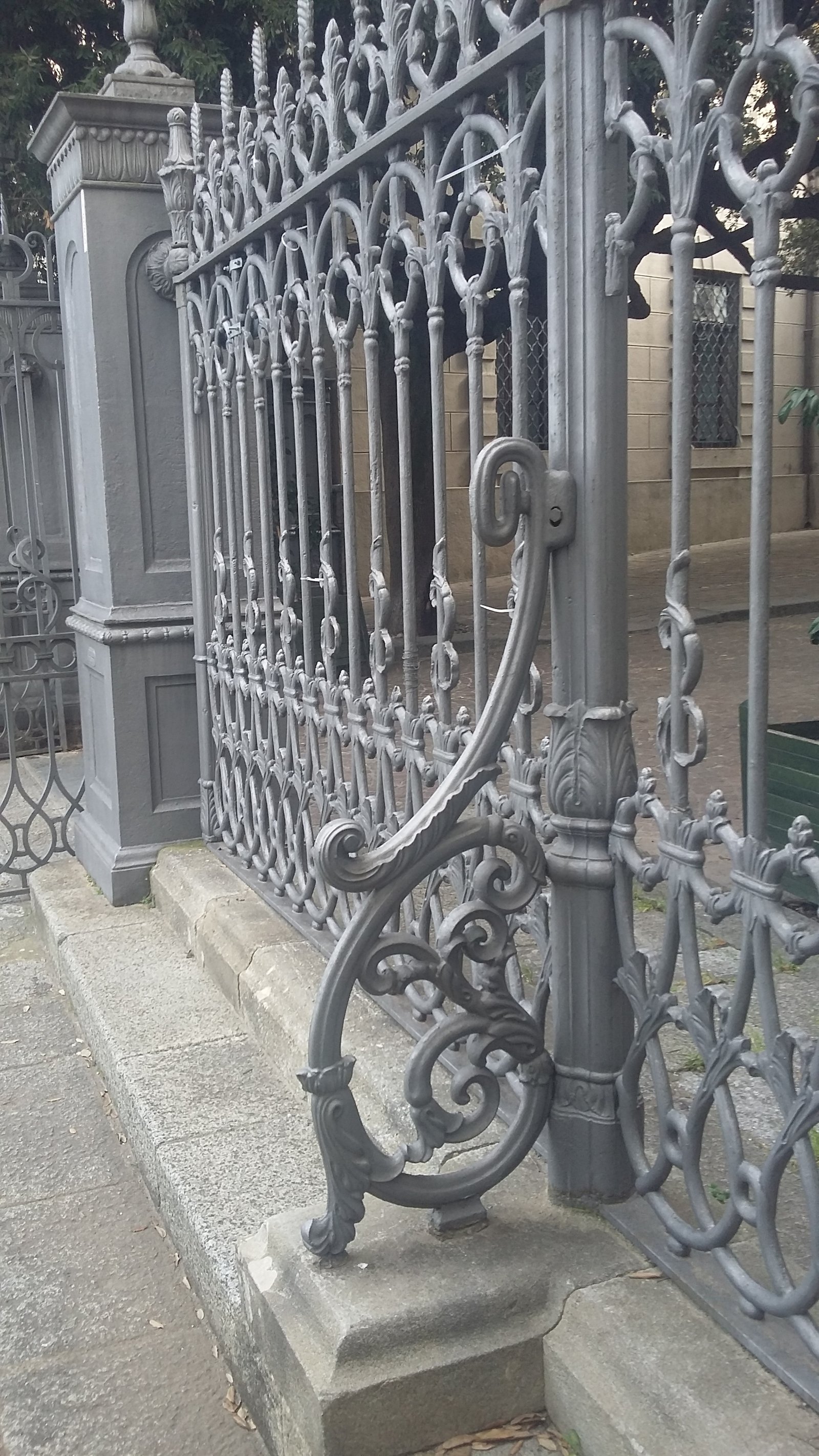
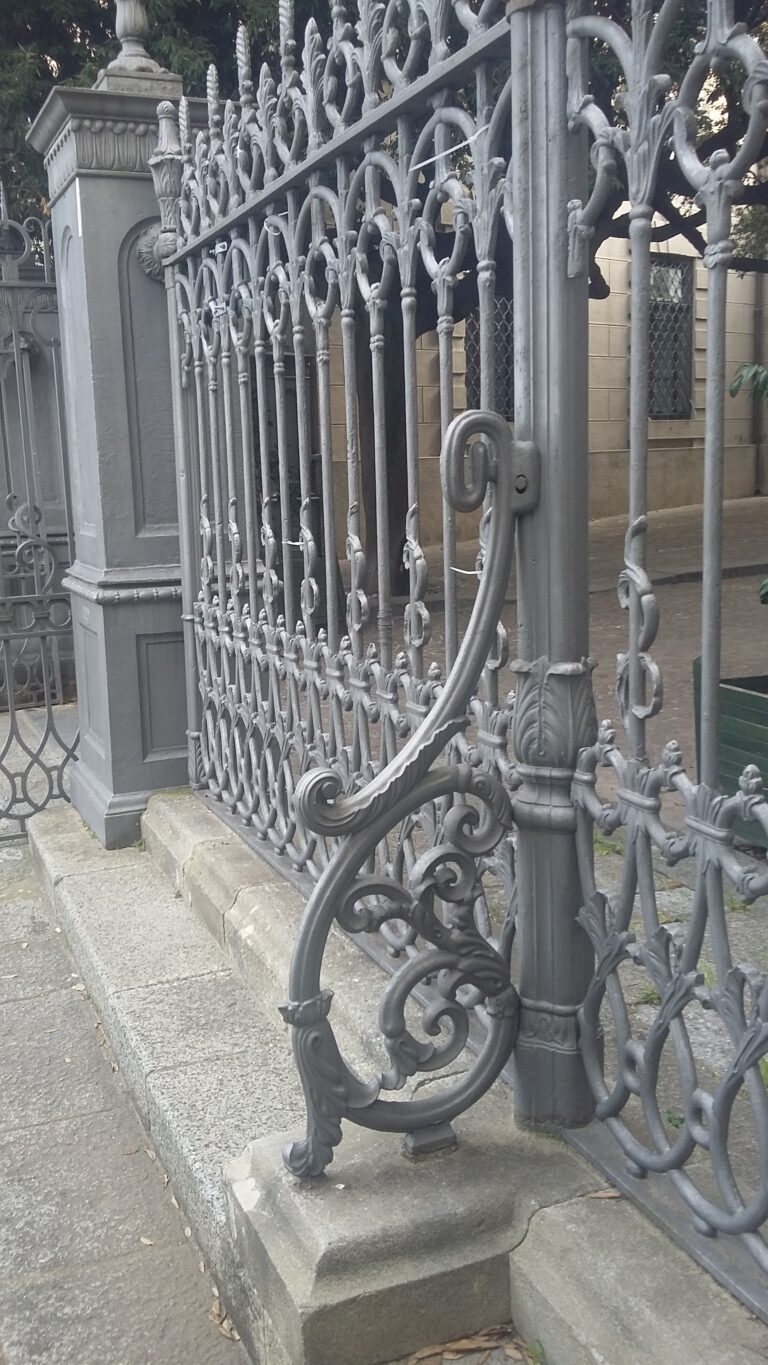
Before any of that, though, there is the fence. Villa Margherita is enclosed along the street by a continuous run of moulded iron — ferro fuso in the survey that catalogued it, iron poured into moulds rather than the higher-carbon ghisa of ordinary foundry ware: a low stone kerb, then panels of vertical bars topped with spearheads, tied by a band of interlaced rings and palmettes, and stopped at intervals by heavy pillars that carry the lamps. The pillars taper upward from a square base, their visible face framing the arms of the city of Catanzaro. Where the gates open, the posts are braced by great scrolled brackets that curl down to the pavement — the most sculptural pieces in the whole enclosure, and the ones that take the strain every time a gate swings.
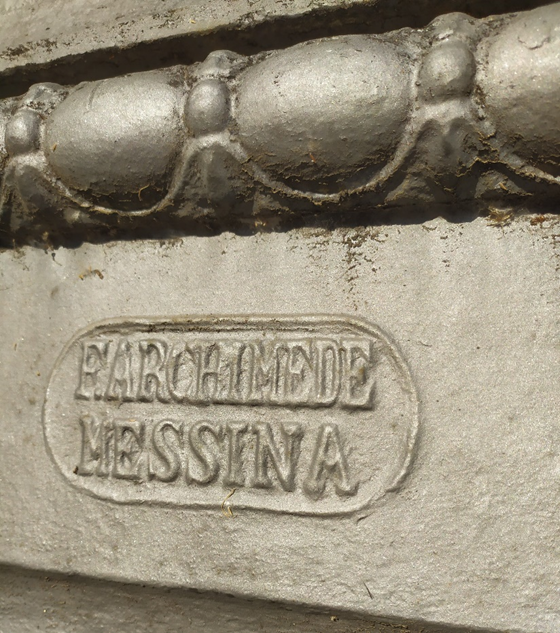
The enclosure carries its maker’s name. Raised in relief inside an oval cartouche, low down on the metal where nobody looks, are the words F. ARCHIMEDE — MESSINA. A second, more corroded cartouche of the same mark survives elsewhere in the city, on the railing posts leaded into the paving of the sagrato of the church of San Giovanni. The fence was therefore not made in Calabria at all: it came from the Archimede works across the strait, in Messina, and was shipped over — a reminder that the ornamental ironwork of a nineteenth-century Italian town was a traded product, ordered from a maker’s range and delivered, rather than beaten out by the local smith. The survey dates these pillars to 1879–1880, the years the garden was being finished. The mark is the only signature the garden has, and it is not mentioned in any guide to the city.
Cultural significance
Villa Margherita embodies the post-Risorgimento ideal of the public garden as a space of civic education and collective wellbeing, bringing formal landscape design — previously the preserve of the aristocracy — into the daily life of the urban population. For Catanzaro, a city with a long history as an administrative and judicial centre of the south, the garden represents the material expression of civic pride and institutional investment in the quality of public space. It remains the principal venue for outdoor cultural life in the city and a cherished landmark for the Catanzarese.
Practical information
- Location
- Catanzaro, Calabria, Italy — in the centre of the city, beside the town hall
- Hours
- Open daily; specific hours may vary by season — check with the Catanzaro municipality
- Admission
- Free entry
Getting there
Catanzaro is served by Lamezia Terme International Airport (SUF), approximately 35 km to the west and connected by bus and taxi. By rail, the city centre is reached via Catanzaro Città station on the Catanzaro Lido–Catanzaro line; Catanzaro Lido station on the Ionian mainline provides connections from Reggio Calabria and Taranto with a change required. By road, the A2 Autostrada del Mediterraneo passes to the west; the SS19 and SS106 serve the city from the south. Villa Margherita is located in the historic city centre and is within walking distance of the main civic buildings.
Sources & resources
On the enclosure and its maker’s mark: C. Riga and O. Mendicino (CROM), Iconografia dei manufatti in ferro dal tardo XVI al XX secolo nel centro storico di Catanzaro, 2025, the survey that first catalogued this material; the identification of the metal as ferro fuso — moulded iron, not ghisa — and the 1879–1880 dating of the pillars follow that survey, which records the Archimede works of Messina as their maker. The reading of the mark and the description above are our own, made from photographs taken on site by Ortensio Mendicino in 2026. See also our card on Palazzo Alemanni, a few minutes away, whose balcony railings belong to the same survey.
Find it on the map
See this place and what’s around it →Record researched and written by Ortensio Mendicino for Cultural Heritage Online, 2026.
📷 Become a Cultural Heritage Online photographer
Share your photos of places: they stay published under your name as the author. The more they're seen, the more you get noticed — and soon a contest will reward the most appreciated photos.
Log in or sign up free to add a photo