
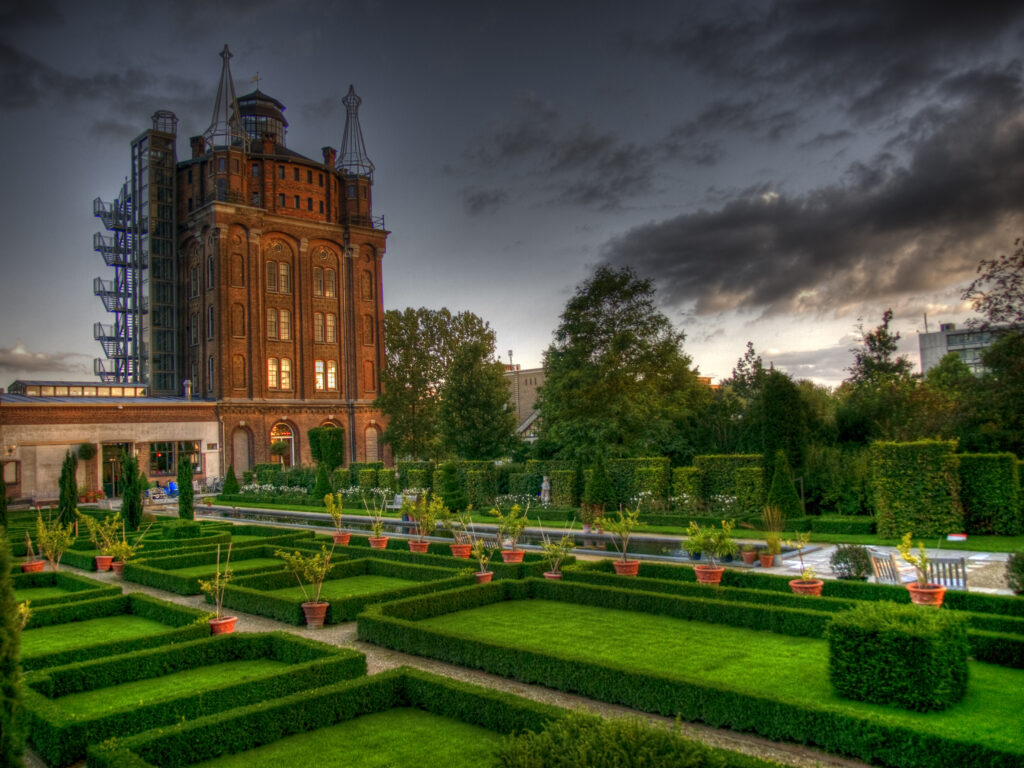

The second oldest water tower in the Netherlands, with the oldest surviving iron flat-bottomed reservoir in the country still inside it. There are twenty hotel rooms in the shaft.
At a glance
The water tower at Dordrecht was built in 1882 to a design by J. A. van der Kloes, the town’s director of public works. It stands thirty-three metres high, in the eclectic manner of its decade with the neo-Dutch Renaissance beginning to show through, and it held a clean-water cellar and an iron flat-bottomed reservoir of 500 cubic metres — the oldest of its type surviving in the Netherlands. It is the second oldest water tower in the country. Since 2007 the tower and the adjoining pump building have held the Villa Augustus hotel and restaurant, with twenty rooms in the tower, a restaurant in the pump house and a kitchen garden around them. Both buildings are national monuments.
Key facts
- Built: 1882
- Designed by: J. A. van der Kloes, director of public works, Dordrecht
- Height: 33 metres
- Distinction: the second oldest water tower in the Netherlands
- Reservoir: an iron flat-bottomed tank of 500 m³, the oldest surviving of its kind in the country
- Style: eclectic, with the emerging neo-Dutch Renaissance
- Protected: the tower and the pump building are both rijksmonument
- GPS: 51.815419, 4.684817 — View on Google Maps
History
Piped water arrived in Dutch towns in the second half of the nineteenth century, and each one needed a tower: a reservoir raised high enough to give the mains their pressure. Dordrecht built its in 1882, second in the country, which places it right at the start of the programme.
Van der Kloes was the municipal engineer, and his tower is an engineer’s building dressed as architecture. The 500-cubic-metre iron tank inside is the reason specialists come: flat-bottomed riveted reservoirs of that generation were almost all scrapped, and this is the oldest left standing in the Netherlands.
The tower stopped supplying water and, like most of its kind, faced the usual choice between conversion and demolition. The conversion came in 2007: twenty hotel rooms and two halls inside the shaft, a restaurant in the former pump building next door, and a kitchen garden laid out around them that supplies the restaurant. It is one of the better-known Dutch examples of industrial reuse, and it kept the machinery’s architecture rather than hiding it.
What you see
A brick tower of considerable bulk, with the strong verticals and the banded detailing that nineteenth-century Dutch engineers used to make a utility look like a civic building. The word the sources use is château d’eau, water castle, and the massing earns it.
The conversion works because the thing being converted is essentially a single tall room with a tank on top. Rooms are stacked up the shaft, so the plan is dictated by the 1882 structure rather than imposed on it. Outside, the garden gives you the distance to read the whole tower at once, which you cannot do from the road.
Practical information
- A hotel, restaurant and garden — the garden and the restaurant are open to visitors who are not staying
- The kitchen garden is the best vantage point for the tower and is worth the detour on its own
- Dordrecht’s historic harbour quarter is a short walk away
Getting there
Dordrecht lies south-east of Rotterdam, about twenty minutes away by train and an hour from Amsterdam. The tower is on the Stadswerven, roughly fifteen minutes on foot from the station, and the waterbus across the harbour is the pleasant way to arrive.
Nearby
- Hotel Tobaco — another industrial complex converted to a hotel, in Łódź
- Le Grand Curtius — brick and civic reuse on the Meuse
Sources
- Wikipedia (Dutch), « Watertoren (Dordrecht) » — the 1882 construction, J. A. van der Kloes, the height, the eclectic style with neo-Dutch Renaissance influence, the 500 m³ iron reservoir and its status as the oldest surviving, and the 2007 conversion
- Rijksmonumenten.nl, entries 526400 and 522366 — national monument status for Villa Augustus and the former pump station
- Villa Augustus, own history pages, and Evides Drinkwater — the conversion, the rooms and the kitchen garden
- OpenStreetMap and Wikipedia coordinates, cross-checked — location
Find it on the map
See this place and what’s around it →📷 Become a Cultural Heritage Online photographer
Share your photos of places: they stay published under your name as the author. The more they're seen, the more you get noticed — and soon a contest will reward the most appreciated photos.
Log in or sign up free to add a photoIs this page about you?
This page is read by travellers and heritage enthusiasts who find it on Google. Tell us how you are connected to this place and we will take it from there.