

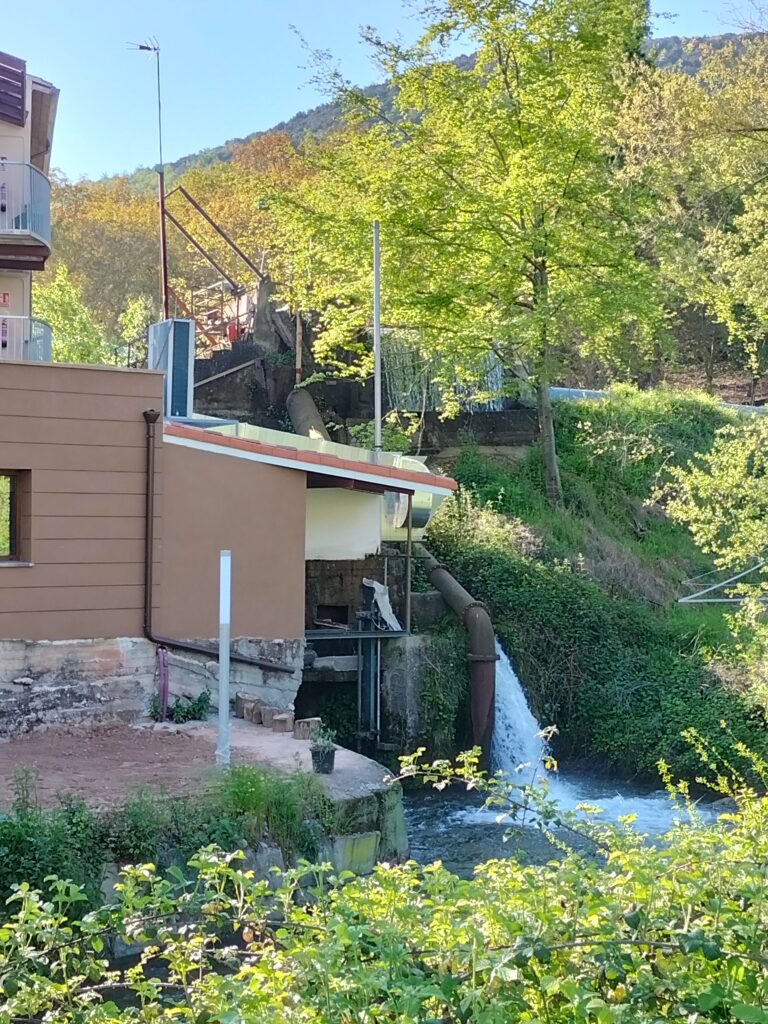

One of seven monastic mills, turned into a flour factory in 1902 and named after the owner’s wife. A 1925 turbine still drives the machinery from the river.
At a glance
La Gloria stands on the bank of the Cárdenas at San Millán de la Cogolla, the Riojan village where the earliest written Castilian is recorded and whose two monasteries, Suso and Yuso, are UNESCO World Heritage. The building sits on one of seven mills that belonged to the Benedictines of Yuso. In 1902 Santos Vázquez converted the mill into a flour factory with French machinery and named it after his wife. It works by the Robinson method of 1850, driven by a Francis turbine of 1925 fed from the river. Listed on Hispania Nostra’s Red List of endangered heritage in 2019, it was restored and has since moved to the Green List; it is now a museum.
Key facts
- Site: one of seven mills belonging to the Benedictine monks of the Monastery of Yuso
- Converted to a flour factory: 1902, by Santos Vázquez, with French technology
- Name: after Santos Vázquez’s wife, Gloria
- Method: the Robinson system, designed in 1850
- Power: a Francis turbine of 1925, driven by the river Cárdenas, still turning the machinery
- Red List: added by Hispania Nostra in April 2019 for advanced deterioration; restored and moved to the Green List
- Now: a museum and interpretation centre for the wheat-to-flour process
- GPS: 42.329521, -2.861780 — View on Google Maps
History
The monastery of Yuso held the water rights and the mills along the Cárdenas, which is the normal medieval arrangement in this part of Spain: the religious house owned the power, and the valley ground its grain where the monks said. Seven mills is a substantial holding, and La Gloria occupies one of them.
The change came in 1902, when Santos Vázquez — whose family had been millers for generations — rebuilt the mill as a flour factory using French machinery. The Robinson method he installed had been designed in 1850 and represented industrial milling as opposed to the stone grinding that had gone before. The Francis turbine of 1925 replaced the older drive and is still the thing that turns the shafts.
By 2019 the building was in an advanced state of decay and Hispania Nostra placed it on the Red List of heritage at risk. That listing did what it is meant to do: the factory was restored and moved to the Green List, and it now works as a museum where the whole process, from wheat to flour, can be followed on the original machinery.
What you see
A tall, plain industrial building of local stone and render on the riverbank, more vertical than a mill needs to be because the Robinson process moves grain up and lets gravity carry it down through the stages. That section is the architecture: the floors exist to hold the sequence of machines.
The interest is the machinery, which survives and runs. Follow the water first — the channel, the turbine of 1925 — then the shafts and belts upward. Very few flour factories of this generation survive complete anywhere in Europe, and fewer still turn.
Practical information
- A museum and interpretation centre; check opening, as hours are seasonal in a small village
- The machinery demonstration is the point of the visit — ask whether the turbine will be running
- The monasteries of Suso and Yuso are a few minutes away and are UNESCO World Heritage
Getting there
San Millán de la Cogolla lies in the Riojan hills, about forty-five minutes by road from Logroño and an hour and a half from Bilbao. There is no railway; a car is the practical way in.
Nearby
- Hotel Tobaco — industrial reuse in Poland, on a much larger scale
- Villa Augustus — a Dutch water tower kept working by conversion
Sources
- Fábrica de Harinas La Gloria, own pages, and San Millán de la Cogolla municipality — the monastic mill, the 1902 conversion by Santos Vázquez with French machinery, the name, the Robinson method and the 1925 Francis turbine
- Hispania Nostra, Lista Roja del Patrimonio, entry for the Fábrica de Harinas La Gloria — the April 2019 listing and the later move to the Green List
- La Rioja Turismo — the museum and interpretation centre
- OpenStreetMap Nominatim — coordinates verified against San Millán de la Cogolla
Find it on the map
See this place and what’s around it →📷 Become a Cultural Heritage Online photographer
Share your photos of places: they stay published under your name as the author. The more they're seen, the more you get noticed — and soon a contest will reward the most appreciated photos.
Log in or sign up free to add a photoIs this page about you?
This page is read by travellers and heritage enthusiasts who find it on Google. Tell us how you are connected to this place and we will take it from there.