
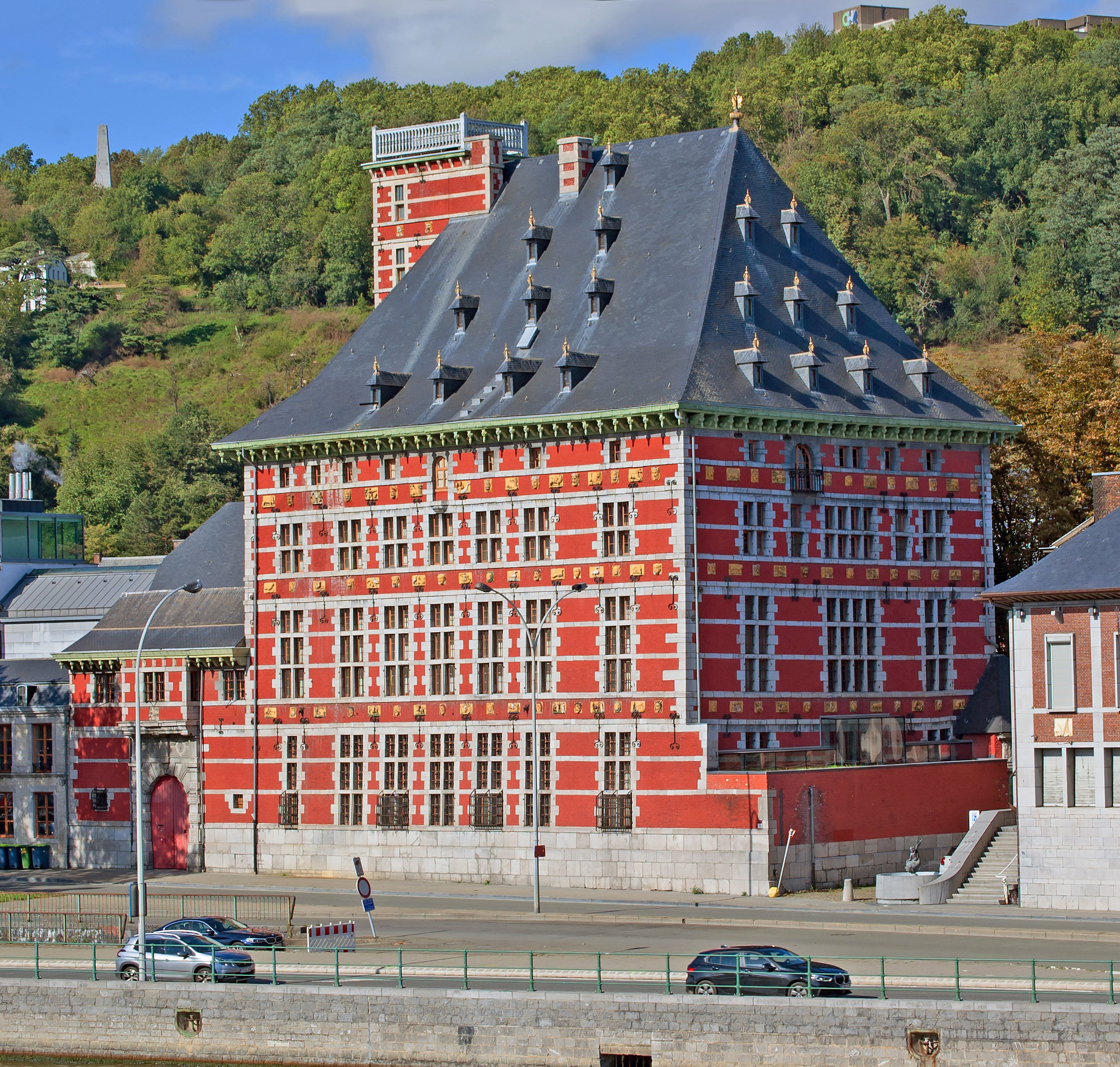

Red brick and pale stone in alternating courses, four storeys of cross-mullioned windows, a roof as tall as the walls. The house an arms dealer built on the Meuse is the textbook example of Mosan Renaissance, and now holds four museums at once.
At a glance
The Grand Curtius stands on the right bank of the Meuse, at the edge of the old centre of Liège. Its core is the mansion built between 1597 and 1610 for Jean Curtius, an industrialist who supplied munitions to the Spanish army — a private house on the scale of a public one. The museum is classified as Major Heritage of Wallonia and brings together, in more than five thousand square metres, the collections of archaeology, weaponry, decorative arts, glass, and religious and Mosan art.
Key facts
- What it is: a museum of archaeology, decorative arts, weaponry, glass and Mosan art
- The building: a private mansion built between 1597 and 1610 for Jean Curtius
- Style: Mosan Renaissance — alternating red brick and natural stone, cross-mullioned windows
- Reopened: March 2009, as the Grand Curtius, after a redevelopment costing €50 million
- Where: Féronstrée 136 and Quai de Maestricht 13, 4000 Liège
- Website: grandcurtius.be
History
Jean Curtius made his money in iron and gunpowder, selling munitions to the army of Spain, and built accordingly. The house went up between 1597 and 1610 on the river front, in the manner that Liège and the Meuse valley had made their own: brick and stone laid in bands, windows divided by a stone cross, a steep roof pierced with dormers.
Four centuries later the city used the mansion as the anchor of a single museum. A redevelopment of €50 million merged four institutions — the Museum of Archaeology, the Museum of Weaponry, the Museum of Decorative Arts and the Arteum of Religious and Mosan Art — and the Grand Curtius opened in March 2009.
Among the things it holds: a gilded reliquary triptych of the twelfth century from the church of Sainte-Croix, the Evangelarium of Notger, sculpture by Jean Del Cour, and the Bonaparte, First Consul painted by Ingres in 1804.
What you see
From the far bank the building reads as a block of colour: red walls striped horizontally in stone, with the same stone running up the corners and around every opening. The roof is the other half of the argument — a hipped slate mass, dormers in two ranks, almost as deep as the facade is high.
The modern additions are kept low and glazed, so the mansion holds the river front on its own, as it did when it was a merchant’s house and not a museum.
Practical information
- Two entrances: Féronstrée 136 and Quai de Maestricht 13.
- Check opening hours and tickets on the museum’s own site before travelling; the collections are shown by department across more than 5,000 m².
- Telephone +32 (0)4 221 68 17.
Getting there
The museum is in the old centre of Liège, along the quays, about twenty minutes on foot from Liège-Guillemins station or a short bus ride.
Nearby
- The Prince-Bishops’ Palace, the seat of the men who ruled the city.
- Liège Cathedral, a few streets inland.
- Val Saint-Lambert at Seraing, twelve kilometres upstream.
Sources
- English Wikipedia, Curtius Museum — the building dates 1597–1610, Jean Curtius, the Mosan Renaissance description, the €50 million redevelopment and the March 2009 reopening, the four merged museums and the highlights of the collection.
- Grand Curtius — the two addresses, the departments and the floor area.
- Wikidata (Q2304164) — coordinates and the 2009 date.
Find it on the map
See this place and what’s around it →Events here — now on & upcoming
- Quand Paganini rencontre Ysaÿe: the violins of the devils — Grand Curtius, Liège, 16 October 2026 to 7 March 202716 Oct 2026 — 07 Mar 2027See the event →
Historical events at this place (1)
📷 Become a Cultural Heritage Online photographer
Share your photos of places: they stay published under your name as the author. The more they're seen, the more you get noticed — and soon a contest will reward the most appreciated photos.
Log in or sign up free to add a photoIs this page about you?
This page is read by travellers and heritage enthusiasts who find it on Google. Tell us how you are connected to this place and we will take it from there.