
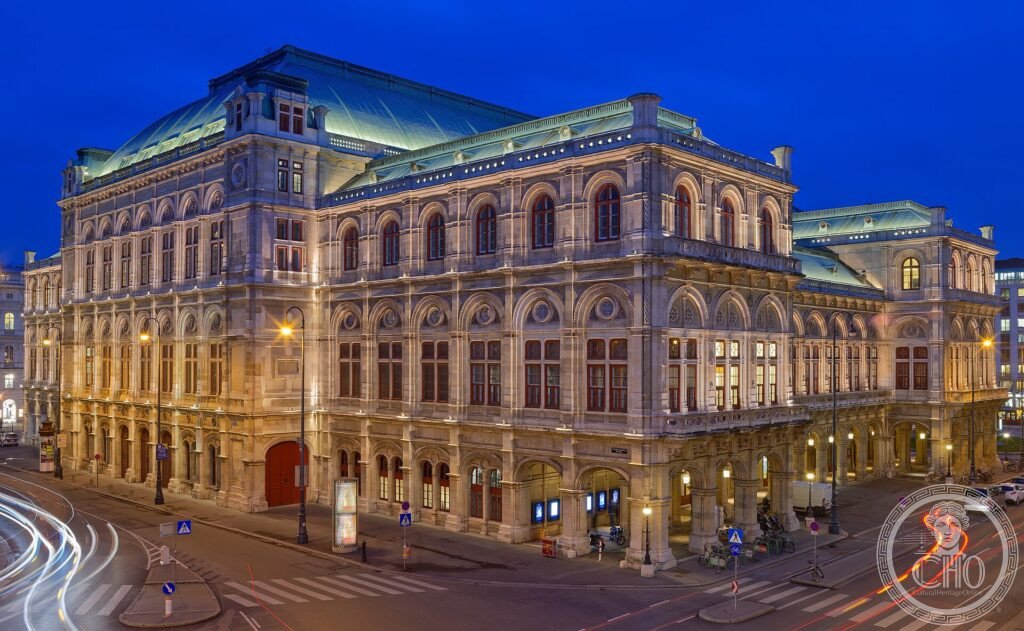
Capital of the Habsburgs for centuries, Vienna wove together imperial power and Europe’s greatest musical tradition. From baroque palaces to the great nineteenth-century Ringstrasse, its historic centre tells three eras: medieval, baroque and imperial. Mozart, Beethoven, Brahms and Strauss all wrote here.
At a glance
The historic centre of Vienna records three great ages of European culture: the medieval city around St Stephen’s Cathedral, the Baroque capital of the Habsburg Empire, and the grand 19th-century boulevard of the Ringstrasse. For centuries the seat of the Holy Roman and Austro-Hungarian empires, Vienna was also the musical capital of Europe, home to Mozart, Beethoven, Schubert, Brahms, Mahler and the Strauss family. The old town was inscribed by UNESCO in 2001.
Key facts
- UNESCO: World Heritage since 2001 (Historic Centre of Vienna)
- Three ages: medieval core, Baroque imperial city, and the 19th-century Ringstrasse
- St Stephen’s Cathedral: the Gothic Stephansdom with its patterned tiled roof
- Ringstrasse: the monumental boulevard of opera, parliament, museums and the Hofburg
- Music capital: the city of Mozart, Beethoven, Schubert, Brahms and Johann Strauss
- Imperial seat: capital of the Habsburg monarchy for over six centuries
History
Roman Vindobona grew into a medieval city around St Stephen’s, and from the 13th century became the seat of the Habsburgs, who would rule a vast European empire. In the Baroque age, after the Ottoman sieges were turned back, the dynasty and its nobles filled the city and its edges with palaces, churches and the summer residence of Schönbrunn.
In the 19th century Emperor Franz Joseph ordered the old walls demolished and replaced by the Ringstrasse, a grand circular boulevard lined with monumental public buildings in historicist styles. Through all these ages Vienna nurtured an unrivalled musical life, from the Classical masters to the waltz and to the modernism of 1900.
What you see
At the heart stands St Stephen’s Cathedral, its south tower and glittering tiled roof rising over the old town’s lanes and squares. The Hofburg palace complex spreads nearby, and the Ringstrasse sweeps around them past the State Opera, the twin museums, the parliament and the city hall.
Coffee houses, the State Opera and the concert halls keep alive the musical and café culture for which the city is famous.
Practical information
- Old town: compact and walkable; much is pedestrianised
- Music: the State Opera and Musikverein offer performances year-round
- Time needed: two or more days for the centre and palaces
- Note: Schönbrunn and Belvedere palaces lie just outside the inscribed core
Getting there
Vienna is the capital of Austria, a major rail and air hub in central Europe. The airport links to the centre by train; the U-Bahn serves the old town from the main stations. GPS: 48.2065° N, 16.3690° E.
Nearby
- Schönbrunn Palace — the Habsburg summer palace, its own UNESCO site
- Wachau — the UNESCO Danube valley, west of the city
- Bratislava — the Slovak capital, an hour down the Danube
Sources
- UNESCO World Heritage Centre — “Historic Centre of Vienna” (ref. 1033)
- Stadt Wien — official city authority
- Encyclopaedia Britannica — Vienna
Find it on the map
See this place and what’s around it →📷 Become a Cultural Heritage Online photographer
Share your photos of places: they stay published under your name as the author. The more they're seen, the more you get noticed — and soon a contest will reward the most appreciated photos.
Log in or sign up free to add a photo