

Built for Louis XIV from 1661 on the site of his father’s hunting lodge, Versailles became the seat of French absolute monarchy and the model every European court sought to imitate. Its Hall of Mirrors later hosted two of the most consequential signings in modern European history.
At a glance
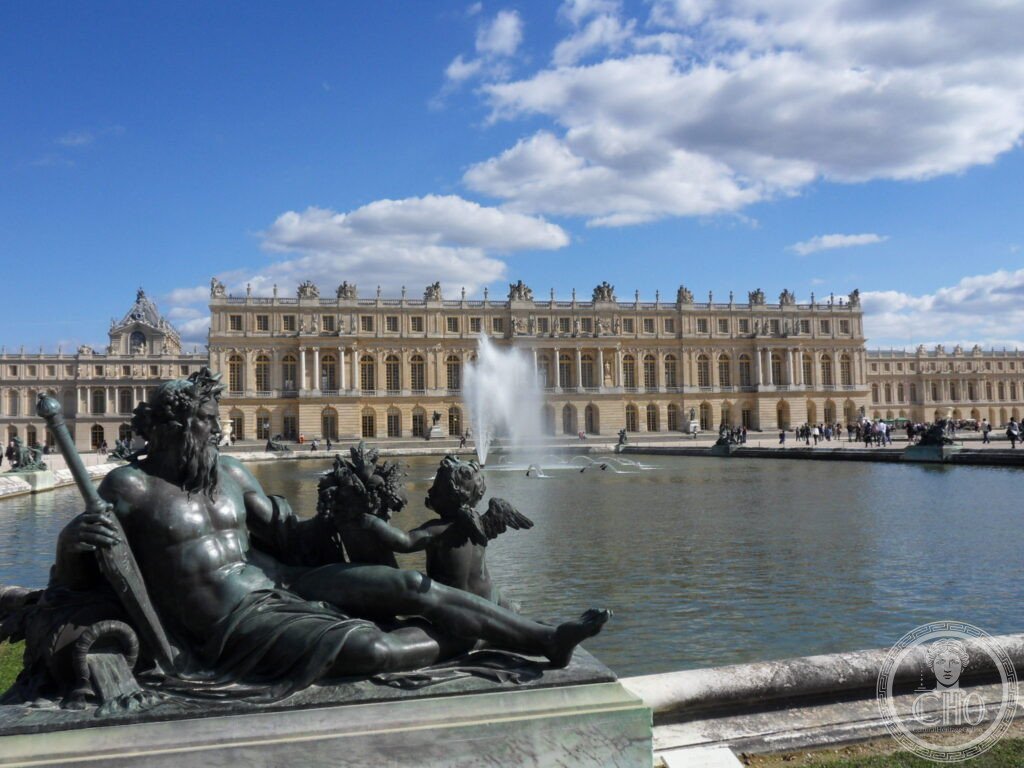
The Palace of Versailles presents a continuous garden facade some 670 metres long, built in pale Pierre de Luèse limestone with regularly spaced pilasters and alternating arched and pedimented windows. The Grand Château alone contains around 700 rooms, 2,153 windows and 67 staircases, with a total floor area of roughly 63,154 square metres. The surrounding gardens, laid out by André Le Nôtre, cover some 800 hectares and are threaded with around 1,400 individual fountain jets fed by an elaborate 17th-century hydraulic system.
The whole composition follows a single east-west axis, aligning the setting sun with the 357 mirrors of the Hall of Mirrors in a deliberate piece of solar theatre tied to Louis XIV’s identity as the Sun King.
Key facts
- Architect: Jules Hardouin-Mansart, who also designed the dome of Les Invalides and the Place Vendôme in Paris.
- Hall of Mirrors: the Galerie des Glaces measures 73 metres long, 10.5 metres wide and 12.3 metres high, lined with 357 mirrors made at the Manufacture Royale des Glaces de Miroirs, established in 1665 to end French dependence on Venetian glass.
- Ceiling paintings: Charles Le Brun completed the allegorical ceiling of the Hall of Mirrors between 1681 and 1686, comprising 30 paintings celebrating Louis XIV’s reign.
- Gardens: designed by André Le Nôtre, covering around 800 hectares and organised around a strict central axis, with thirteen themed groves known as bosquets.
- Water supply: the Machine de Marly, built from 1682, used fourteen water wheels on the Seine to pump water 162 metres uphill to feed the Versailles fountains.
- Trianon architect: Ange-Jacques Gabriel designed the Petit Trianon for Louis XV between 1762 and 1768; Richard Mique later designed the Hameau de la Reine for Marie Antoinette.
History
Versailles began as a hunting lodge built for Louis XIII. From 1661 Louis XIV transformed the site into a vast palace, employing Jules Hardouin-Mansart as architect, André Le Nôtre for the gardens and Charles Le Brun for the interior decoration. In 1682 Louis XIV moved his court and government there, making Versailles the political and cultural centre of France.
The palace later became the setting for two pivotal moments in modern history. On 18 January 1871 the German princes proclaimed Wilhelm I of Prussia as Kaiser of the new German Empire in the Hall of Mirrors, following France’s defeat in the Franco-Prussian War. On 28 June 1919 the Treaty of Versailles, formally ending the First World War, was signed in the same room, with the German delegation seated beneath ceiling paintings celebrating earlier French military victories over Germany.
The Palace and Park of Versailles were inscribed on the UNESCO World Heritage List in 1979.
What you see
The visit begins with the long garden facade of the Corps de Logis and its flanking wings, fronted by the Parterre d’Eau, twin reflecting pools edged with lead sculptures of river gods and nymphs. Inside, the Hall of Mirrors remains the centrepiece, its arched mirrors facing tall windows onto the gardens beneath Le Brun’s painted ceiling.
Beyond the palace, Le Nôtre’s gardens unfold along a strict central axis, from the tapis vert lawn to the Bassin d’Apollon, where a sculpted Apollo emerges in his chariot, and the Latona fountain, whose allegorical figures and jets recall the myth of Latona and the transformed peasants. Scattered among the geometric groves are set-piece bosquets such as the Salle de Bal and the Théâtre d’Eau.
Further into the estate stand the Petit Trianon, Marie Antoinette’s comparatively restrained private retreat, the Temple of Love in its English garden, and the Hameau de la Reine, a cluster of rustic thatched buildings including a working mill and dairy, built to look deliberately humble in contrast to the formality of the main palace.
Practical information
- Opening arrangements: ticketing, timed entry and seasonal opening hours are managed by the Château de Versailles and are best checked on its official website before visiting.
- Scale of the visit: the palace, gardens and Trianon estate together cover a very large area, and visitors typically plan for a full day to take in more than the main state apartments.
- Fountains: the musical fountain displays run only on selected dates, so timings should be confirmed with the official Château de Versailles programme.
Getting there
Versailles lies in the Île-de-France region, a short distance from Paris. Regional trains connect the town directly with the French capital, and the palace itself is within walking distance of the Versailles stations; current timetables and routes are best checked through official transport and Château de Versailles channels.
Nearby
- Petit Trianon — within the park, Marie Antoinette’s private Neoclassical retreat built for Louis XV.
- Hameau de la Reine — adjoining the Petit Trianon, a rustic hamlet of thatched farm buildings built in 1783.
- Grand Canal — on the garden’s main axis, a formal waterway some 1.6 kilometres long.
Sources
- UNESCO
Find it on the map
See this place and what’s around it →Events here — now on & upcoming
- Anniversary: The German Empire Proclaimed at Versailles — January 18, 187118 Jan 2027See the event →
Historical events at this place (1)
📷 Become a Cultural Heritage Online photographer
Share your photos of places: they stay published under your name as the author. The more they're seen, the more you get noticed — and soon a contest will reward the most appreciated photos.
Log in or sign up free to add a photoIs this page about you?
This page is read by travellers and heritage enthusiasts who find it on Google. Tell us how you are connected to this place and we will take it from there.