

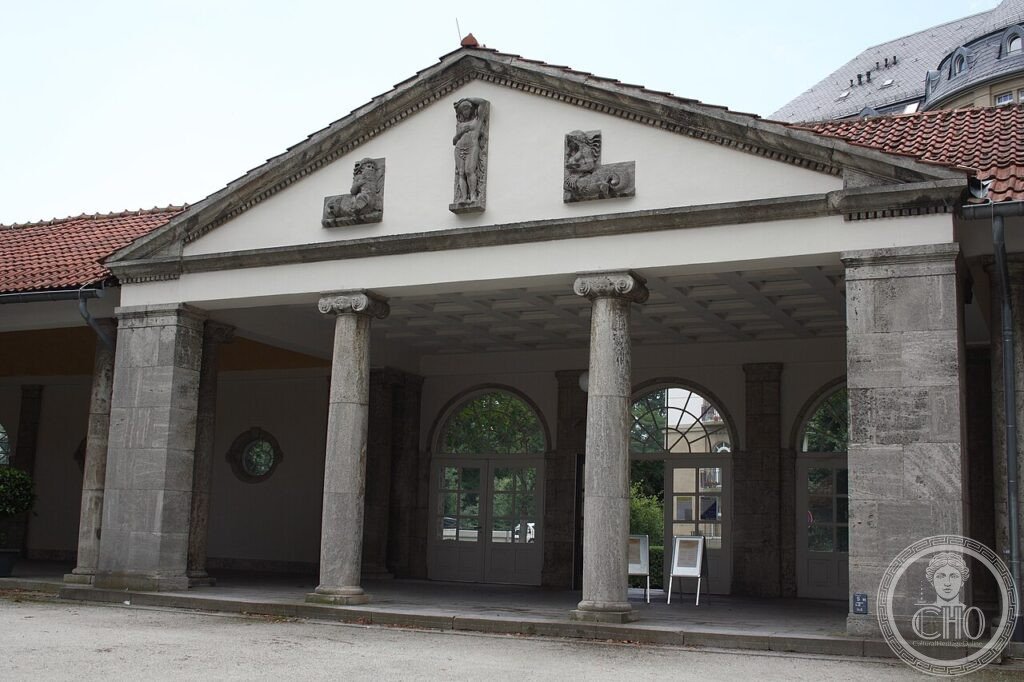

Drinking mineral water was never staged more beautifully: a horseshoe of Jugendstil colonnades, a basin, an orchestra shell and a little eight-sided temple over the spring — Bad Nauheim’s second act after the Sprudelhof.
At a glance
The Trinkkuranlage — the drinking-cure complex — was built from the autumn of 1910 to the spring of 1911, with its furnishings completed by 1912, to designs by Wilhelm Jost, the architect of the neighbouring Sprudelhof. Commissioned on behalf of Grand Duke Ernst Ludwig of Hesse, whose patronage had already made Darmstadt’s Mathildenhöhe the German capital of Jugendstil, it arranges columned walkways in a horseshoe around a large basin, with an orchestra shell for the spa band and, as the ensemble’s jewel, an octagonal temple sheltering the drinking spring.
Key facts
- Built: Autumn 1910 – spring 1911; furnishings completed 1912
- Architect: Wilhelm Jost, architect of the Sprudelhof
- Patron: Grand Duke Ernst Ludwig of Hesse
- Composition: Horseshoe of columned walkways around a large basin; orchestra shell; octagonal spring temple
- Style: Late Jugendstil
- Location: Ernst-Ludwig-Ring, Bad Nauheim
- GPS: 50.362512, 8.740060 — View on Google Maps
History
Bad Nauheim’s carbonated brine springs made it one of Europe’s great heart spas, and Grand Duke Ernst Ludwig — the same prince who founded the Darmstadt artists’ colony — determined that its architecture should match its medicine. Wilhelm Jost delivered first the Sprudelhof (1905–1911), the monumental bathing court, and then this quieter complement: where the Sprudelhof staged bathing, the Trinkkuranlage staged the morning ritual of drinking the waters, glass in hand, walking the colonnades while the orchestra played. The complex has remained in spa use for over a century, its restoration supported by the German Foundation for Monument Protection, and concerts still fill the orchestra shell in season — the ritual it was built for, essentially unchanged.
What you see
The plan is a great horseshoe opening toward the town: covered walkways on paired columns curve around the central basin, their rhythm designed for slow pacing rather than passage. The orchestra shell closes one axis; the octagonal spring temple — the ensemble’s jewel — marks the source itself, its canopy detailed with the geometric late-Jugendstil ornament that Jost had refined at the Sprudelhof next door. Together the two complexes form one of the most complete Art Nouveau spa landscapes in Europe — comparable only to ensembles like Salsomaggiore or Vichy — and the walk from the Sprudelhof’s bathing courts to the Trinkkuranlage’s colonnades takes five minutes and one century of spa ritual.
Practical information
- The complex is an open public spa ensemble — the colonnades, basin and spring temple are freely accessible
- Concerts at the orchestra shell run in the warm season — check the Bad Nauheim spa calendar
- Combine with the Sprudelhof for the full Jost ensemble; allow 1–2 hours for both
Getting there
The Trinkkuranlage faces the Ernst-Ludwig-Ring in the spa quarter, five minutes on foot from Bad Nauheim station. Trains from Frankfurt am Main reach Bad Nauheim in about half an hour, making the spa town an easy day trip from the metropolis.
Nearby
- Sprudelhof — Jost’s monumental bathing court of 1905–1911, the largest Jugendstil ensemble in Germany, next door
- Kurpark — the landscaped spa park continuing the ensemble
- Mathildenhöhe Darmstadt — Ernst Ludwig’s artists’ colony, the other pole of Hessian Jugendstil
Sources
- Deutsche Stiftung Denkmalschutz (denkmalschutz.de), “Trinkkuranlage” — dates, patron, composition, restoration
- Stadt Bad Nauheim (bad-nauheim.de) — Jugendstil heritage pages, current spa use
- badnauheim.tour-de-kultur.de — Wilhelm Jost and the ensemble
- Wikidata Q111027760 — coordinates
Find it on the map
See this place and what’s around it →Record researched and written by Luigi De Marchi for Cultural Heritage Online, 2026.
📷 Become a Cultural Heritage Online photographer
Share your photos of places: they stay published under your name as the author. The more they're seen, the more you get noticed — and soon a contest will reward the most appreciated photos.
Log in or sign up free to add a photoIs this page about you?
This page is read by travellers and heritage enthusiasts who find it on Google. Tell us how you are connected to this place and we will take it from there.