
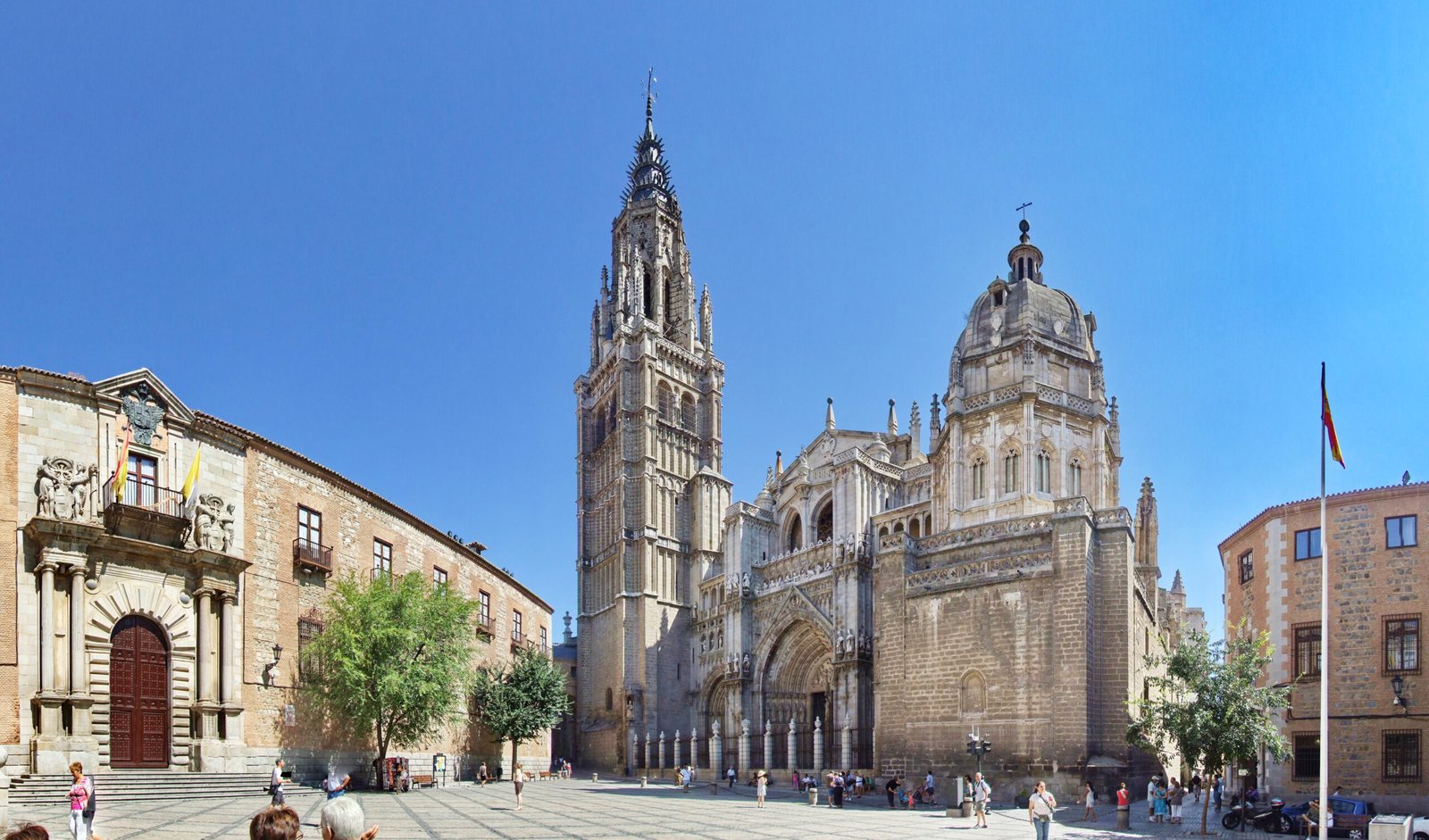
The primatial cathedral of Saint Mary of Toledo is the seat of the primate of Spain and one of the great masterpieces of European Gothic. It was begun in 1226. Some sources say 1227, but the cathedral itself celebrates in 2026 the eighth centenary, counting from 1226. The work began under Ferdinand III the Saint and Archbishop Rodrigo Jiménez de Rada, on the foundations of the ancient Visigothic basilica of Saint Mary, which in Muslim times had been turned into the great mosque of the city. The layering of the three religions of Toledo, Jewish, Christian and Islamic, is here literally in the foundations, and the official UNESCO description makes it plain. The work closed in 1493, when the last bays of the central nave were vaulted, after generations of masters had worked on it: a French «master Martín» by tradition, then Petrus Petri, and later Alvar Martínez, Hanequin of Brussels, Enrique Egas, Covarrubias. The result was a Gothic of French inspiration bent to Castilian light: a plan of five naves, a wide transept, an ambulatory and radial chapels, about 120 metres long and some sixty wide. The single tower, 92 metres high, was raised between 1380 and 1422 in Toledan Gothic with mudéjar grafts and crowned by a pyramidal iron spire. The opposite side of the front is closed by the dome of the Mozarabic Chapel, which Jorge Manuel Theotocópuli, son of El Greco, rebuilt after the fire of the lantern in 1622, completing the whole in 1631. That chapel holds what makes Toledo unique: in 1504 Cardinal Cisneros set it aside to perpetuate the Hispano-Mozarabic rite, and a Mass in that ancient liturgy is still celebrated there every morning. Behind the high altar opens El Transparente by Narciso Tomé, finished in 1732: to light it, the sculptor pierced the vault of the ambulatory so that a ray of sun would fall from above onto the Sagrario, «an explosion of marble, bronze, stucco and light», as the cathedral itself puts it. The sacristy is a picture gallery: beneath the ceiling fresco by Luca Giordano and facing the Espolio of El Greco, Titian, Caravaggio, Van Dyck and Goya are in conversation. In the choir, the lower stalls were carved by Rodrigo Alemán between 1489 and 1495 with scenes of the conquest of Granada, the upper ones by Felipe Bigarny and Alonso Berruguete. And there is the Custodia of Enrique de Arfe, a processional monstrance of almost 200 kilos of gilded silver and more than three metres high, commissioned by Cardinal Cisneros and finished in 1524, which goes out every year in the Corpus Domini procession. From the tower hangs the Campana Gorda, cast in 1753 and cracked at its first stroke. The cathedral is not inscribed on the UNESCO list on its own: it is the keystone monument of the Historic City of Toledo, inscribed in 1986 under criteria (i), (ii), (iii) and (iv).
About the Cathedral
The Primate Cathedral of Saint Mary of Toledo, seat of the Primate of Spain, was begun in 1226 over the Visigothic basilica that had served as the city’s Great Mosque, and completed in 1493. A five-nave Gothic church inspired by French models but shaped by Castilian light, it carries a single 92-metre tower, Narciso Tomé’s light-pierced Transparente, and a Mozarabic Chapel where the Hispano-Mozarabic rite is still sung each morning. It is the central monument of the Historic City of Toledo, a UNESCO World Heritage Site since 1986.
Key facts
- 1226: construction begins under Ferdinand III and Archbishop Rodrigo Jiménez de Rada (some sources say 1227); the cathedral marks its 800th anniversary in 2026.
- 6th century / Muslim period: the site held the Visigothic basilica of St. Mary, later the city’s Great Mosque.
- 1493: completed, when the last vaults of the central nave were closed.
- 1380–1422: the single 92-metre bell tower built in Toledan Gothic with Mudéjar detail.
- 1631: Jorge Manuel Theotocópuli, El Greco’s son, completes the rebuilt Mozarabic Chapel dome after the 1622 fire.
- 1732: Narciso Tomé’s Transparente completed, lit by a shaft cut through the ambulatory vault.
- 1986: Historic City of Toledo inscribed by UNESCO, criteria (i)–(iv).
History
Toledo’s cathedral rises on the layered ground that makes the city itself a UNESCO site: a 6th-century Visigothic basilica of St. Mary that became the Great Mosque under Muslim rule, cleared to build the Gothic cathedral begun in 1226 under Ferdinand III and Archbishop Rodrigo Jiménez de Rada. Its French-inspired design passed through generations of masters — a Master Martín by tradition, then Petrus Petri, later Alvar Martínez, Hanequin of Brussels and Enrique Egas — and was completed in 1493, when the last vaults of the central nave were closed by the Catholic Monarchs. The single tower went up between 1380 and 1422; the domed Mozarabic Chapel opposite it was rebuilt by El Greco’s son Jorge Manuel in 1631.
What sets Toledo apart is not only its scale but its continuity. In 1504 Cardinal Cisneros set aside the Mozarabic Chapel to preserve the Hispano-Mozarabic rite, a liturgy older than the Roman Mass in Spain; it is still sung there every morning, eight centuries into the building’s life. The 18th century added Narciso Tomé’s Transparente, a Baroque explosion of marble and light behind the high altar, and the Campana Gorda, cast in 1753 and cracked at its very first ringing — a cathedral that never quite stopped being built.
What you see
From the Plaza del Ayuntamiento the west front shows the asymmetry that identifies Toledo: one soaring crowned bell tower to the north, the domed Mozarabic Chapel to the south. Inside, five naves run some 120 metres under 88 columns, past the choir — lower stalls carved by Rodrigo Alemán with the fall of Granada, upper by Bigarny and Berruguete — to Tomé’s Transparente, where a shaft of daylight cut through the vault falls on the tabernacle. The sacristy is a picture gallery in itself: El Greco’s Expolio, a Luca Giordano ceiling, and canvases by Titian, Caravaggio, Van Dyck and Goya. The treasury keeps Enrique de Arfe’s silver-gilt Custodia, over three metres tall, carried through the streets each Corpus Christi.
Practical information
- Opening hours: generally Monday–Saturday 10:00–18:30, Sunday afternoons; last access 30 minutes before close — check current times before visiting.
- Entry: cultural visits enter by the step-free Puerta Llana (Calle Cardenal Cisneros); tickets online or at the Cathedral Shop opposite.
- Location: Plaza del Ayuntamiento, 45002 Toledo, Spain.
- Status: active Primate Cathedral of Spain; daily Mass, including the Hispano-Mozarabic rite in the Mozarabic Chapel.
Getting there
The cathedral sits at the very centre of Toledo’s medieval maze, a short walk from the Alcázar and the old synagogues; Toledo is about 30 minutes from Madrid by high-speed train. GPS: 39.8574°N, 4.0240°W.
Nearby
- Historic City of Toledo — the UNESCO-listed “city of three cultures”, Jewish, Christian and Muslim.
- Monastery of San Juan de los Reyes — the Isabelline-Gothic royal monastery named in the same UNESCO listing.
- Alcázar of Toledo — the great square fortress crowning the city’s highest point.
Sources
- Catedral Primada de Toledo — official history, tower, chapels, choir, sacristy, Transparente and Custodia records.
- UNESCO World Heritage Centre — “Historic City of Toledo” (ref. 379).
- Encyclopædia Britannica — Toledo, Spain.
- Junta de Comunidades de Castilla-La Mancha — cultural-heritage catalogue and tourism records.
- spain.info — national tourism board, cross-checked.
- Wikipedia (English and Spanish) — “Toledo Cathedral”, used as a map and cross-checked.
Find it on the map
See this place and what’s around it →📷 Become a Cultural Heritage Online photographer
Share your photos of places: they stay published under your name as the author. The more they're seen, the more you get noticed — and soon a contest will reward the most appreciated photos.
Log in or sign up free to add a photo