
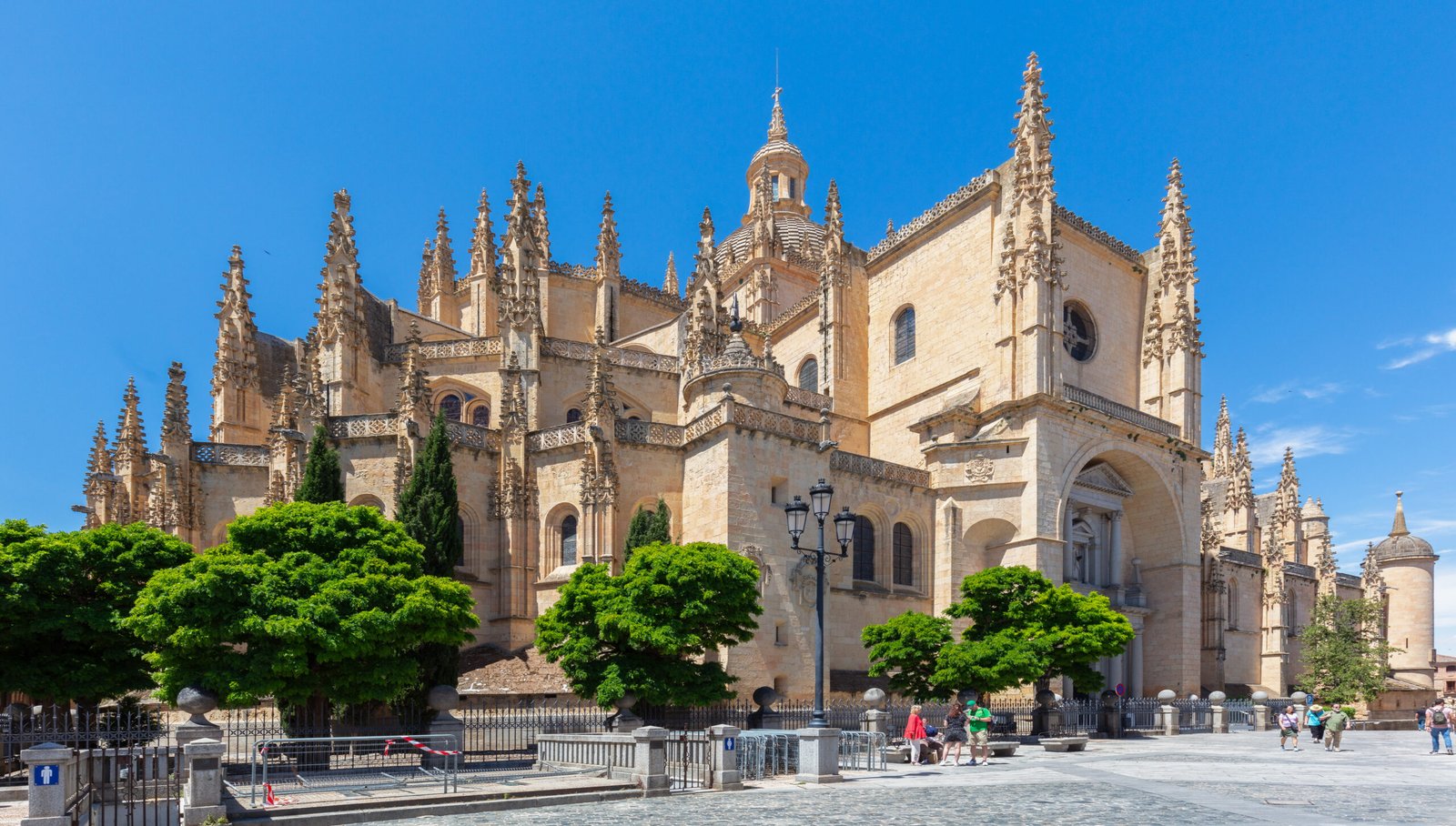
The cathedral dedicated to the Assumption of Mary and to San Frutos, patron saint of Segovia, was born out of the destruction of the one before it. The old Romanesque cathedral stood beside the Alcázar; during the War of the Communities of 1520-21 it was used as a defensive position and badly damaged, which is what the official record states, rather than a levelling in one blow, and was then abandoned. The contract with Juan Gil de Hontañón was signed on 7 May 1524 and the first stone laid on 8 June 1525 on the western side. Juan Gil died the year after the works began, and was succeeded by his son Rodrigo Gil de Hontañón, who worked on the building until his death in 1577. The cathedral was blessed and opened for worship, still unfinished, on 15 August 1558, but the final consecration came only on 16 July 1768, 243 years after the first stone. It is this delay that gives sense to the most repeated superlative: the official UNESCO description calls it «the last cathedral to be built in Spain in this style», the Gothic, and that is the wording followed here, while the website of the cathedral, more cautious, says «one of the latest in Spain and in Europe», so the extension to Europe is not used. The late-Gothic cloister of the fifteenth century, the work of Juan Guas, was not rebuilt from scratch: it was taken apart stone by stone from the old cathedral and reassembled here by Juan Campero, one of the first moves of its kind carried out in Spain. The tower long marked the skyline: 108 metres high, with a final wooden spire of 25 metres in Valsaín pine clad in lead, not mahogany as is sometimes written, it was set alight by lightning on 18 September 1614. The lead ran for hours, and a spark reached the vault of the Capilla Mayor. It was replaced by a stone dome designed by Pedro de Brizuela and executed by Juan de Mugaguren; the tower now measures 88 metres and, since 2014, can be climbed by booking. Inside there are 157 stained-glass windows, the oldest of the sixteenth century, by Spanish and Flemish masters, and the neoclassical high altarpiece that Francesco Sabatini made at the request of Charles III, in marble and bronze, to hold the fourteenth-century Virgen de la Paz. Elegant and slender, the cathedral is known as «la Dama de las Catedrales», the Lady of the Cathedrals, a nickname in current use whose author has not been established, and which is therefore attributed to no one here. It is not inscribed on the UNESCO list on its own: it is one of the major monuments of the Old Town of Segovia and its Aqueduct, inscribed in 1985 under criteria (i), (iii) and (iv).
About the Cathedral
Segovia Cathedral, dedicated to the Assumption of the Virgin and to San Frutos, rises over the Plaza Mayor in honey-coloured stone. Its first stone was laid in 1525, after the older Romanesque cathedral by the Alcázar was ruined in the War of the Communities; begun by Juan Gil de Hontañón and continued by his son Rodrigo, it was consecrated only in 1768. UNESCO calls it the last Gothic cathedral built in Spain. Its late-Gothic mass, 88-metre tower and 157 stained-glass windows anchor the Old Town of Segovia, a UNESCO World Heritage Site since 1985.
Key facts
- 1520–21: the old Romanesque cathedral, used as a defensive position in the War of the Communities, is wrecked.
- 8 June 1525: first stone of the new cathedral laid, to Juan Gil de Hontañón’s design; continued by his son Rodrigo after 1526.
- 15 August 1558: blessed and opened for worship while still unfinished.
- 18 September 1614: lightning burns the 25-metre wooden spire; a stone dome by Pedro de Brizuela replaces it.
- 16 July 1768: final consecration, 243 years after the first stone.
- 88 m: height of the tower, open to guided visits since 2014.
- 1985: Old Town of Segovia and its Aqueduct inscribed by UNESCO, criteria (i)(iii)(iv).
History
Segovia built its cathedral late and out of a defeat. The old Romanesque cathedral stood beside the Alcázar and was ruined during the War of the Communities of 1520–21, when it served as a defensive position; the Chapter moved the seat to higher ground by the Plaza Mayor, laying the first stone in 1525. Juan Gil de Hontañón died the year after work began, and his son Rodrigo carried the design to his own death in 1577. Through 160 years of building, the later masters held to the Hontañón line, giving the church a stylistic unity unusual in Spanish architecture — and, in UNESCO’s phrase, making it the last Gothic cathedral built in Spain.
Two survivals from the old cathedral travelled across the city: the 15th-century cloister by Juan Guas, dismantled and rebuilt stone by stone by Juan Campero, and the Gothic sense of scale itself. The tower once reached 108 metres with a lead-clad wooden spire, until a lightning strike on 18 September 1614 set it alight, the lead running molten for hours; Pedro de Brizuela’s stone dome replaced it, and the tower now stands 88 metres. The final consecration came only in 1768, when Francesco Sabatini was already fitting the Neoclassical high altar at the request of Carlos III.
What you see
From the Plaza Mayor the cathedral reads as a single vast late-Gothic mass, a forest of crocketed pinnacles over the chapels and a ribbed crossing dome, all in the warm cream limestone that gives Segovia its light. Inside are 157 stained-glass windows — the oldest 16th-century, by Spanish and Flemish masters, in cycles of the Redemption, the Life of the Virgin and the Public Life of Christ — some twenty chapels, and Sabatini’s Neoclassical high altar sheltering the 14th-century Virgen de la Paz. The re-erected cloister of Juan Guas opens off the south side; the tower, climbable since 2014, gives the classic view over the Aqueduct, the Romanesque churches and the Alcázar.
Practical information
- Opening hours: open daily; the tower is by guided visit in fixed time slots — check current times before visiting.
- Location: C/ Marqués del Arco 1, 40001 Segovia, Spain — fronting the Plaza Mayor.
- Status: active seat of the Diocese of Segovia.
Getting there
The cathedral stands at the heart of the walled old town, a short walk from the Roman Aqueduct at one end and the Alcázar at the other; Segovia is about 30 minutes from Madrid by high-speed train. GPS: 40.9501°N, 4.1254°W.
Nearby
- Aqueduct of Segovia — the Roman aqueduct that shares the UNESCO listing, at the eastern end of the old town.
- Alcázar of Segovia — the ship-prow castle above the confluence of the Eresma and Clamores.
- Plaza Mayor — the arcaded main square directly in front of the cathedral.
Sources
- Catedral de Segovia — official history, tower, stained-glass and cloister records.
- Junta de Castilla y León — heritage microsite on the cathedral’s construction phases.
- UNESCO World Heritage Centre — “Old Town of Segovia and its Aqueduct” (ref. 311).
- Turismo de Segovia and Turismo de Castilla y León — semi-official tourism records, cross-checked.
- Diario de Castilla y León — the high altar and the “Dama de las Catedrales” nickname.
- Wikipedia (English and Spanish) — “Segovia Cathedral”, used as a map and cross-checked.
Find it on the map
See this place and what’s around it →📷 Become a Cultural Heritage Online photographer
Share your photos of places: they stay published under your name as the author. The more they're seen, the more you get noticed — and soon a contest will reward the most appreciated photos.
Log in or sign up free to add a photo