
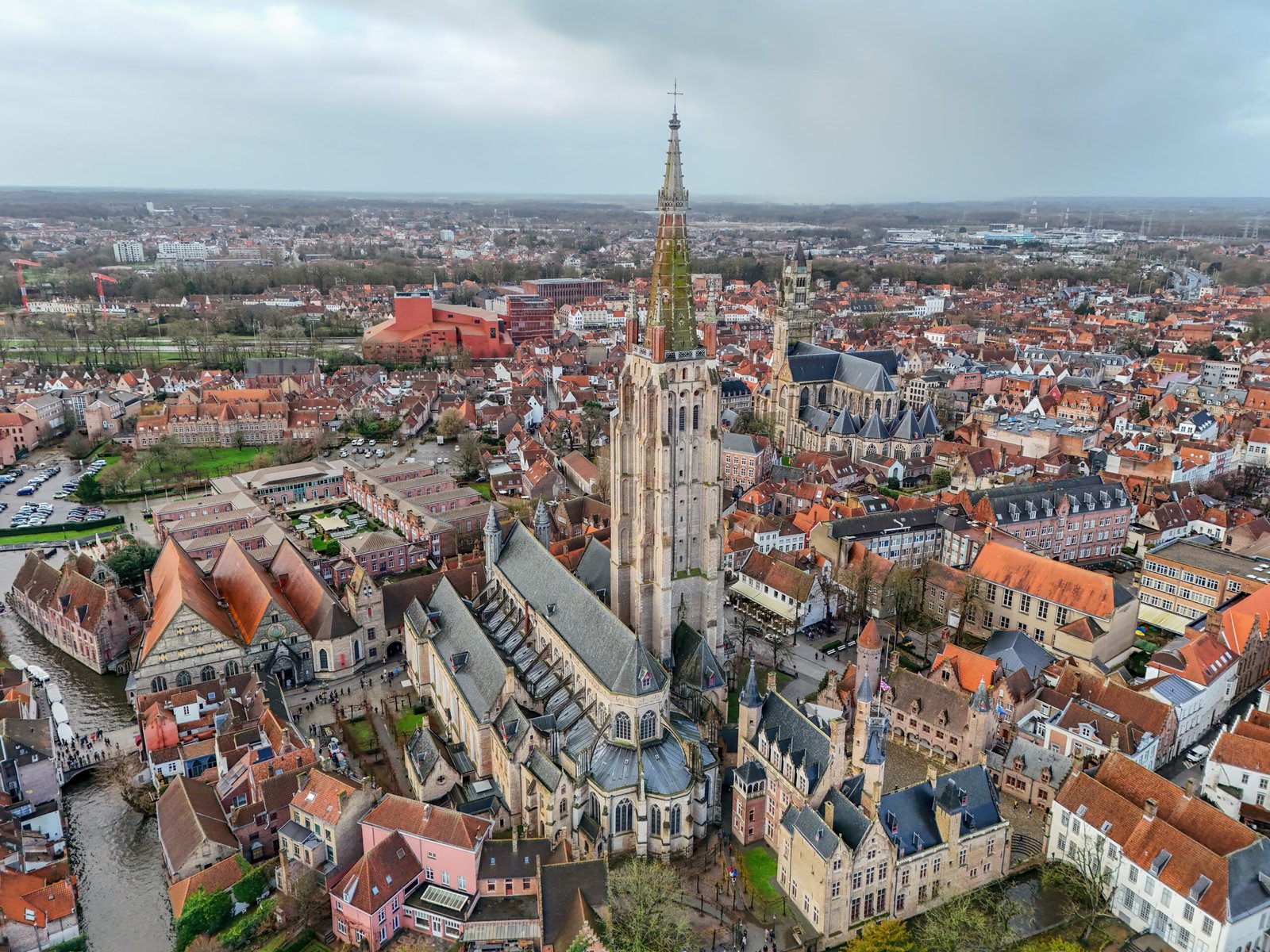
The Church of Our Lady, the Onze-Lieve-Vrouwekerk on Mariastraat, is not the cathedral of Bruges: that is St Salvator’s. But it is the building that marks the sky of the city most, with a brick tower about 115.5 metres high, the tallest structure in Bruges. On the record it is worth being exact: the tourist sources of the city call it the «second tallest brick tower in the world», but the figures place it third, behind St Martin of Landshut, 130.6 m, and the Marienkirche of Lübeck, about 125 m, both in Germany. Here, therefore, it is called «third», or simply «the tallest in the city». Built between the 13th and the 15th century in brick Gothic, the church holds what the world knows it for: the Madonna of Bruges by Michelangelo, a marble group of the Virgin and Child carved around 1503-1504. The Mouscron brothers, Giovanni and Alessandro Moscheroni, cloth merchants, bought it for one hundred ducats and brought it to Bruges from Italy. It was, the official sources of the city say, the only sculpture by Michelangelo to leave Italy while the artist was alive, although other sources say more cautiously «the first»; it is reported here with that caution. The work was plundered twice and twice came back: in 1794 the French revolutionaries took it to Paris, and it returned in 1815, after the defeat of Napoleon; in 1944 German soldiers in retreat carried it off to Germany wrapped in mattresses on a Red Cross lorry. It was found the following year in the salt mine of Altaussee, in Austria, and returned by the Monuments Men, the Allied specialists later made famous by the cinema. In the choir, behind the high altar, lie the tombs of Charles the Bold, last duke of Burgundy, and of his daughter Mary of Burgundy, with recumbent effigies in gilded bronze on slabs of black stone. The church is not inscribed on the UNESCO list on its own: it is one of the monuments that make up the Historic Centre of Bruges, inscribed in 2000 under criteria (ii), (iv) and (vi), in the city of brick Gothic and of the Flemish Primitives.
About the Church
The Church of Our Lady (Onze-Lieve-Vrouwekerk), on Mariastraat, is Bruges’s parish landmark — not the city’s cathedral, which is St. Salvator’s — but its brick tower, about 115.5 metres, is the tallest structure in Bruges and among the tallest brick church towers in the world. Built between the 13th and 15th centuries, it holds Michelangelo’s Madonna of Bruges, carved around 1503–1504, and the gilded-bronze tombs of Charles the Bold and Mary of Burgundy. It stands within the Historic Centre of Brugge, a UNESCO World Heritage Site since 2000.
Key facts
- 13th–15th century: construction of the brick-Gothic church.
- ~115.5 m: the brick tower, the tallest structure in Bruges — the third-tallest brick church tower in the world, after Landshut and Lübeck.
- c. 1503–1504: Michelangelo carves the Madonna of Bruges; bought by the Mouscron brothers and brought from Italy.
- 1794 & 1944: the Madonna looted twice — to Paris under the French Revolution (returned 1815) and to Germany by the Nazis (recovered 1945 from the Altaussee salt mine by the Monuments Men).
- Choir: the tombs of Charles the Bold and Mary of Burgundy, with gilded-bronze effigies on black stone.
- 2000: Historic Centre of Brugge inscribed by UNESCO, criteria (ii)(iv)(vi).
History
Bruges built its Church of Our Lady in brick across three centuries, from the 13th to the 15th, raising a tower that still outreaches everything else in the city at roughly 115.5 metres. It is often called the second-tallest brick church tower in the world, though the height figures put it third, behind the German towers of Landshut and Lübeck. What made it a place of pilgrimage for art, though, arrived from Italy: around 1503–1504 the Bruges cloth merchants Giovanni and Alessandro Mouscron bought a marble Madonna and Child from Michelangelo and installed it here — by the city’s own account the only sculpture Michelangelo let leave Italy in his lifetime.
The Madonna’s fame made it a target. French revolutionary authorities carried it to Paris in 1794, and it came home only after Napoleon’s defeat in 1815. In 1944 retreating German soldiers smuggled it out again, wrapped in mattresses; it was found the next year in the Altaussee salt mine in Austria and returned by the Allied Monuments Men. Around the same choir lie the dukes of Burgundy themselves — Charles the Bold and his daughter Mary — their gilded-bronze effigies stretched full length on black stone, a Burgundian court frozen in metal.
What you see
From almost anywhere in Bruges the church announces itself as a single tapering needle of brick, far taller and thinner than the civic Belfry on the Markt. Inside, past the brick nave, the art gathers at the east end: Michelangelo’s Madonna in its own niche, serene and self-contained; the gilded-bronze tombs of Charles the Bold and Mary of Burgundy in the choir behind the high altar; and a Passion triptych begun by Bernard van Orley, court painter to Margaret of Austria. Glass floors in the choir reveal medieval painted grave niches beneath.
Practical information
- Opening hours: open regularly; the museum section closes for services and events — check current times before visiting.
- Admission: entering the church is free; the museum area (the Madonna and the Burgundian tombs) is ticketed via Musea Brugge.
- Location: Mariastraat, 8000 Bruges, Belgium.
- Status: active Roman Catholic parish church (the cathedral of Bruges is St. Salvator’s).
Getting there
The church stands in the heart of the old town on Mariastraat, a few minutes’ walk from the Markt, the Belfry and the Gruuthuse; Bruges is about an hour from Brussels by train. GPS: 51.2046°N, 3.2245°E.
Nearby
- Historic Centre of Brugge — the UNESCO-listed brick-Gothic town of canals and the Flemish Primitives.
- Gruuthuse Museum — the 15th-century palace directly beside the church, linked to it by a private oratory.
- Belfry of Bruges — the civic bell tower on the Markt, itself a separate UNESCO listing.
Sources
- Musea Brugge — official records for the Church of Our Lady museum, the Madonna and the tombs.
- Visit Bruges and VisitFlanders — official tourism records, cross-checked.
- UNESCO World Heritage Centre — “Historic Centre of Brugge” (ref. 996).
- Wikipedia (English) — “Church of Our Lady, Bruges”, “Madonna of Bruges”, “List of tallest church buildings”, used as a map and cross-checked against height data.
Find it on the map
See this place and what’s around it →📷 Become a Cultural Heritage Online photographer
Share your photos of places: they stay published under your name as the author. The more they're seen, the more you get noticed — and soon a contest will reward the most appreciated photos.
Log in or sign up free to add a photo