

A saddle in the Carpathians that Hungarian national memory marks as the point of arrival, in 895, of the tribes who founded the country. Forty-five years before a monument said so in stone, the same crossing was fortified with concrete and mines — not to celebrate an entrance, but to stop one happening again.
At a glance
The Veretski Pass (Hungarian: Vereckei-hágó) carries the old road across the main Carpathian ridge between Galicia and Transcarpathia, at the headwaters of the Latorytsia river. Hungarian tradition holds that the Magyar tribes led by Árpád crossed here in 895 on their way into the Carpathian Basin — the founding migration the Árpád Line, built more than a thousand years later, took its name from.
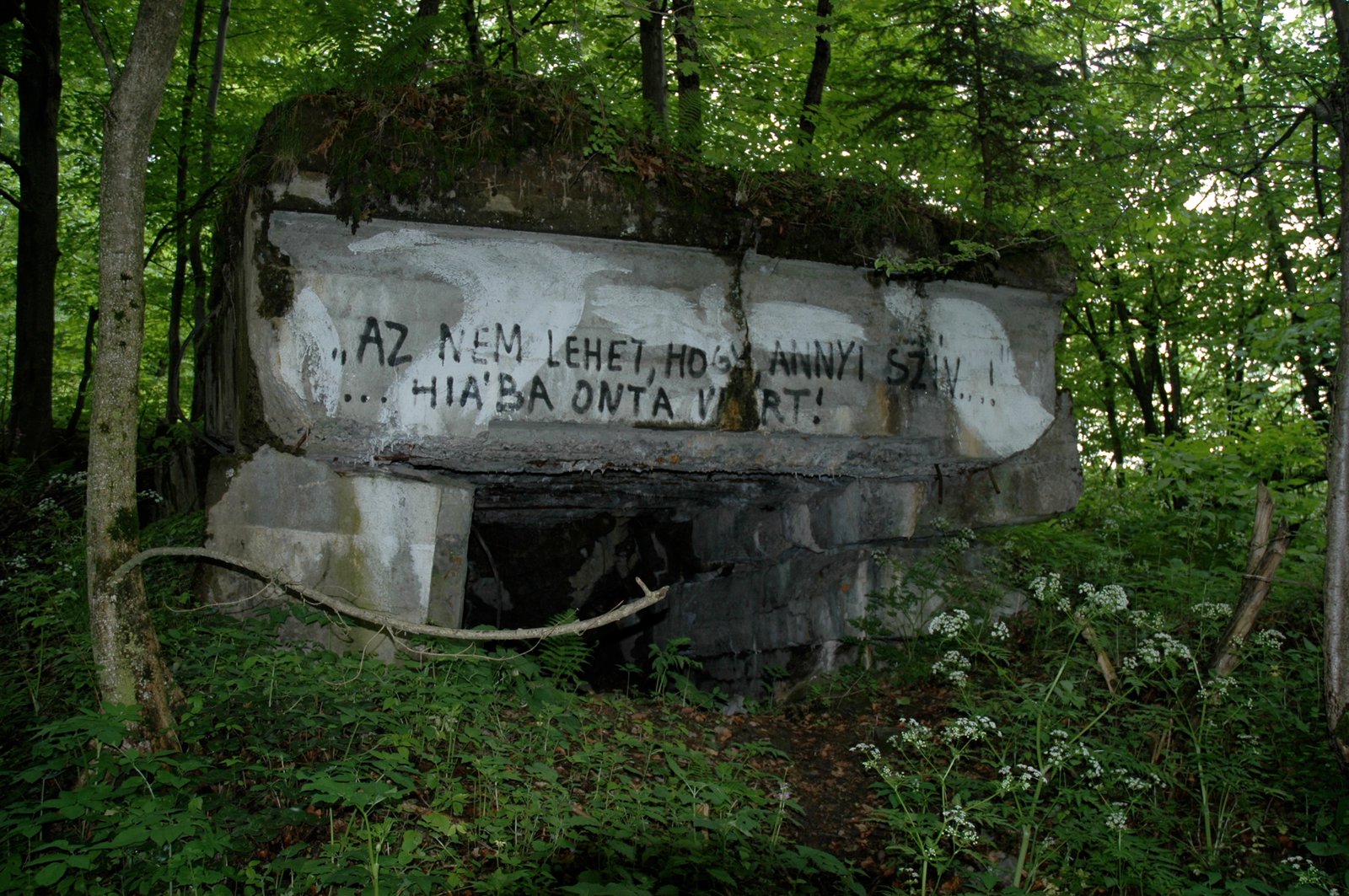
The pass has been fought over far more often than it has been peacefully crossed. Austro-German forces took it from the Russian army in January 1915; Hungary annexed the surrounding region, Carpatho-Ukraine, in March 1939; and between 1940 and 1944 the Hungarian Royal Army closed the valley below it with one of the Árpád Line’s standard positions, a pillbox sited where the road and the young Latorytsia run close together.
Key facts
- Legendary date: 895, traditional crossing point of the Magyar tribal confederation into the Carpathian Basin
- Winter 1915: taken by Alexander von Linsingen’s Austro-German South Army on 26 January, during the Carpathian Campaign against the Russian Southwestern Front
- March 1939: the surrounding region, briefly the autonomous republic of Carpatho-Ukraine, was occupied and annexed by Hungary
- Fortified: 1940–1944, part of the Hungarian Royal Army’s Árpád Line, a chain of valley-closure positions across the Eastern Carpathian passes
- At Veretski: a reinforced-concrete pillbox in the Latorytsia valley on the pass’s eastern approach, near the village of Skotarske
- Line abandoned: late October 1944, after the collapse of the Hungarian front on the plain near Debrecen made the mountain positions strategically moot
- Monument: a stone marker for the 895 crossing, unveiled 2008, sculptor Péter Matl, erected with the agreement of the Ukrainian authorities
- Coordinates: 48.7339° N, 23.2689° E (Skotarske)
How it was built
The pillbox below Veretski follows the same logic as every other position on the Árpád Line: not a wall, but a closure, sited to block one road through one valley rather than to hold a continuous front. Hungarian military planning in 1939–40 accepted that the new eastern border, drawn along mountains rather than the rivers and plains the western powers had fortified, could not be defended the way the Maginot or Siegfried lines were — there was neither the budget nor the years for it. Instead, engineers picked the points where road, river and ridge narrowed together, and built there: concrete pillboxes, earth-and-timber gun positions, anti-tank obstacles and minefields, each position self-contained and sited to use the terrain the mountains already provided.
The system as a whole ran for more than 600 km through the Eastern Carpathians, about a third of it in territory that is Romania today, the rest across what are now Ukraine and Slovakia. Construction accelerated after the German defeat at Stalingrad in early 1943, when a Soviet advance toward Hungary stopped looking hypothetical. At Veretski, the pillbox sits where it was built to sit: covering the same narrow corridor the road, the river and, tradition says, the Magyar tribes themselves once used to cross the ridge.
A crossing fought over four times
Before it was a fortified line, the pass was a front. In the winter of 1914–15, as part of the Central Powers’ push to relieve the besieged fortress of Przemyśl, Alexander von Linsingen’s South Army fought its way across the ridge, taking Veretski on 26 January 1915 before advancing on the Uzsok Pass to the south. The fighting was part of a campaign fought largely in snow, at altitude, with casualties on both sides that the terrain made as dangerous as the enemy.
A quarter-century later, in March 1939, the region changed hands again. Carpatho-Ukraine, an autonomous Ukrainian republic that had existed for barely a year within Czechoslovakia’s collapsing federal structure, declared independence on 15 March and was occupied by Hungary within days. The Árpád Line, built into the same mountains over the following five years, was the physical answer to a question the 1939 annexation had just raised: having taken the passes back, how does Hungary keep them? The line held through 1944 without being broken at Veretski or at most other points along its length — it was abandoned only when the war on the plains, far to the west, made the question of who held the mountains irrelevant.
Who tells it, and where the accounts diverge
The 2008 monument at Veretski tells one story, and tells it well: this is where the nation began, the founding crossing of 895, marked in stone with the cooperation of the government of the country the pass now belongs to. It is a story about arrival, and it is the story visitors come to see.
The military record of the same ridge, spread across the twentieth century, tells a different kind of story — not about a single arrival but about a crossing point that repeatedly had to be taken, held, retaken, refortified and finally given up. The 1915 battle, the 1939 annexation and the 1940–44 fortification are not part of the founding narrative the monument commemorates, but they happened on the same ground, and the concrete pillbox in the valley below is a direct physical answer to the 1939 annexation: having reclaimed the pass, Hungary spent the next four years building to make sure it could not be crossed the other way. The monument marks an arrival celebrated as destiny. The bunker fifty metres below it was built because arrivals, this crossing’s history shows, are rarely final.
What you see today
- The Árpád Line pillbox in the Latorytsia valley, reinforced concrete, sited to cover the road below the pass.
- The 895 monument at the pass itself, the stone marker unveiled in 2008.
- Since 1980 the pass has been bypassed by a lower, more direct road, which has left the old crossing and its fortifications quieter and less disturbed than most sites on the line.
- The site is unmanaged rural terrain: no ticket, no signage system, and no facilities beyond what the villages nearby provide.
Getting there
Skotarske lies in the Volovets community, on the Zakarpattia side of the pass, reached from Volovets town on the road that follows the Latorytsia valley up toward the ridge. Volovets itself sits on the railway between Lviv and Uzhhorod.
Nearby
- Volovets, the district town in the Latorytsia valley, on the Lviv–Uzhhorod railway
- The Uzhok Pass, another Árpád Line closure to the south-west, taken by the same Austro-German advance in early 1915
Sources
- Wikipedia, Veretskyi Pass — the 895 tradition, the 2008 monument, surviving Árpád Line remains, the post-1980 bypass.
- Wikipedia, Carpathian Campaign — Linsingen’s South Army taking the pass, 26 January 1915.
- Wikipedia, Hungarian invasion of Carpatho-Ukraine — the March 1939 annexation.
- Lia-Maria Cioancă, «Árpád Fortification Line, as a Horthist Heritage of the Eastern Carpathians…», International Conference Knowledge-Based Organization 26:3 (2020), DOI 10.2478/kbo-2020-0117 — system-wide construction pattern and scale.
- Magyarok a második világháborúban, Hungarian military-historical reference encyclopedia (Arcanum) — the Eastern Carpathian withdrawal and its cause in late October 1944.
Find it on the map
See this place and what’s around it →📷 Become a Cultural Heritage Online photographer
Share your photos of places: they stay published under your name as the author. The more they're seen, the more you get noticed — and soon a contest will reward the most appreciated photos.
Log in or sign up free to add a photo