

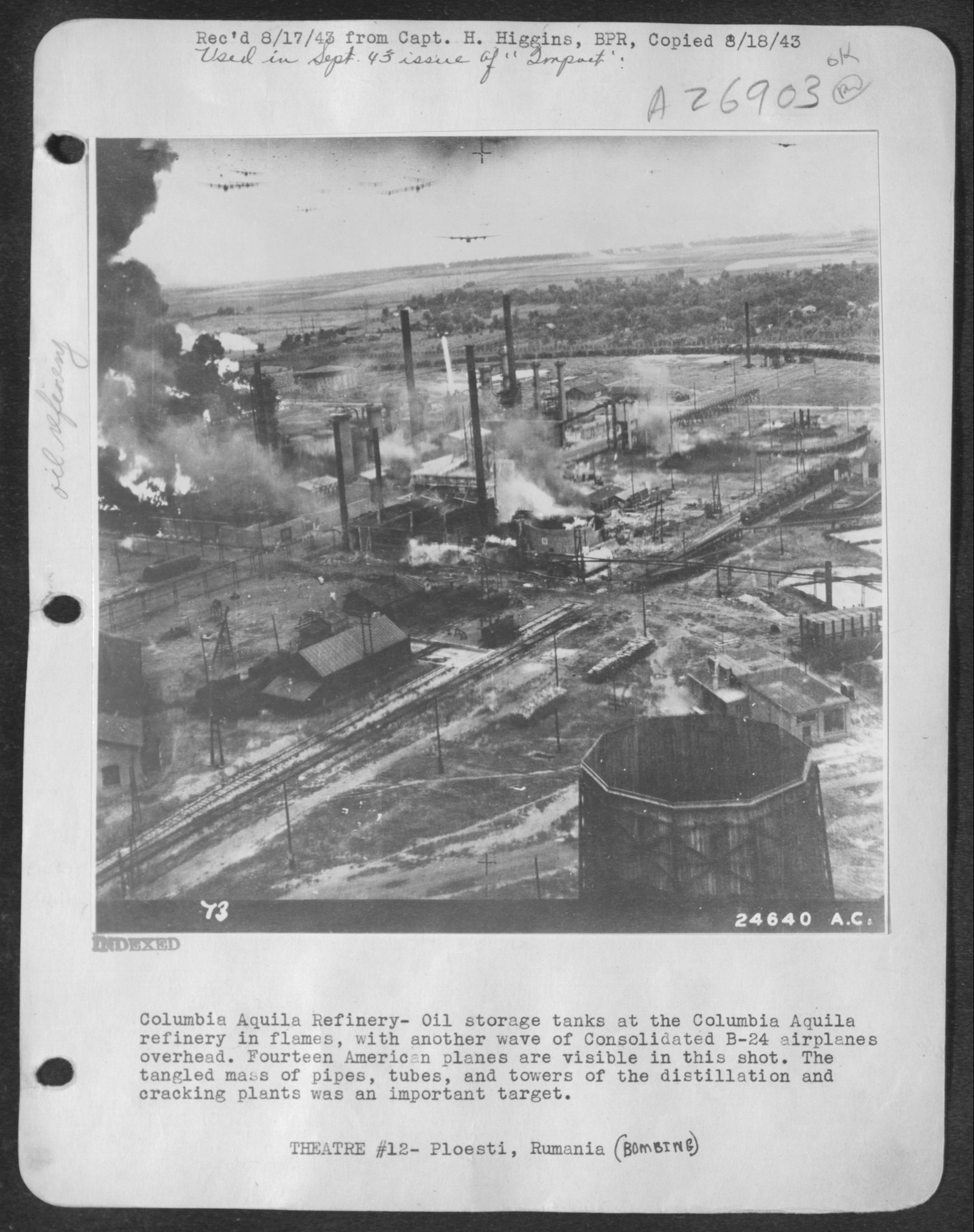
The Ploiești raid of 1 August 1943 remains the most decorated single mission in US Army Air Forces history, yet within weeks the refineries it struck were producing more fuel than before. On the ground, the city remembers the civilians and prisoners who died under the smoke.
At a glance
On 1 August 1943, 177 B-24 Liberators flew from Benghazi over the Mediterranean, the Adriatic and occupied territory to bomb nine refineries around Ploiești from about fifty feet. Targets were codenamed White 1–5, Blue at Brazi and Red at Câmpina. The mission remains one of the costliest and most decorated single operations of the US Army Air Forces.
In the United States the day is remembered chiefly for the men in the planes. In Ploiești it is remembered for what the planes hit on the way down.
Key facts
- Date: 1 August 1943, later known in USAAF memory as “Black Sunday”.
- Force: 177 B-24 Liberators, 1,751 aircrew, five bomb groups of the Ninth Air Force from Benghazi.
- Targets: Nine refineries, codenamed White 1–5, Blue (Creditul Minier, Brazi) and Red (Steaua Română, Câmpina).
- Defences: Roughly 300 anti-aircraft guns, about 200 Romanian and German fighters, barrage balloons, smoke generators and an armoured flak train.
- American losses: 53 B-24s destroyed and 55 damaged; 310 airmen killed or missing, 108 captured and 78 interned in Turkey.
- Decorations: Five Medals of Honor, 56 Distinguished Service Crosses and 41 Silver Stars.
History
Ploiești had been a refining centre since the 1850s, and by the Second World War its plants belonged to a mix of Romanian, British, French, Dutch and American capital. After Romania aligned with the Axis, all of it worked for Germany. What made the target dangerous was not the refineries themselves but what Berlin had built around them: General Alfred Gerstenberg’s flak belt, one of the densest concentrations of anti-aircraft artillery on the continent, reinforced by fighter squadrons and by decoys built to draw bombers into the guns rather than the tanks. The Tidal Wave plan answered that defence with altitude, or the absence of it: flying at fifty feet was meant to put the formation under the radar and under the effective depression of the heavy flak, trading exposure to small-arms and light cannon fire for a chance of surprise.
Over Romania the formation lost its cohesion in cloud and navigational error. It arrived late, split against the wrong initial points, and in places approached from directions that put aircraft on collision courses over the refineries. The defence built for high-altitude raiders instead met a low, straggling formation flying nearly wingtip to wingtip through smoke, flame and its own bomb bursts.
Five bomb groups went in: the 98th under Colonel John Kane, the 44th under Colonel Leon Johnson, the 93rd under Colonel Addison Baker and Major John Jerstad, and the 389th under Colonel Jack Wood with Lieutenant Lloyd Hughes. Baker and Jerstad held their burning aircraft over its target rather than waste the bomb run, then died trying to climb clear so the crew could bail out. Hughes flew his crippled Liberator into its target through a wall of flame; all three received the Medal of Honor posthumously. Kane and Johnson brought their groups through and survived the war. On the ground, Romanian fighter pilot Carol Anastasescu shot down one B-24 in an IAR 80 and then rammed a second, killing himself and both crews. A stricken bomber went down on Ploiești’s women’s prison, where inmates and crew died together. Within weeks the refineries were producing more fuel than before the raid.
What you see
The former Astra Română refinery site and other Prahova valley plants are still partly in industrial use and partly derelict; the district remains Romania’s refining heartland. A memorial to Operation Tidal Wave and to the Romanian defenders, maintained by a dedicated foundation, lists the American and Romanian dead of 1 August 1943.
This is a working industrial and urban landscape, not a preserved battlefield. Most of the wartime plant has been rebuilt, demolished or replaced over eighty years of continuous refining.
Practical information
- Location: Ploiești, Prahova County, Romania, about 60 km north of Bucharest.
- Memorial: Maintained by a dedicated foundation and listing the American and Romanian dead of 1 August 1943.
- Condition: A working industrial and urban landscape; not a preserved battlefield.
- Official information: Consult the memorial foundation’s official channel for current access and any visitor arrangements.
Getting there
Ploiești lies roughly 60 km north of Bucharest and is reachable by rail or the DN1/A3 motorway. The refinery district lies mainly to the south and south-west of the historic centre.
Nearby
- Câmpina — about 20 km north-west; site of the Red target (Steaua Română), the one refinery that stayed off-line for the rest of the war.
- Brazi — just south of Ploiești; site of the Blue target (Creditul Minier).
- Bucharest — roughly 60 km south, reachable by rail or the DN1/A3 motorway.
Sources
- Wikipedia, Operation Tidal Wave
- Memorial Ploiești (memorialploiesti.org), ‘Tidal Wave’
- Warfare History Network, ‘Ploesti Raid: A Tragic Tidal Wave’
Find it on the map
See this place and what’s around it →Events here — now on & upcoming
- Anniversary: The Operation Tidal Wave Raid on Ploiești — August 1, 194301 Aug 2027See the event →
📷 Become a Cultural Heritage Online photographer
Share your photos of places: they stay published under your name as the author. The more they're seen, the more you get noticed — and soon a contest will reward the most appreciated photos.
Log in or sign up free to add a photo