

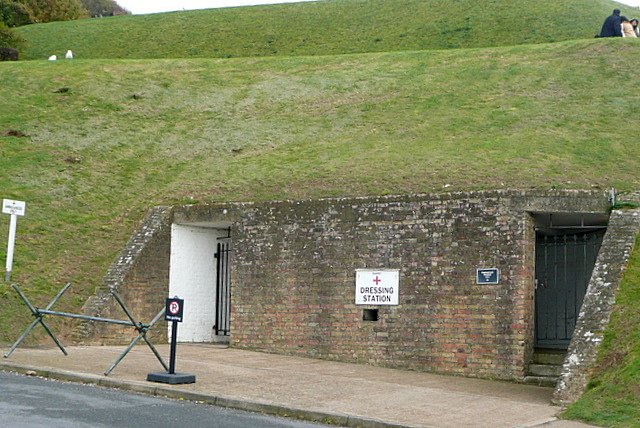
From galleries cut into the cliff two centuries earlier against Napoleon, a British admiral directed the rescue of 338,000 men from a beach in France. Churchill, addressing the House of Commons days later, refused to let anyone call it a victory.
At a glance
The tunnels beneath Dover Castle were cut into the chalk cliff between 1797 and 1803, during the Napoleonic Wars, under the engineer William Twiss, to hold up to 2,000 soldiers some 15 metres below the clifftop. Largely disused through the nineteenth century, they were reactivated at the outbreak of the Second World War: first as an air-raid shelter, then as a military command centre and underground hospital. In 1940 they became the nerve centre of one of the most consequential evacuations in British military history.
Key facts
- Origin: cut into the cliff 1797–1803 under engineer William Twiss, capacity for around 2,000 troops
- WWII reactivation: from 1939, air-raid shelter, command centre and underground hospital; a military telephone exchange installed in 1941 was heavily used enough to need its own dedicated power-supply gallery
- Operation Dynamo: directed from the tunnels by Vice-Admiral Sir Bertram Ramsay, recalled from retirement by Churchill; the operation’s name came from the «Dynamo Room», which had housed the castle’s Victorian-era electrical generators
- Dates: 26 May – 4 June 1940
- Evacuated: approximately 338,000 British and French troops, using nearly 900 vessels of all kinds, including civilian boats
- Losses: around 68,000 men of the British Expeditionary Force could not be evacuated; 236 vessels were lost; almost all heavy equipment and armour was abandoned on the beaches
- Later use: the tunnels became a Combined Operations Headquarters, then an underground military hospital, and in the 1960s were prepared, then abandoned, as a regional seat of government in the event of nuclear attack
- Coordinates: 51.1290° N, 1.3229° E
How they were built, and rebuilt
The tunnels’ two lives, a century and a half apart, answered the same problem differently: a strategic point on England’s most exposed coast, needing a defended position that ordinary fortification above ground could not easily provide. William Twiss’s Napoleonic-era galleries gave the garrison of 1803 depth and shelter against a French invasion that never came. When the threat became real again in 1940, the same chalk did the same job for a different war — converted into a working command centre with its own power supply, communications and, eventually, hospital wards, all cut into rock that had been waiting, largely empty, for over a hundred years.
Nine days that decided nothing, and everything
From the Dynamo Room, Ramsay coordinated a fleet assembled from whatever could cross the Channel and back under fire — destroyers, ferries, fishing boats, private pleasure craft — to lift men off open beaches and a shattered harbour mole at Dunkirk. Over nine days, close to 340,000 men were brought out, roughly six times the number planners had thought possible when the operation began. It remains one of the largest military evacuations ever conducted, and one of the most celebrated moments in British wartime memory.
Who tells it, and where the accounts diverge
Winston Churchill delivered the correction to the popular memory of Dunkirk before the popular memory had even fully formed. Addressing the House of Commons on 4 June 1940, the day the evacuation ended, he warned: «We must be very careful not to assign to this deliverance the attributes of a victory. Wars are not won by evacuations.» Behind the number of men saved sat a heavier one: roughly 68,000 who were not, 236 vessels lost, and the near-total loss of the British Expeditionary Force’s tanks, artillery and transport — a defeat by any military accounting, however remarkable the rescue operation layered on top of it.
The tension between the two readings — miracle and military catastrophe — is documented by the same institutional sources that preserve the tunnels today, not smoothed over by them. What Dover Castle’s command centre actually did was neither: it ran, as well as it could, the salvage of an army so that Britain would have soldiers left to fight the war that followed.
What you see today
- The wartime tunnels, open to visitors under English Heritage management, with the underground hospital and command areas presented as they operated in 1940.
- The Dynamo Room and adjoining operations spaces, restored to convey the atmosphere of the evacuation’s command centre.
- The wider Dover Castle complex above ground, spanning Roman, medieval and Napoleonic-era fortification alongside the WWII tunnels.
Getting there
Dover Castle stands above Dover, Kent, a short walk from Dover Priory railway station and well served by road from the M20/A20.
Nearby
- The White Cliffs of Dover, immediately adjacent, part of the same coastal landscape
- Dover’s port, the departure point for cross-Channel ferries and, in 1940, part of the evacuation route
Sources
- Wikipedia, Dover Castle (tunnels section) — construction history, WWII reactivation, later uses.
- English Heritage, Operation Dynamo visitor and history pages — command role, evacuation figures, Ramsay’s role.
- Historic England / Heritage Calling, «Operation Dynamo: The Miracle of Dunkirk» — operational context and losses.
- International Churchill Society — verbatim text of Churchill’s 4 June 1940 House of Commons speech.
Find it on the map
See this place and what’s around it →📷 Become a Cultural Heritage Online photographer
Share your photos of places: they stay published under your name as the author. The more they're seen, the more you get noticed — and soon a contest will reward the most appreciated photos.
Log in or sign up free to add a photo