

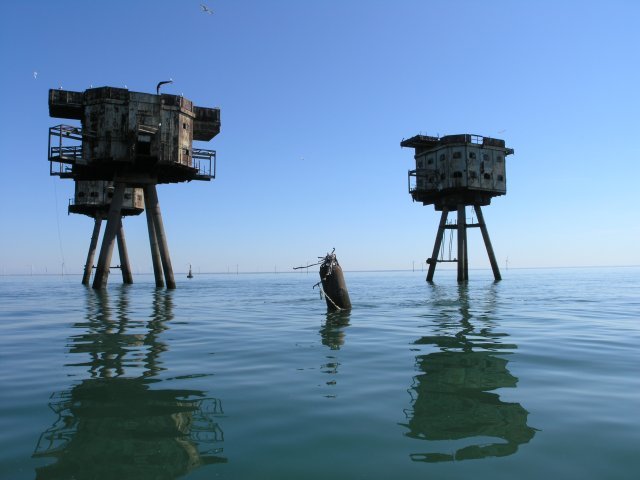
Anti-aircraft platforms built on legs in the open sea to shoot down bombers using the Thames as a signpost to London. Within twenty years of the war they ended, some of the same towers were broadcasting pop music to a country that still needed a licence to buy a radio.
At a glance
Designed by the civil engineer Guy Maunsell and built in 1942–43, the forts came in two forms: four Navy platforms of solid concrete with twin hollow towers, and six Army forts — three in the Thames Estuary, three in the Mersey — built as steel platforms on legs, each a cluster of towers linked originally by walkways: four gun towers in a semicircle, a central control and accommodation tower, a Bofors gun tower and a searchlight tower. Their job was to intercept German bombers using the Thames as a navigation landmark on the run into London, and to disrupt the laying of naval mines in the shipping channels.
Key facts
- Designer: Guy Maunsell (1884–1961); built 1942–43
- Structure: Navy forts — concrete platform roughly 51 × 21 m with two hollow towers; Army forts — steel platforms with four gun towers, a control/quarters tower, a Bofors tower and a searchlight tower, connected by walkways
- Locations: Nore, Red Sands and Shivering Sands in the Thames Estuary; three further forts in the Mersey Estuary; Red Sands was positioned between 18 September and 13 December 1943
- Purpose: anti-aircraft defence against bombers navigating by the Thames, and disruption of enemy minelaying in the estuary channels
- Operational record: credited with 22 aircraft and around 30 V-1 flying bombs shot down by the Thames Army forts; the Navy forts destroyed at least one German E-boat
- Garrison: around 100 men on the largest forts at peak
- Decommissioned: late 1950s
- 1960s: several forts occupied by pirate radio stations — Radio Sutch and later Radio City at Shivering Sands, Radio Invicta and later Radio 390 at Red Sands, Radio Essex at Knock John
- Coordinates: 51.4985° N, 1.0808° E (Shivering Sands)
How they were built
The forts solved a problem no fixed coastal gun could: the Thames Estuary was too wide and too open for shore-based anti-aircraft defence to cover effectively, so Maunsell’s design put the guns out in the water itself, on platforms built onshore and towed into position before being sunk onto prepared footings on the seabed. It was audacious engineering for 1942 — steel towers standing on legs in open, tidal water, designed to hold a garrison of around a hundred men through the winter storms of the North Sea as readily as through an air raid.
War, decommission, and a second life
The forts did what they were built to do through the war and into the V-1 campaign of 1944, credited between them with dozens of aircraft and flying bombs. Decommissioned in the late 1950s, several stood empty and structurally sound enough that, within a few years, a different kind of operator saw their value: sitting outside British territorial waters at the time, they were beyond the reach of broadcasting law. Screaming Lord Sutch launched Radio Sutch from Shivering Sands in 1964, soon expanded into Radio City; Red Sands hosted a succession of stations including Radio 390, run by a former wartime intelligence officer. The same towers built to listen for German bombers spent the following decade broadcasting pop music to a British public still legally required to tune in only to the BBC.
Not every fort survived intact. A ship collision at Nore in 1953 destroyed two towers and killed four men; another collision at Shivering Sands in 1963 brought down a further tower. Tongue Sands collapsed entirely in 1996. A structural survey of Red Sands in 2021 found serious defects across six towers, and public access, previously offered by a heritage project, has been suspended on safety grounds.
Who tells it, and where the accounts diverge
The forts have two well-documented identities that rarely appear in the same breath: serious wartime infrastructure, credited with real kills against real threats to London, and later an improvised, half-illegal broadcasting scene built by people who saw empty steel platforms and a legal loophole rather than a military monument. Both are true, and the second could not have happened without the first — only structures built to survive a war were still standing, decades later, sound enough to carry a transmitter and a resident DJ.
What you see today
- Several forts remain standing in the Thames Estuary, visible from the shore and from passing boats, in varying states of structural decay.
- Red Sands, the best-preserved group, was previously open to limited public visits; access has been suspended since a 2021 structural survey.
- Shivering Sands and other forts remain unmanaged and are not safe to board without authorisation.
Getting there
The Thames forts are visible from the Kent and Essex coasts and from boat trips departing Whitstable and other estuary towns; landing on the structures themselves is not generally permitted.
Nearby
- Whitstable and the north Kent coast, the usual departure point for boat trips past the forts
- The Isle of Sheppey and the wider Thames Estuary coastal defences
Sources
- Wikipedia, Maunsell Forts and Shivering Sands Army Fort — design, construction, operational record, decommissioning, pirate radio history.
- Imperial War Museum, collection items and bibliography on the Maunsell Sea Forts.
- HeritageDaily, coverage of the 2021 structural survey and suspension of access to Red Sands.
Find it on the map
See this place and what’s around it →📷 Become a Cultural Heritage Online photographer
Share your photos of places: they stay published under your name as the author. The more they're seen, the more you get noticed — and soon a contest will reward the most appreciated photos.
Log in or sign up free to add a photo