
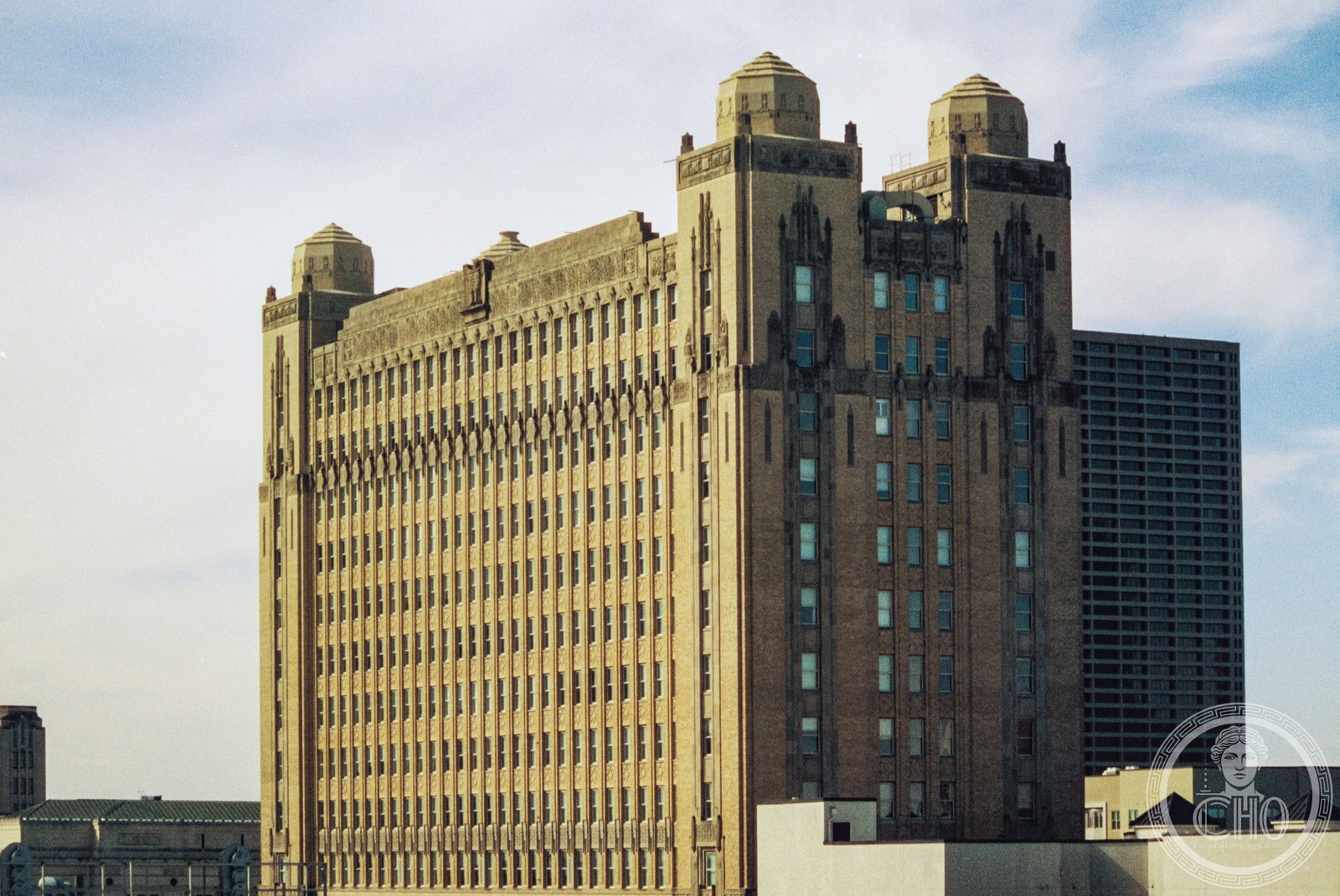
The T&P Station at 221 West Lancaster Avenue in Fort Worth — a 1931 Art Deco tower designed by Wyatt C. Hedrick that combined a working railway terminal with thirteen floors of office space above it — stands as Fort Worth’s most assertive statement from the era when the convergence of railroad infrastructure and architectural ambition was producing the most distinctive buildings in American commercial cities.
At a glance
The Texas and Pacific Railway Station, known locally as the T&P Station, is an Art Deco Moderne landmark on the south edge of downtown Fort Worth that served as the city’s primary railroad gateway from its opening in December 1931 until rail passenger service declined in subsequent decades. Designed by Wyatt C. Hedrick and Herman Paul Koeppe, the building stacks a ground-floor terminal concourse and waiting rooms beneath thirteen floors of offices in a tower profile that reads as a confident vertical accent on the city’s skyline. Eagle sculptures at the tower’s upper levels and the geometric relief ornament of the facade make the T&P one of the most photographed examples of Art Deco architecture in Texas. Listed on the National Register of Historic Places in 1976, the station is now part of the Intermodal Transportation Center and serves as an event and commercial space.
Key facts
- Address: 221 West Lancaster Avenue, Fort Worth, TX 76102
- Opened: December 1931
- Architects: Wyatt C. Hedrick and Herman Paul Koeppe
- Style: Art Deco Moderne
- Height: 13 stories
- GPS: 32.7472° N, 97.3296° W
- Status: National Register of Historic Places (1976); Fort Worth Landmark
History
Wyatt C. Hedrick was one of the most prolific architects working in Texas in the first half of the twentieth century, designing hotels, office buildings, courthouses, and terminals across a state that was growing faster than almost any other in the nation. The commission for the T&P Station came at a moment when the Texas and Pacific Railway needed to consolidate its Fort Worth operations into a single building that could serve both the practical requirements of a busy terminal — waiting rooms, ticketing, baggage handling, platform access — and the desire of a major railroad to project institutional confidence through its architecture. Hedrick and Koeppe resolved this program in a building type that had few direct precedents: a tower that wore its commercial office function as a vertical crown above the horizontal base of the terminal, the two uses stacked and expressed rather than disguised or merged.
Fort Worth in 1931 was the western edge of the Dallas-Fort Worth metropolitan zone — a city that had built its economy on the intersection of cattle, rail, and oil and was now beginning to diversify into the manufacturing and financial services that would sustain it through the mid-century decades. The T&P Station opened into this economy as both infrastructure and symbol: the terminal that processed the physical movement of people and goods, and the tower that announced the railroad’s permanence and ambition to the arriving traveler. The eagle sculptures at the upper levels of the facade — a motif that recurs in American Art Deco government and transportation buildings of the era — located the T&P within the institutional rhetoric of civic purpose and national connectivity.
The decline of rail passenger traffic in the postwar decades affected the T&P as it affected every American railroad terminal. Amtrak’s consolidation of intercity rail service and the growth of automobile and air travel reduced the terminal’s operational intensity, and the building was eventually repurposed for mixed commercial use. Its listing on the National Register in 1976 secured its architectural recognition, and subsequent decades have seen the building serve as an event venue, office space, and part of the Fort Worth Intermodal Transportation Center, which continues to use the site for transit connections.
What you see
The T&P Station presents two architectural scales simultaneously. At street level, the terminal base occupies the full width of the West Lancaster Avenue frontage in a horizontal composition of arched openings, decorative stone panels, and the canopy that marks the entrance zone. Above this base, the tower rises in the vertical massing characteristic of Art Deco Moderne commercial architecture: stepped setbacks at the upper levels, the geometric relief ornament in the spandrel panels and pilaster capitals, and the eagle sculptures at the tower’s terminal cornice — cast stone birds that translate the decorative vocabulary of the period’s civic and institutional buildings into a form that reads from the street as both ornament and civic declaration.
The interior concourse, where it remains accessible, retains the spatial qualities of the 1931 design: the high ceilings of the waiting room, the decorative tilework and metalwork of the public areas, and the proportion of the principal spaces that was characteristic of an era when railroads designed their waiting rooms to rival the grandest interiors in the cities they served. The tower floors above, variously occupied by commercial tenants over the building’s history, have seen more alteration, but the structural logic of Hedrick’s design — the clear separation between the terminal base and the office tower — remains legible in the building’s profile from any approach.
Practical information
- Access: Part of the Fort Worth Intermodal Transportation Center; exterior freely accessible; interior event spaces by reservation
- Location: South edge of downtown Fort Worth on West Lancaster Avenue; Sundance Square is approximately 10 minutes on foot north
- Transit: Trinity Railway Express (TRE) commuter rail stops at the adjacent Fort Worth Central station; TEXRail airport connector nearby
- Duration: Exterior and immediate surroundings: 20–30 minutes; Fort Worth downtown circuit: half a day
Getting there
Dallas/Fort Worth International Airport (DFW) is approximately 18 miles northeast via TX-121/I-30; the TEXRail commuter rail connects DFW Terminal B to downtown Fort Worth in approximately 37 minutes. Fort Worth Meacham International Airport (FTW) handles general aviation. By road, I-30 connects Fort Worth to Dallas (~30 miles east) and to the Arkansas border; I-35W runs north to Oklahoma and south to Waco and Austin. The T&P Station is on West Lancaster Avenue, the southern edge of downtown, where it intersects with the Intermodal Transportation Center’s bus and rail connections.
Nearby
- Sundance Square — Main Street downtown, approximately 10 minutes north on foot; 35-block urban entertainment and retail district in the historic core of Fort Worth, with 19th- and early 20th-century commercial buildings alongside newer development
- Kimbell Art Museum — 3333 Camp Bowie Boulevard, Cultural District; Louis Kahn’s 1972 masterpiece houses one of the finest European art collections in the Southwest, with particular strengths in Old Masters
- Fort Worth Stockyards National Historic District — 130 E. Exchange Avenue, approximately 2 miles north; the restored stockyards where longhorn cattle are still driven daily down Exchange Avenue
- Amon Carter Museum of American Art — 3501 Camp Bowie Boulevard, Cultural District; Philip Johnson’s 1961 building houses American painting, photography, and sculpture from the colonial era to the present
Sources
- National Register of Historic Places — Texas and Pacific Railway Station nomination (1976)
- Tarrant County Historic Resources Survey — Fort Worth architectural inventory
- Fort Worth Weekly — T&P Station documentation and history
- Wikimedia Commons — T&P Station, Southeast (CC BY, Bellabellab, via Wikimedia Commons)
- Texas State Historical Association — Texas and Pacific Railway history
Find it on the map
See this place and what’s around it →📷 Diventa un fotografo di Cultural Heritage Online
Condividi le tue foto dei luoghi: restano pubblicate con la tua firma come autore. Più vengono viste, più ti fai conoscere — e presto un concorso premierà le foto più apprezzate.
Accedi o registrati gratis per aggiungere una fotoDo you manage this place?
This page is read by travellers and heritage enthusiasts who find it on Google. Keep it accurate — and make it work for you. Free for non-profit heritage institutions.