
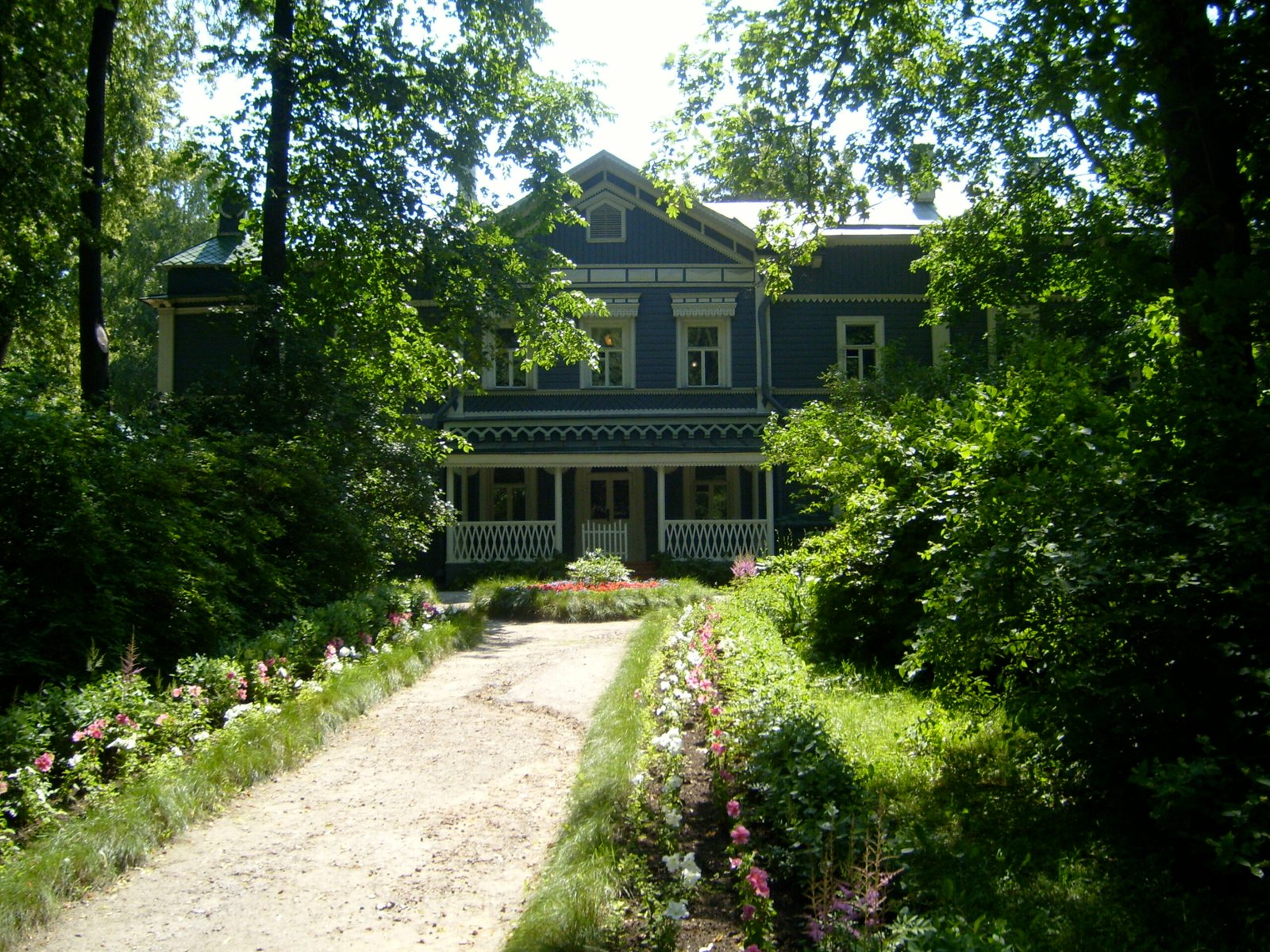
In this rented house outside Klin, Pyotr Ilyich Tchaikovsky spent his last eighteen months. Here he finished the Pathétique symphony at a plain birch table facing the garden.
At a glance
Founded as a museum in 1894, barely a year after the composer’s death, the house stands 85 kilometers northwest of Moscow. It was Modest Tchaikovsky, the composer’s brother, who preserved the rooms and turned them into Russia’s first musical memorial museum. The property remains heritage-listed and open to visitors today.
History
Tchaikovsky had already lived in two other houses near Klin, at Maidanovo and Frolovskoye, both later demolished. In May 1892 he rented this larger property, built in the 1870s by V.S. Sakharov on land granted by Emperor Nicholas I. He wrote to his brother that the view was “really wonderful” and hoped to buy the house outright. There, between proofreading Iolanta and The Nutcracker, he composed his Symphony No. 6 and finished his Third Piano Concerto on October 3, 1893. Four days later he left for Moscow, then St. Petersburg, where he died on October 25 (November 6, new style) at age 53. Modest and the composer’s nephew Vladimir Davydov built a separate archive building so the main house could stay untouched, and Modest willed it to the Moscow Department of the Russian Musical Society in 1916, modeled on the Mozart and Beethoven museums abroad. It survived an anarchist occupation after 1917, nationalization in 1921, and German occupation during the Battle of Moscow, when soldiers stored motorcycles on the ground floor and slept upstairs. The collection, evacuated to Votkinsk in 1941, returned in 1944, and the museum reopened in May 1945.
What you see
Tchaikovsky occupied the second floor; his servant Alexei Sofronov’s family lived below, near the kitchen and dining room. The largest room, his reception and study, holds a Becker piano given to him in 1885. Above his writing desk hangs a portrait of Anton Rubinstein, his first teacher, with Beethoven’s image just below. Bookcases hold his literary and musical library alongside gifts from admirers, including a Statue of Liberty inkpot from his American tour. A curtained doorway leads to the bedroom, where an unpainted Karelian birch table sits by the window. On that table he wrote the Pathétique.
Cultural significance
The house preserves the daily rhythm Modest Tchaikovsky described: solitary morning walks, quiet composing, evening readings and duets with visiting musicians. Tchaikovsky never performed publicly on this piano, only for friends. The garden he loved, an intentionally unruly stretch of paths and wildflowers, still holds lilies of the valley planted by Modest in his brother’s memory. Since the 1920s musicians have gathered here to perform each May, keeping the site a living monument rather than a sealed relic.
Key facts
- Location: Klin, Moscow Oblast, Russia
- Museum founded: 1894
- Tchaikovsky resident: May 1892 – October 1893
- Last major work completed here: Symphony No. 6, “Pathétique”
- Heritage-listed protected site
Practical information & getting there
Klin sits along the highway and rail line linking Moscow and St. Petersburg, making it a manageable day trip from either city. You can reach it by suburban train from Moscow’s Leningradsky station or by road. Check the museum’s official site before visiting for current hours and exhibition details.
Sources & resources
Find it on the map
See this place and what’s around it →📷 Become a Cultural Heritage Online photographer
Share your photos of places: they stay published under your name as the author. The more they're seen, the more you get noticed — and soon a contest will reward the most appreciated photos.
Log in or sign up free to add a photoIs this page about you?
This page is read by travellers and heritage enthusiasts who find it on Google. Tell us how you are connected to this place and we will take it from there.